TL;DR

Get baking supplies delivered free with Prime
- Fast, free delivery on millions of items
- Prime Video, Amazon Music and more included
- Member-only deals all year
The angel food cake method uses whipped egg whites as the main leavening, stabilized with acid and sugar, folded gently into flour, then baked in an ungreased pan. Proper technique yields a light, springy, cloud-like crumb perfect for elegant desserts.
Ever wondered how to make a cake that feels like biting into a fluffy cloud? That’s the magic of the angel food cake method. It relies entirely on whipped egg whites to lift the batter, creating an airy, delicate crumb that’s practically weightless. It’s a baking trick that transforms simple ingredients into a show-stopping dessert.
Whether you’re aiming for a classic angel food cake or experimenting with lighter textures in other cakes, understanding this method opens the door to desserts that are tender, moist, and irresistibly springy. In this guide, you’ll learn the core principles, step-by-step techniques, and common pitfalls to avoid. Ready to elevate your baking game? Let’s dive into the secrets of creating a cloud-like crumb that melts in your mouth.
Use room-temperature egg whites and a clean bowl for maximum foam volume.
Fold gently and in several additions to keep the bubbles intact.
Avoid greasing the pan—ungreased tubes help the cake rise high.
Invert the cake immediately after baking to set its height.
Watch for glossy, soft peaks during whipping—overwhipping ruins the structure.
The Angel Food Cake Method for a Cloud-Like Crumb
Angel food cake rises without yolks, butter, oil, or chemical leaveners. Its height comes from a carefully stabilized egg-white foam, gently folded flour, and an ungreased pan that gives the batter something to climb.
“Build the bubbles, protect the bubbles, then set the bubbles.”
The method in one sentenceProtein surrounds and supports thousands of tiny air bubbles.
Medium peaks should hold their shape with a slightly curved tip.
Cake flour limits gluten and keeps the finished crumb tender.
Upside-down cooling preserves height while the structure sets.
Five moves from liquid whites to lofty cake
Each stage prepares the next. Volume is created during whipping, protected during folding, supported by the pan, and preserved during cooling.
Prepare
Warm the whites to room temperature. Use a completely clean, dry, grease-free bowl and whisk.
Stabilize
Whip until foamy, then add cream of tartar and salt to strengthen the forming network.
Sweeten
Add fine sugar gradually. Continue only until the foam is glossy, flexible, and well defined.
Fold
Add sifted flour in several light additions. Stop as soon as dry streaks disappear.
Bake & invert
Bake in an ungreased tube pan, then turn it upside down immediately until completely cool.
Air alone is not enough
The signature texture depends on three partners working together. Protein traps air, acid makes the foam more stable, and sugar helps the bubbles survive folding and baking.
Protein + air
Whipping unfolds egg-white proteins. They form a network around fine bubbles, while oven heat expands the trapped air and sets the cake.
Acid control
Cream of tartar lowers the whites’ pH, encouraging a finer foam that is less likely to over-coagulate or collapse.
Sugar timing
Gradual additions strengthen bubble walls and retain moisture. Adding sugar too quickly can suppress volume before the foam is established.
Aim for the flexible center
The peak should stand with a slight curl and look moist. Loose foam cannot carry the flour; dry, clumpy foam resists folding and breaks into uneven pockets.
Protect the fine bubble network
Angel food cake rewards restraint. Clean tools, fine ingredients, deliberate movements, and the correct pan make a larger difference than extra mixing.
Remove every trace of fat
Even a small amount of yolk, oil, or grease can interfere with foam formation and reduce final volume.
- Separate eggs carefully.
- Wipe bowl and whisk clean.
- Use room-temperature whites.
Sift for even dispersion
Repeated sifting distributes cake flour and sugar into a light mixture that folds in without forming heavy pockets.
- Choose low-protein cake flour.
- Use fine, readily dissolved sugar.
- Do not substitute starchy powdered sugar.
Give the batter grip
A two-piece aluminum tube pan provides straight walls and a central core for climbing and even heat penetration.
- Leave the pan completely ungreased.
- Avoid intricate nonstick Bundt pans.
- Invert immediately after baking.
Gentle, complete, and brief
The aim is not to save every bubble. It is to preserve a uniform network of small bubbles without leaving flour streaks.
Read the crumb, find the cause
Most failures trace back to foam strength, folding, pan preparation, or doneness. Diagnose the pattern before changing the recipe.
| Visible problem | Likely cause | Corrective move |
|---|---|---|
| !Flat or collapsed | Weak foam, underbaking, greased pan, or upright cooling | Reach glossy medium peaks, confirm doneness, and invert immediately. |
| !Dense bottom layer | Flour settled, batter stood too long, or folding was incomplete | Fold in light additions and transfer the finished batter without delay. |
| !Large tunnels | Overwhipping, uneven folding, or large trapped air pockets | Stop before the foam dries and pass a thin skewer through the pan once. |
| !Tough or rubbery | Too much flour, overwhipped whites, or excessive baking | Measure accurately, keep peaks flexible, and test the cake promptly. |
| !Dry crumb | Overbaking, too little sugar, or inaccurate measurement | Preserve the stabilizing sugar ratio and remove the cake when springy and set. |
How technique becomes texture
The final cloud-like crumb is the visible result of a connected sequence. Weakness at any link reduces height, tenderness, or spring.
Clean whites
Proteins can unfold and surround air without fat interference.
FoundationStable foam
Acid and gradual sugar create fine, resilient bubble walls.
ArchitectureGentle folding
Low-protein flour enters without destroying the aeration.
PreservationPan grip
The ungreased tube walls support upward expansion.
LiftInverted set
The baked network cools without being compressed by gravity.
Cloud-like crumbBefore you start whipping
Four practical decisions can determine whether the cake rises tall or settles into a dense, compressed layer.
Can carton egg whites be used?
Yes, but pasteurization and additives may reduce whipping performance. Choose a carton specifically labeled as suitable for whipping.
Why must the pan remain ungreased?
The batter needs direct contact with the sides and central tube. A slick coating removes the grip required for a tall rise.
Can the sugar be reduced?
Only modestly and with testing. Sugar is structural: it stabilizes the foam, retains moisture, and supports tenderness.
How is doneness judged?
Look for a deeply golden surface that springs back after a light touch, plus a tester that emerges without wet batter.
Why Whipped Egg Whites Are the Secret to a Cloud-Like Crumb
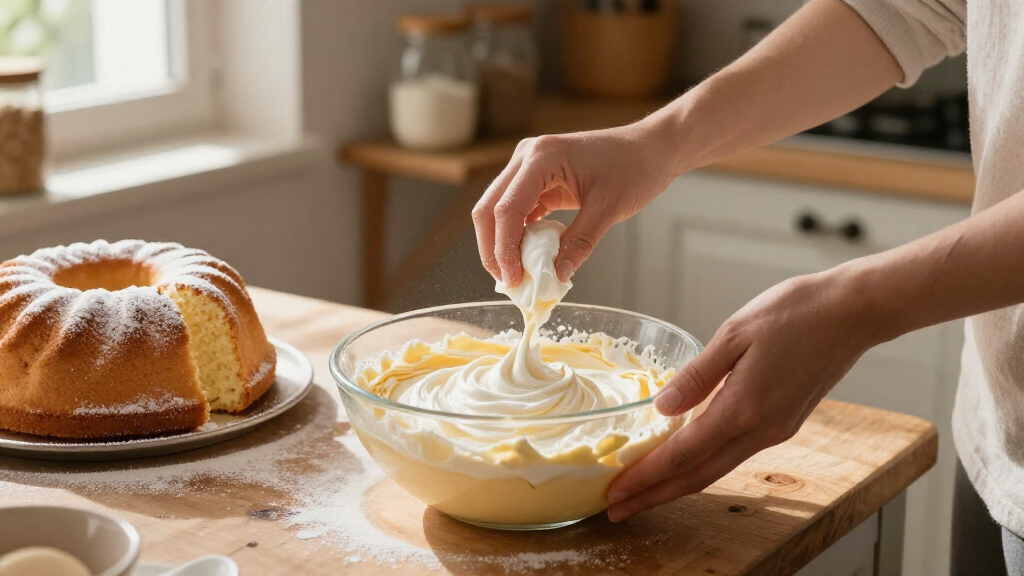
Whipped egg whites form the backbone of angel food cake’s signature lightness. When you whip whites, you unfold their proteins and trap air in a fine, stable foam. As the cake bakes, heat expands these tiny bubbles, giving the cake its springy, airy texture.
Imagine whipping a bowl of egg whites and watching them turn from clear liquid into glossy, soft peaks. Those peaks are what hold the tiny air pockets that make the crumb so delicate. The key is to whip them just right—too little, and the structure collapses; too much, and they become dry and coarse.
An example? Think of a balloon that’s just filled with enough air to be buoyant but not bursting. That’s the perfect foam—light, stable, and ready to lift the batter to new heights. Understanding this foundation is essential for achieving that ethereal, cloud-like texture in your cake.
Products Worth Considering

Cuisinart SM-50R 5.5-Quart Stand Mixer, Ruby Red

KitchenAid Artisan 5-Quart Tilt-Head Stand Mixer, Almond Cream

KitchenAid Artisan Series 5-Quart Tilt-Head Stand Mixer, Dried Rose (KSM150PS)
As an affiliate, we earn on qualifying purchases.
How to Whip Egg Whites Perfectly for a Fluffy Crumb
- Start with fresh, room-temperature egg whites. They whip up faster and achieve higher volume.
- Use a clean, grease-free bowl and whisk. Any fat or oil can weaken the foam.
- Begin whipping at medium speed until the whites turn frothy.
- Add a pinch of cream of tartar or a splash of lemon juice. This acid helps stabilize the foam.
- Increase to high speed and whip until soft peaks form—think of a gentle curl or a swooping mountain.
- Gradually add sugar, a tablespoon at a time. Whip until stiff, glossy peaks form that hold a slight curl at the tip.
Remember, the goal is a foam that’s glossy and holds its shape without drying out. This stage is crucial—it’s where the magic of lightness begins.
Pro tip: test your peaks by lifting the whisk. They should stand tall but still be moist-looking. Underwhipped whites won’t support the batter; overwhipped whites will be dry and difficult to fold.
Folding in Flour and Flavorings Without Destroying Air Bubbles
Folding is an art. It’s how you incorporate dry ingredients into the whipped whites without knocking out all that delicate air. The goal? A uniform batter with tiny, evenly distributed bubbles that give the cake its springy crumb.
Use a large spatula and a gentle, slicing motion. Cut through the middle, sweep along the bottom, then lift and fold over. Rotate the bowl and repeat. Do this in several additions—usually three or four—until just combined.
For flavorings like vanilla or lemon zest, fold them in after the flour. Be gentle—aggressive stirring will deflate the foam and ruin your rise.
Real-world example? Think of folding as gently mixing a delicate fabric—avoid wringing or twisting. The more you handle it roughly, the more bubbles pop, and the denser the crumb becomes.
Choosing the Right Pan and Cooling Technique for Perfect Height
An ungreased, tube pan is essential for angel food cake. Its central tube and straight sides help the batter climb upward, creating that iconic height and lightness. Greasing or coating the pan prevents the batter from gripping the sides, which can cause it to fall.
Once baked, immediately invert the pan onto a bottle or cooling rack. This upside-down cooling prevents gravity from compressing the delicate crumb and helps it set perfectly. Keep it cooled completely—usually about an hour—before removing the cake.
Imagine a balloon that’s just been inflated. If you let it sit upright while it cools, it slowly deflates or sinks. But if you hang it upside down, it maintains its shape, becoming that lofty, cloud-like dessert you crave.
Tip: use a pan with a removable bottom or a specially designed angel food cake pan. This makes releasing the cake easier without damaging its fragile structure.
Troubleshooting Common Failures: How to Fix Them
Despite careful technique, sometimes things go awry. Here’s a quick guide to common problems and their fix.
| Problem | Likely Cause |
|---|---|
| Flat or collapsed cake | Underbaking, weak foam, greased pan, or improper cooling |
| Dense bottom layer | Poor folding, flour settling, or standing too long |
| Larger tunnels or holes | Overwhipping, uneven folding, or large air pockets not released |
| Tough or rubbery crumb | Excessive flour, overwhipping whites, or overbaking |
| Dry cake | Overbaking, too little sugar, or inaccurate measurements |
Careful attention to these details can save you from many pitfalls. Remember, even experienced bakers sometimes need to adjust based on the oven or ingredients.
Modern Twists: How Bakers Are Evolving the Classic Method
While the core angel food cake method remains unchanged, bakers today experiment with new flavors and techniques. From reduced sugar versions to gluten-free adaptations, the goal is to keep the cake light but also more inclusive.
Using stand mixers with precise control makes whipping easier and more consistent. Some bakers incorporate zest, spices, or even matcha powder to add flavor without compromising the airy structure. Others try mini cakes or cupcakes—though these require adjustments in baking time and cooling.
New ingredients like aquafaba—chickpea cooking liquid—are also making appearances as egg-white substitutes. However, these often require specific recipes to mimic the foam stability of real egg whites.
Each adaptation seeks to maintain that delicate balance: fluffy, tender, and springy, with a hint of creative flair.
Frequently Asked Questions
Can I use carton egg whites for angel food cake?
Yes, but results vary. Pasteurized carton whites may whip less vigorously because of additives or processing. Choose a product labeled suitable for whipping and follow the same steps for best results.
Why must the pan be ungreased?
The batter needs to cling to the sides to support its climb during baking. Greasing the pan prevents this adhesion, causing the cake to sink or fall flat once cooled.
How do I know when the egg whites are whipped enough?
Look for glossy, soft peaks that hold a slight curl at the tip. They should be shiny, moist-looking, and able to support gentle peaks without collapsing or becoming dry.
Can I reduce the sugar in an angel food cake?
Modest reductions are possible but can compromise the foam’s stability and the cake’s tenderness. Sugar stabilizes the egg foam and helps retain moisture, so any reduction should be tested carefully.
What’s the best way to remove the cake from the pan?
Allow the cake to cool completely upside down, then gently loosen the edges with a thin knife or spatula. Carefully lift or invert the pan—using a removable bottom pan makes this easier—without tearing the delicate crumb.
Conclusion
Mastering the angel food cake method turns simple egg whites into a feather-light masterpiece. Focus on gentle folding, proper pan choice, and cooling upside down. The next time you want a dessert that feels like a slice of heaven, remember: it’s all about respecting those tiny bubbles.
With a little patience and attention to detail, you’ll create a cake so tender and airy, it practically floats off your plate. Why settle for anything less than a cloud?