
TL;DR

Get baking supplies delivered free with Prime
- Fast, free delivery on millions of items
- Prime Video, Amazon Music and more included
- Member-only deals all year
Cookies burn on the bottom because the pan-side of the dough absorbs heat faster than the top can bake — usually from a dark or thin pan, a low oven rack, or an oven that runs 25–50°F hotter than its dial says. Move your rack to the center, switch to a light heavy-gauge aluminum sheet lined with parchment, and verify your temperature with a cheap oven thermometer. These three changes fix the problem for the vast majority of bakers.
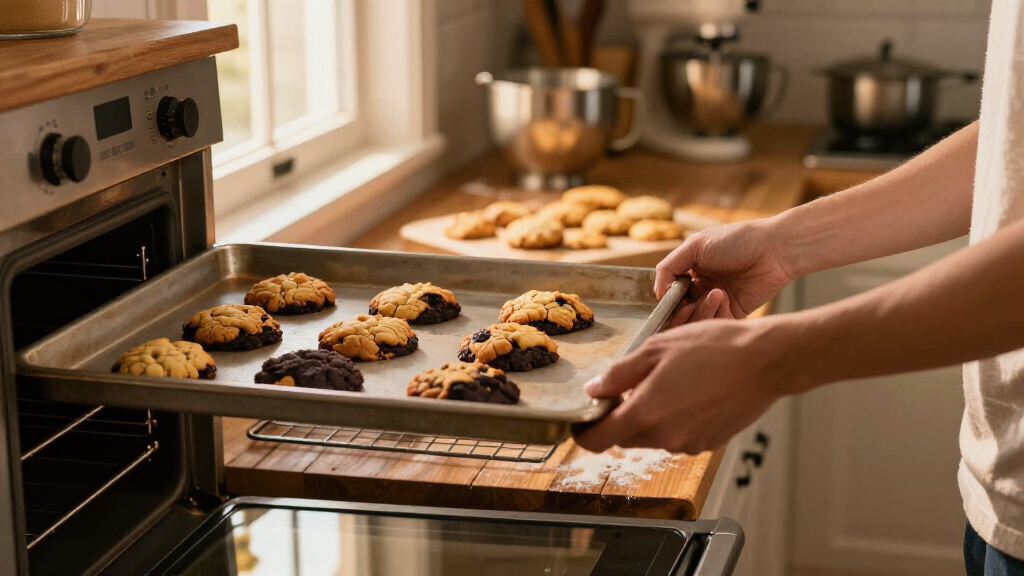
You pull the sheet from the oven, flip a cookie over, and there it is: a bottom the color of dark toast. The tops look golden and perfect. The middle is soft. But the underside is scorched — and no amount of frosting hides that bitter, acrid bite.
Here’s the part nobody tells you: your recipe is probably fine. Burnt bottoms are almost always an equipment and heat-management problem, not a baking-skill problem. The heat hitting the pan-side of your cookies is too intense, too direct, or too long — and that’s fixable with a few changes that cost less than a bag of good chocolate.
In this guide, you’ll learn the five most common culprits ranked by likelihood, how to diagnose which one is haunting your kitchen, and the exact fixes Aromas Healthy Bake recommends — including one $10 tool that solves the mystery for most people for good.
Bake every cookie batch on the center rack — the bottom rack places dough too close to the heating element and is the single most common cause of burnt bottoms.
Dark and non-stick pans effectively run about 25°F hotter than light aluminum; either drop your oven temperature 25°F or switch to a heavy-gauge light half-she…
Most home ovens are miscalibrated by 25–50°F — a $10 oven thermometer tells you the real temperature and fixes more than just cookies.
Always line pans with parchment or a silicone mat; bare metal (and greased metal) conducts heat straight into the cookie’s base and accelerates scorching.
Transfer cookies off the hot pan within a couple of minutes — residual pan heat keeps baking bottoms after the oven’s job is done.
Find Your Culprit in 60 Seconds: The Quick Diagnosis
Before you change anything, figure out which problem you actually have. Cookies placed too close to the heat source, baked on the wrong pan, or left in a mis-calibrated oven each fail differently — and the failure pattern tells you which one it is.
Flip your next batch over and read the evidence like a detective:
- Black bottoms, raw middles → heat is hitting the pan-side too fast. Think: dark pan, bottom rack, or an oven running hot.
- Burnt on one side only → your oven has a hot spot. The fix is rotation, not recipe changes.
- Evenly over-browned all over → your oven likely runs hotter than its dial, or the bake time is simply too long.
- Burnt only where dough touches bare metal → you need parchment or a silicone mat, full stop.
One batch of deliberately observed cookies will tell you more than a week of guessing. Start there.
Products Worth Considering

KitchenAid Classic Series 4.5 Quart Tilt-Head Stand Mixer K45SS, Onyx Black

Cuisinart CPZ-120 Indoor Pizza Oven, Stainless Steel

Cuisinart 8-in-1 Air Fryer Toaster Oven with Grill, TOA-70NAS
As an affiliate, we earn on qualifying purchases.
Culprit #1: Your Oven Rack Is in the Wrong Spot
The oven rack position is the most common culprit, and it’s the easiest fix in all of baking. Cookies placed too close to the bottom heating element absorb direct radiant heat — the same intense heat that makes your broiler work — and the pan-side of the cookie takes the hit while the top bakes gently by convection.
If your rack sits in the lowest position, your cookies are basically sunbathing inches from a heating coil. The bottom of the dough hits caramelization temperature (roughly 320–350°F for sugar) long before the top sets. Scorch city.
The fix: bake cookies on the center rack for every batch. This positions the dough in the most even-heat zone of the oven, roughly equidistant from the top and bottom elements. The bottom rack is almost always wrong for cookies — it’s better reserved for things like pizza stones or bread that benefit from a crisped base.
Real-world example: a reader bakes the same dough on the bottom rack and the middle rack, same temperature, same pan. The bottom-rack batch comes out with mahogany undersides; the center-rack batch is evenly golden. Nothing else changed. That’s how much rack position matters.
Culprit #2: Your Pan Is Working Against You
Dark and non-stick bakeware browns faster — full stop. Dark surfaces absorb radiant heat instead of reflecting it, so the pan itself gets hotter than a shiny light one at the same oven setting. The practical effect is that a dark pan behaves as if your oven is running about 25°F hotter than the dial says, which is why many recipes tell you to drop the temperature by 25°F when using one.
Thin, flimsy sheets cause a different problem: they warp under heat, and warped metal creates hot spots that scorch one cookie while its neighbor stays pale. Those $8 grocery-store cookie sheets are the repeat offenders here. A heavy-gauge half-sheet pan in light aluminum — the kind restaurant kitchens use — holds its shape and spreads heat evenly for decades.
| Pan Type | Bottom-Browning Speed | What To Do |
|---|---|---|
| Light heavy-gauge aluminum | Even, moderate | Use as-is; the gold standard |
| Dark non-stick | Fast, aggressive | Reduce oven temp by 25°F |
| Thin cheap sheets | Uneven, spotty | Replace, or double-pan for insulation |
| Insulated double-layer | Slow | Watch bake time — may run 1–2 min longer |
And a counterintuitive one: greasing the pan can make burning worse, not better. Liquid fat conducts heat directly to the dough. Reach for parchment or a silicone mat instead.
Culprit #3: Your Oven Is Lying to You
Ovens are frequently miscalibrated — often by 25–50°F — and almost never in the direction you’d hope. If your dial says 350°F and the cavity actually runs 380°F, every recipe you’ve ever tried has been fighting an invisible headwind. Ovens also cycle on and off, and during those cycles they can spike well above the set temperature.
This is why the humble oven thermometer is one of the most recommended tools in all of baking. It costs about $10, sits on your center rack, and tells you the truth. Leave it in the oven permanently — check it whenever something bakes oddly.
Here’s how to calibrate with it:
- Set your oven to 350°F and let it preheat for a full 15 minutes beyond the beep.
- Read the thermometer. Note the difference (dial says 350, thermometer reads 375 → you’re 25°F hot).
- Adjust your setting by that offset going forward (set 325°F to get a true 350°F).
- Recheck seasonally — ovens drift over time, especially older gas models.
- If the offset is huge or wildly inconsistent, check your manual for a calibration adjustment, or call a technician.
An oven that runs 25°F hot doesn’t just burn cookie bottoms — it quietly ruins roasts, custards, and meringues too. One thermometer fixes them all.
Culprit #4: Bare Metal and Missing Insulation
Dough sitting directly on metal browns faster than dough separated from it — metal conducts heat straight into the cookie’s base. Parchment paper and silicone baking mats both act as a thin insulating layer that slows that transfer, giving the top time to catch up. It’s the cheapest improvement in baking.
Silicone mats insulate slightly better and are reusable for years; parchment is disposable but doubles as a cleanup miracle and can be cut to fit any pan. Aromas Healthy Bake’s take: keep both on hand. Mats for delicate cookies like macarons and thin tuiles, parchment for everything everyday.
For especially scorcher-prone doughs, try double-panning: stack two identical sheets together before scooping dough. The air gap between the layers acts like insulation and dramatically slows bottom browning — a trick professional bakers use for fragile cookies and shortbread. The tradeoff is a slightly longer bake, usually 1–2 minutes, so start checking early.
Culprit #5: Your Dough Itself Burns Easily
Some recipes are simply more scorch-prone than others. High-sugar doughs — especially those built on brown sugar, honey, corn syrup, or molasses — caramelize and then burn faster than low-sugar ones, because sugar begins caramelizing around 320–350°F and moves from amber to black fast. If your favorite recipe is a deep-dark molasses cookie, the margin between perfectly chewy and charred is genuinely narrow.
Butter-heavy doughs add another wrinkle: fat conducts heat quickly to the pan-side, and butter’s milk solids brown (deliciously, until they don’t). Shortening-based doughs actually brown slower for this reason — one of the few tradeoffs where butter’s flavor comes at a cost.
And thin cookies — those flat, lacy, spread-out ones — have almost no insulation between the hot pan and their surface area. A thin cookie can go from golden to burnt in under a minute. If you love thin and crispy, the answer isn’t a different recipe; it’s the pan, rack, and parchment fixes above doing more of the work.
The 9-Step Rescue Plan for Your Next Batch
Here’s the complete fix list, in the order that solves the most problems fastest. Work top to bottom — most people find their answer in the first three steps.
- Move the rack to the center position. Non-negotiable for cookies.
- Hang an oven thermometer and bake to the real temperature, not the dial.
- Line your pan with parchment or a silicone mat — never bake on bare metal.
- Switch to a light, heavy-gauge aluminum half-sheet pan when your budget allows.
- Drop the temperature 25°F if you’re staying with dark or non-stick bakeware, and extend the time slightly.
- Double-pan delicate or very sugary doughs for extra insulation.
- Check cookies 2–3 minutes early. Bottoms brown shockingly fast at the end of the bake.
- Rotate the pan halfway through to even out hot spots.
- Cool briefly, then transfer to a rack. A hot pan keeps baking bottoms after it leaves the oven.
That last step surprises people. Your sheet pan comes out of the oven holding a serious amount of residual heat, and cookies left sitting on it keep cooking — sometimes right past done. Two minutes on the pan, then a wire rack. Your bottoms will thank you.
Yes, You Can Salvage the Batch You Just Burned
Before you bin that sad batch: lightly burnt bottoms are often rescueable. Let the cookies cool completely, then gently rub or scrape the scorched layer off against a fine grater or the fine side of a box grater, working over the sink. You’ll remove the bitter part and lose only a millimeter of cookie.
Lightly scorched (dark amber, slightly bitter)? Grating works well. Truly black and acrid-tasting? Compost them — burnt flavor permeates the whole cookie, and no amount of grating fixes that. Your nose knows the difference.
And going forward, do a flip-check about two minutes before the recipe’s stated time. Lift one cookie with a spatula and look underneath. Golden-bronze with darker edges is done; anything heading toward mahogany means the oven comes out of your future batches a little cooler or a little shorter.
Frequently Asked Questions
This points to heat hitting the pan-side too fast: usually a dark pan, a bottom-rack position, or an oven running 25°F or more hotter than its dial. Move to the center rack, line the pan with parchment, and check the temperature with an oven thermometer. Drop the temp 25°F if your pan is dark non-stick.
Does parchment paper really prevent burnt bottoms?
It helps a lot — parchment acts as a thin insulating barrier between the dough and hot metal, slowing heat transfer to the cookie’s base. But it can’t fix an oven that runs 40°F hot or a rack sitting on the heating element. Think of parchment as one layer of the solution, not the whole thing.
Are dark cookie sheets bad?
Not bad — just faster-browning. Dark surfaces absorb radiant heat, so they behave as if the oven is about 25°F hotter than it is. Keep using one if you like it; just reduce your recipe’s temperature by 25°F and expect slightly darker results than a light pan would give.
Why do my cookies burn on only one side?
That’s a hot spot — an uneven area of heat in your oven, often from a thin warped pan or an element that heats unevenly. Rotate the pan 180 degrees halfway through baking to compensate, and consider upgrading to a heavy-gauge pan that distributes heat more evenly.
Can I save cookies that already have burnt bottoms?
Often, yes. Let them cool fully, then gently grate or scrape the scorched layer off with a fine grater over the sink. This works for lightly darkened bottoms; truly black, acrid-tasting cookies can’t be saved because the burnt flavor has spread through the whole cookie.
Conclusion
If you change only three things, make them these: center rack, parchment-lined light aluminum pan, and an oven thermometer telling you the truth. That trio eliminates the vast majority of burnt-bottom complaints — no recipe changes required.
Because the goal isn’t just unburnt cookies. It’s pulling a batch from the oven, flipping one over out of habit, and finding that even, golden underside — every single time.