TL;DR

Get baking supplies delivered free with Prime
- Fast, free delivery on millions of items
- Prime Video, Amazon Music and more included
- Member-only deals all year
A writer for The Kitchn reports that avoiding groceries sold in plastic packaging helped her save at least $40 per month, or about 20% of her budget. Her account describes personal experience, not a controlled price comparison, and the savings may depend on local prices, shopping habits and available alternatives.
A writer for The Kitchn says she saved at least $40 a month on grocery and household spending after making avoidance of plastic packaging a rule for her shopping. The reported savings equal about 20% of her budget, according to her account, though the article does not provide receipts or a comparison of prices before and after the change.
The writer, Mackenzie Filson, describes the approach as a shopping game: plastic-packaged products are off limits when she can find an alternative in glass, paper, aluminum or no packaging. She says the rule made her pause before impulse purchases and led her to buy more items from service counters, bulk bins and farmers markets. The reported $40 includes both grocery and household bills; the article does not break down the amount by category.
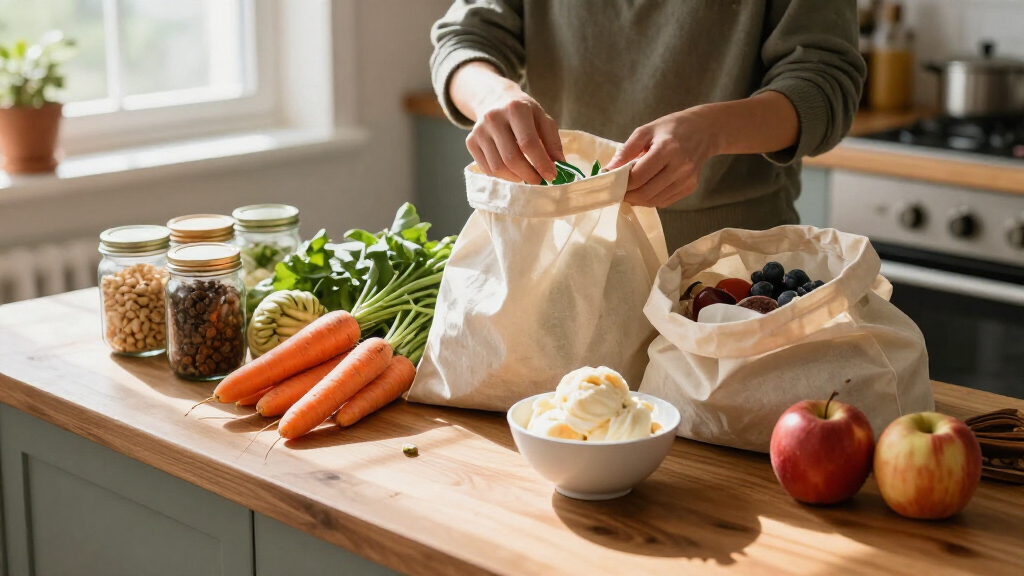
Her examples include buying spices and condiments in glass jars, choosing larger or package-free amounts where available, and asking a butcher or cheesemonger to wrap selected portions in paper. For produce, she describes shopping at a farmers market and ordering a box in which vegetables typically arrive loose. She also favors sturdy produce that needs less protective packaging, such as potatoes, onions, bananas and squash.
Filson says some substitutions also reduced other purchases. She reuses jars for household storage and has stopped buying new storage containers, while choosing the amount of meat or cheese she needs can help her avoid waste. For items she has not found without plastic, she describes making alternatives at home, including hummus from canned beans and tahini, and salad dressing in a reused jar. These are her reported choices, not findings from a broader consumer study.
How Packaging Choices Affect the Bill
The account offers a practical example of how changing the format of a purchase can affect spending. Filson points to differences such as loose mushrooms costing less than the same mushrooms sold in a package, and larger tubs of yogurt costing less per ounce than single-serve portions. Those examples support a broader point in her report: packaging and portion size can affect unit price, although the amount varies by product and store.
For readers trying to reduce both spending and packaging waste, the approach may be useful as a way to compare options during a regular shop. Buying only the amount needed from a counter or bulk bin may also help some shoppers avoid excess food. Filson says she wanted to reduce the chance of consuming microplastics and avoid putting hard-to-recycle items in recycling when they may not be accepted. The article does not measure either outcome, so those remain her reasons for changing her habits, rather than demonstrated results of the shopping method.
The claimed savings should be read in light of the personal nature of the report. Filson does not specify her original monthly budget, identify the stores and prices for every comparison, or say whether her household size and diet changed. A $40 reduction for one shopper is not a prediction for other households. Local access to bulk bins, farmers markets and staffed counters, along with the prices of alternatives, could all shape the result.
Products Worth Considering

Breville Smart Grinder Pro Conical Burr Coffee Grinder, Brushed Stainless Steel

Ninja Artisan 5-in-1 Portable Electric Pizza Oven, Blue & Gold

KitchenAid Classic Series 4.5-Quart Tilt-Head Stand Mixer, Onyx Black
As an affiliate, we earn on qualifying purchases.
Where the Shopper Found Alternatives
Filson says she began looking for alternatives after finding that routine efforts to cut grocery costs felt difficult. She writes that budgeting had become frustrating and that she wanted to watch spending, particularly during farmers market visits in peach season. Her plastic-free rule gave her a simple condition to apply while shopping: choose another format when one is available.
She names several sources for those options. At Sprouts Farmers Market, she says bulk bins offer products such as oats, licorice and pea protein powder in quantities she can vary. She also mentions farmers markets, a weekly Misfits Market produce box, grocery store service counters and local bakeries. The named shops and brands are examples from her own shopping; the article does not compare their prices with other retailers.
Her choices cover dairy, eggs, pantry staples and produce. She looks for some yogurt and cheeses in glass jars, asks for paper wrapping at the cheese counter, and selects cardboard egg cartons. For broth, she says she switched from cartons to Better Than Bouillon sold in jars. She also buys canned or jarred fruit and vegetables, including artichokes, peppers, prunes, pineapple and applesauce. Her account shows that avoiding plastic does not mean buying everything fresh or unpackaged; cans and glass containers remain part of her approach.
“Opting for aluminum, paper, glass, or ideally package-free items instead has helped me shave at least $40 off my grocery and household bills each month (that’s 20% of my budget!).”
— Mackenzie Filson, writing for The Kitchn
What the $40 Estimate Leaves Out
The source does not show a monthly spending ledger, receipts or a defined period over which Filson calculated her savings. It also does not provide a baseline budget beyond saying that $40 represents about 20% of her budget. The article does not clarify whether that percentage refers to grocery spending alone or the combined grocery and household spending she describes.
It is also unclear how much of the change came from packaging choices themselves, rather than buying fewer impulse items, choosing different quantities, reducing waste or changing stores. Filson describes all of those as part of her experience, but gives no separate figures for their effects. She says she has not found plastic-free versions of some products, including hummus and salad dressing in the options available to her, and does not list every item she continues to buy in plastic.
The account does not test claims about microplastics or recycling outcomes. It reports Filson’s motivation to reduce possible exposure and avoid placing difficult-to-recycle packaging in the waste stream. No health outcome or reduction in plastic waste is quantified in the supplied material.
How Readers Can Check Local Costs
Filson’s report does not announce a follow-up study or a broader savings estimate. For readers considering similar changes, the article’s examples point to a straightforward next step: compare the price per unit of the same or similar item in different packaging, while noting the amount purchased and the store. Tracking spending over several shopping trips could show whether a change in packaging, portion size or buying fewer extras accounts for any difference.
Availability will vary. Readers can ask whether a service counter offers paper wrapping, check whether local bulk bins allow purchases in chosen quantities, and see which produce is sold loose. Filson’s account suggests starting with options already stocked nearby, including glass jars, cans, cardboard cartons and package-free produce, rather than assuming every item has an alternative.
Whether the reported savings can be repeated by other shoppers remains unknown. The $40 figure is Filson’s own estimate, and the source gives no common measurement method for comparing results across households. Any further account would need to specify the budget, shopping period and price comparisons to show how the figure was reached.
Key Questions
How much did the writer say she saved?
Filson says she saved at least $40 per month on grocery and household bills, an amount she describes as about 20% of her budget. The source does not include receipts or a detailed calculation.
What packaging did she choose instead of plastic?
She describes choosing glass, paper, aluminum and package-free products where available. Her examples include jarred condiments, cardboard egg cartons, paper-wrapped cheese and loose produce.
Does the article show that plastic-free shopping saves everyone money?
No. It is a first-person report and does not compare results across households or stores. Prices and the availability of alternatives differ, and the source does not isolate the effect of packaging from other shopping changes.
What did the writer do when she could not find a plastic-free option?
Filson says she made some foods at home, including hummus and salad dressing, and bought bread from grocery store or independent bakeries in paper sleeves. She does not claim every product has a practical alternative where she shops.
Source: rss