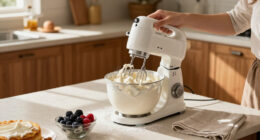
For healthy baking, a mixing bowl should be easy to clean, suitable for your ingredients, and practical for the way you prepare food. Glass and stainless steel both meet those needs, but they solve different problems. Glass makes batters easy to inspect and can handle some microwave or oven tasks when the manufacturer permits; stainless steel is much lighter and more resistant to breaking if it slips from a counter. Neither material makes a recipe healthier by itself. The meaningful choice is how much you value visibility and heat versatility against low weight and resilience. Choose glass if you often melt, warm, or monitor ingredients in the same bowl. Choose stainless steel if you mix frequently, prefer easy handling, or want a set that can take more everyday knocks.

Get baking supplies delivered free with Prime
- Fast, free delivery on millions of items
- Prime Video, Amazon Music and more included
- Member-only deals all year

Premium Mixing Bowls with Airtight Lids Set, Thicker Stainless Steel, Black
- ✔ Material: Stainless steel
- ✔ Capacities: 1.5, 2, 3, 4, and 5 quarts
- ✔ Set size: Five bowls

Cuisinart 3-Piece Stainless Steel Mixing Bowl Set with Lids, CTG-00-SMB
- ✔ Material: Stainless steel
- ✔ Capacities: 1.5, 3, and 5 quarts
- ✔ Set size: Three bowls with three lids

Compact Stainless Steel Mixing Bowls, 3-Piece (1.5, 2.2 & 3.4 Qt)
- ✔ Material: Food-grade 304 stainless steel, according to supplied description
- ✔ Capacities: 1.5, 2.2, and 3.4 quarts
- ✔ Set size: Three bowls
At a Glance
| Criteria | Glass mixing bowls | Stainless steel mixing bowls | Winner |
|---|---|---|---|
| Food contact and ingredient compatibility | Nonreactive for typical baking ingredients; check that bowls are food-safe and undamaged | Nonreactive for typical baking ingredients; check food-contact labeling and avoid damaged bowls | Tie |
| Visibility while mixing | Transparent sides make color, texture, and mixing progress visible | Opaque sides hide the mixture and its color | A |
| Weight and handling | Heavier, especially in larger sizes; stable on a counter | Lightweight and easy to lift, pour from, and store | B |
| Breakage and durability | Does not rust, but can chip, crack, or shatter if dropped or thermally shocked | Resists breakage and rust when made from suitable stainless steel; may dent | B |
| Microwave and oven use | Many bowls tolerate microwave or oven use, but temperature limits vary by product | Usually unsuitable for microwave use; oven use depends on product and handles | A |
| Cleaning and maintenance | Usually dishwasher safe; scratches and stains may remain visible | Usually dishwasher safe; fingerprints and water spots can show | Tie |
| Value | Worth paying for if visibility or oven and microwave versatility will be used | Often a strong everyday value, especially for nesting sets | Depends |
Premium Mixing Bowls with Airtight Lids Set, Thicker Stainless Steel, Black
The PriorityChef five-bowl set makes the strongest all-purpose case for a baker who wants one set to cover ingredient prep, mixing, and short-term storage. Its stated 1.5, 2, 3, 4, and 5 quart sizes give us more steps between a small task and a large batch than either three-piece alternative. The smaller bowls can hold separated ingredients while the larger ones take batter or dough, and etched measurements help when a recipe calls for measuring directly into the bowl.Its most practical edge over Cuisinart and Gronivex is the silicone nonslip base. A bowl that stays put can make whisking or folding easier, particularly when a recipe needs a steady hand. The set also includes BPA-free lids, like Cuisinart, but the product description calls these airtight and asks that they be hand-washed. That care step adds work compared with the stated dishwasher-safe bowls.The black finish and thicker-than-industry-standard steel are positioned as durable features, but the supplied details do not give a gauge measurement or quantify how much sturdier the set is. These are still metal bowls, so they are not microwave-safe, and the lids should not be treated as dishwasher-safe. Compared with the compact Gronivex set, this is a more flexible choice for different batch sizes; compared with Cuisinart, it trades simpler three-bowl storage for two extra capacities, measurement marks, and added mixing stability. Choose it when you bake varied recipes and value those aids; skip it if you want the fewest pieces or a fully dishwasher-cleanable set including lids.
Pros:
- Five capacities from 1.5 to 5 quarts cover a broad range of prep and baking tasks.
- Silicone bases are designed to reduce sliding while mixing.
- Etched measurements allow measuring in the bowl.
- Includes BPA-free lids for covering and storing ingredients.
Cons:
- Lids require hand-washing, adding a separate cleanup step.
- Stainless steel cannot be used in a microwave.
- The black finish and thicker steel are described without a specific gauge or quantified durability measure.
Best for: Bakers who want five graduated bowl sizes, built-in volume marks, and a nonslip base for mixing.
Not ideal for: Buyers who need microwave-safe bowls, dishwasher-safe lids, or the simplest three-piece set.
Bottom line: We rank PriorityChef first for its combination of five sizes, in-bowl measurements, and nonslip bases, with hand-wash lids as the main compromise.
“We rank PriorityChef first for its combination of five sizes, in-bowl measurements, and nonslip bases, with hand-wash lids as the main compromise.”
Cuisinart 3-Piece Stainless Steel Mixing Bowl Set with Lids, CTG-00-SMB
Cuisinart’s set is for cooks who regularly move ingredients from the mixing stage into the refrigerator or freezer. The 1.5, 3, and 5 quart bowls span quick prep through larger batches, and each has a matching lid. That makes this set more storage-oriented than Gronivex, which lists no lids, and more straightforward than PriorityChef if you would rather have three bowls than five.For baking, the rolled edges are a useful detail: they offer a more comfortable place to grip and can help when pouring batter or transferring a mixture. Stainless steel resists stains and odors according to the supplied description, and the bowls are described as refrigerator- and freezer-safe. The set’s nested design also limits how much cabinet room the three sizes take up. These features make it a sensible choice for recipes prepared in stages, or for keeping measured ingredients covered between steps.There are tradeoffs. The supplied product copy says dishwasher-safe, but a separate care field lists “Hand Wash Only,” so we would check the exact product listing and care label before relying on machine washing. Cuisinart also has no stated nonslip base or etched measurements, both of which distinguish PriorityChef. And although the three sizes are versatile, this set has fewer intermediate capacities than that five-bowl option. Like the other steel picks, it cannot go in the microwave. Choose Cuisinart when matching storage lids matter more than measurement marks; choose Gronivex for compact smaller batches or PriorityChef for more size choices and steadier mixing.
Pros:
- Three capacities—1.5, 3, and 5 quarts—cover small prep through larger batches.
- Each bowl includes a matching lid for storage.
- Rolled edges support gripping and pouring.
- Nesting design saves cabinet space.
Cons:
- The supplied information conflicts on dishwasher care; confirm the instructions for the exact set.
- No nonslip base or etched volume markings are specified.
- Three sizes offer fewer intermediate options than PriorityChef’s five-bowl set.
Best for: Bakers and meal preppers who want three useful bowl sizes with matching lids for covered storage.
Not ideal for: Anyone who needs a stated nonslip base, etched measuring marks, or confirmed dishwasher care without checking the listing.
Bottom line: We recommend Cuisinart when matching lids and a simple three-size range matter more than nonslip mixing or built-in measurements.
“We recommend Cuisinart when matching lids and a simple three-size range matter more than nonslip mixing or built-in measurements.”
Compact Stainless Steel Mixing Bowls, 3-Piece (1.5, 2.2 & 3.4 Qt)
Gronivex takes a narrower approach: its 1.5, 2.2, and 3.4 quart bowls are intended for one or two people, small kitchens, and lighter baking. The smaller step between capacities can be more useful for everyday prep than jumping from 1.5 to 3 quarts, as Cuisinart does. The product description suggests the smallest bowl for eggs or melted chocolate, the middle for cake batter or marinades, and the largest for cookie dough or a side salad. Those are practical examples of the set’s scale, rather than a promise that it will suit every recipe.The bowls are described as food-grade 304 stainless steel, with a brushed interior, rolled rim, and laser-etched quart and milliliter marks. Measurement marks set it apart from Cuisinart, while the compact range and stated 20% thicker gauge are positioned for space-conscious cooks. The bowls nest together, and the description claims they take up less cabinet space. Dishwasher-safe care is also stated, without the lid hand-washing caveat found with PriorityChef.Its limitation is capacity. At 3.4 quarts, the largest bowl is smaller than the 5 quart options from both competitors, so large cookie batches, family-sized salads, and doubled recipes may feel cramped. There are no lids listed, and no nonslip base is specified. The supplied description points buyers who need larger bowls toward a separate five-piece set, but this roundup evaluates the three-piece compact version. Choose it if counter and cabinet space are tight and your baking tends toward modest batches; choose Cuisinart or PriorityChef if larger mixing volume is a regular need.
Pros:
- Compact capacities suit small batches and everyday prep for one or two people.
- Stated food-grade 304 stainless steel is non-reactive and rust-resistant.
- Laser-etched quart and milliliter markings support measuring in the bowl.
- Dishwasher-safe bowls nest for compact storage.
Cons:
- The largest bowl is 3.4 quarts, smaller than the 5 quart bowls in the other two sets.
- No lids are listed for covering ingredients or storing mixtures.
- No nonslip base is specified.
Best for: Solo cooks, couples, apartment dwellers, and small-batch bakers who value compact nesting storage.
Not ideal for: Families, frequent double-batch bakers, or anyone who wants lids or a stated nonslip base.
Bottom line: Gronivex is the best fit when compact sizing and etched measurements matter more than room for large batches or covered storage.
“Gronivex is the best fit when compact sizing and etched measurements matter more than room for large batches or covered storage.”
As an Amazon Associate we earn from qualifying purchases.
Key Differences
The most useful distinction is how each bowl behaves during prep. Glass gives a clear view of whether flour has been incorporated, whether a batter is smooth, or whether a mixture has changed color. Its weight can also keep a bowl steady while you whisk. Stainless steel sacrifices that visibility, but its low weight makes a difference when lifting a large bowl, pouring batter, or moving through several mixing steps. For frequent bakers, that can make steel the less tiring everyday tool.
Heat compatibility shifts the choice toward glass, with an important product-specific caveat: not every glass bowl is oven-safe, and even heat-resistant glass can crack under sudden temperature changes. Follow the maker’s instructions and avoid moving a cold bowl directly into high heat. Stainless steel generally cannot go in the microwave, so ingredients that need melting or warming require a separate container. For value, steel is the better default when a set will mainly be used for mixing, while glass earns its higher cost when its visibility and permitted heat use replace extra dishes.
Detailed Comparison
Food contact and ingredient compatibility (minor difference)
Both materials are nonreactive for the acidic ingredients common in baking, such as citrus, yogurt, and vinegar, when the bowls are food-safe and in good condition. Neither has a broad health advantage for ordinary mixing. Glass can crack or chip, and a damaged bowl should be taken out of use. Stainless steel should be identified as suitable for food contact and kept clean, especially around seams or attachments. This is a tie for most kitchens; choose by use and condition rather than assuming one material improves nutrition.
Visibility while mixing (Glass mixing bowls wins — moderate)
Glass wins clearly because its sides reveal the mixture from more angles. That helps when checking for dry pockets, watching whipped ingredients, or judging whether fruit or spices are distributed evenly. Steel requires scraping or pausing to inspect the mixture, although experienced bakers may not mind. The gap is moderate: visibility can prevent missed patches and make unfamiliar recipes easier, but it does not change the bowl’s mixing performance by itself.
Weight and handling (Stainless steel mixing bowls wins — moderate)
Stainless steel is substantially easier to lift and maneuver, particularly in large capacities. That matters when pouring a thick loaf batter, transferring dough, or holding a bowl in one hand while scraping with the other. Glass has more heft and can feel planted during vigorous whisking, but the same weight is a drawback for some users and when a bowl is full. Steel has a moderate practical advantage for frequent or one-handed use.
Breakage and durability (Stainless steel mixing bowls wins — major)
Steel wins for ordinary kitchen durability: it will not shatter if knocked against a counter or dropped, though it can dent. Glass stays smooth and does not rust, but a fall or sudden temperature shift can chip or break it, creating a safety concern and ending its useful life. The gap is major in kitchens with children, limited storage, or busy prep routines. Handle glass carefully and inspect it; choose steel when impact resistance matters more than a clear view.
Microwave and oven use (Glass mixing bowls wins — major)
Glass has the advantage because some bowls can safely go into a microwave or oven, allowing a baker to soften butter, warm ingredients, or bake a dish in the same vessel. The word “some” matters: check the product label and temperature limits, and avoid thermal shock. Steel cannot be used in a microwave and is generally bought for mixing rather than baking. This is a major difference for cooks who use one bowl for multiple heat-related steps; it matters little if all warming and baking happen in separate pans.
Cleaning and maintenance (minor difference)
There is no universal cleaning winner. Both materials are commonly dishwasher safe, but the maker’s care instructions should decide. Glass shows batter residue and can retain visible stains or scratches; steel can show fingerprints and water spots. Smooth, simple shapes are easier to wash than bowls with hard-to-reach rims or attached bases, so inspect the design as well as the material. The difference is minor for most users.
Value (moderate difference)
Steel often offers stronger everyday value because it is light, resilient, and widely sold in nesting sets for mixing tasks. Glass can justify a higher price when it replaces a microwave-safe prep dish or lets you monitor a recipe without transferring ingredients. Its added utility depends on the specific bowl’s heat rating, not the material name alone. The better buy depends on whether you will use those extra functions; paying more for glass makes sense only when they solve a recurring kitchen task.
Glass mixing bowls: Pros and Cons
Pros:
- Transparent sides make it easier to monitor mixing and ingredient distribution
- Many models can be used for microwave or oven tasks when rated for them
- Nonreactive surface suits common baking ingredients
- Weight can help the bowl stay steady during mixing
Cons:
- Heavier to lift and pour from, especially at larger sizes
- Can chip, crack, or shatter if dropped or exposed to sudden temperature change
- Heat limits differ by product, so oven use cannot be assumed
- Damage can make a bowl unsafe to keep using
Stainless steel mixing bowls: Pros and Cons
Pros:
- Lightweight and convenient for pouring, lifting, and storage
- Resists shattering and handles busy daily prep well
- Nonreactive for typical baking ingredients
- Nesting sets often provide useful capacity choices at a practical price
Cons:
- Opaque sides make it harder to inspect the mixture
- Not suitable for microwave use
- Can dent, and some finishes show fingerprints or water spots
- Heat use depends on the specific product and its components
Who Should Choose What
Choose Glass mixing bowls if:
- You want to see batter texture or ingredient distribution while mixing
- You often soften or warm ingredients in a microwave-safe bowl
- You value a heavier bowl that stays planted during whisking
- The product’s stated oven rating lets it serve another regular kitchen use
Choose Stainless steel mixing bowls if:
- You mix often and want a large bowl that is easy to lift and pour from
- Your bowls are likely to get knocked, dropped, or packed into tight storage
- You want a practical nesting set for everyday baking at a moderate cost
- You do not need to microwave or bake in the mixing bowl
Skip both if: If you need a bowl with handles, a pouring spout, a non-slip base, or a specialized capacity, compare those features directly; material alone will not guarantee a comfortable fit.
Value for Money
For most kitchens buying bowls mainly for mixing, stainless steel is the better value. Its light weight and resistance to shattering suit repeated use, and a nesting set can cover small ingredient prep through large batches without paying extra for heat versatility. Glass is worth paying more for when its transparent sides or manufacturer-approved microwave and oven use will replace separate dishes often. If those features would sit unused, the added weight and breakage risk do not buy much practical benefit. Compare capacity, rim shape, and care instructions alongside price: a well-sized bowl that is easy to pour from is more useful than a cheaper set with awkward proportions.
Final Verdict
Choose stainless steel as the default for frequent healthy baking: it is lighter to handle, more forgiving of everyday knocks, and usually the better value for a dedicated mixing set. Choose glass if watching mixtures closely or using the same bowl for approved microwave or oven steps is central to your routine, and you are willing to handle it carefully. The biggest deciding factor is whether glass’s visibility and heat versatility will replace real extra steps in your kitchen. If not, steel is the more sensible buy for most bakers.
Frequently Asked Questions
Are glass or stainless steel bowls healthier for baking?
Neither material makes baked food healthier. Both are nonreactive choices for typical baking ingredients when the bowls are intended for food use and remain undamaged. Good ingredient choices and recipe proportions have far more effect on nutrition.
Can I put a glass mixing bowl in the oven?
Only if the manufacturer identifies that specific bowl as oven-safe and you follow its temperature and handling instructions. Avoid sudden temperature changes, which can cause even heat-resistant glass to crack.
Can stainless steel bowls go in the microwave?
No. Metal bowls are not suitable for microwave use. Transfer ingredients to a microwave-safe container if a recipe calls for warming or melting them.
Which material is better for a large bowl of batter?
Stainless steel is easier to lift and pour when the bowl is full. Glass is heavier and may feel more stable while mixing, but that added weight can make transferring batter less convenient.
Is it worth paying more for glass mixing bowls?
Pay more when transparent sides or verified heat use will serve regular tasks. For mixing alone, a well-sized stainless steel set is generally the stronger value.