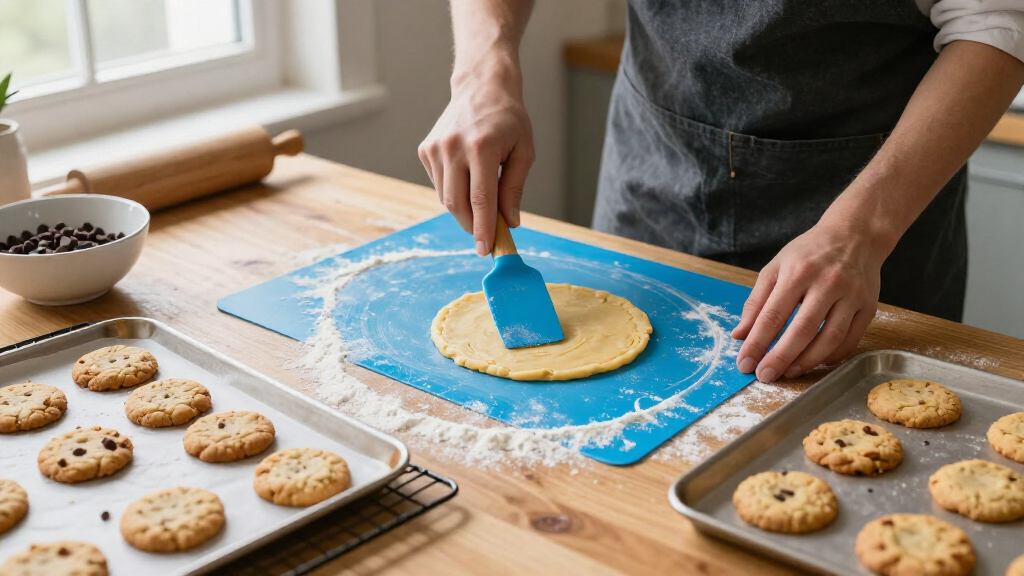

Choosing between silicone baking mats and parchment paper is less about whether either can keep cookies from sticking and more about how you bake. Both line pans and simplify cleanup, but they behave differently in the oven and ask different things of the person using them. Silicone mats cost more upfront and need washing and storage; parchment paper is bought repeatedly but can be cut to fit and thrown away after use.

Get baking supplies delivered free with Prime
- Fast, free delivery on millions of items
- Prime Video, Amazon Music and more included
- Member-only deals all year

Zulay Kitchen Silicone Baking Mats, 2-Pack, 16.5 × 11.6 in, Dark Gray
- ✔ Quantity: 2 mats
- ✔ Dimensions: 16.5 × 11.6 in each
- ✔ Material: Food-grade silicone
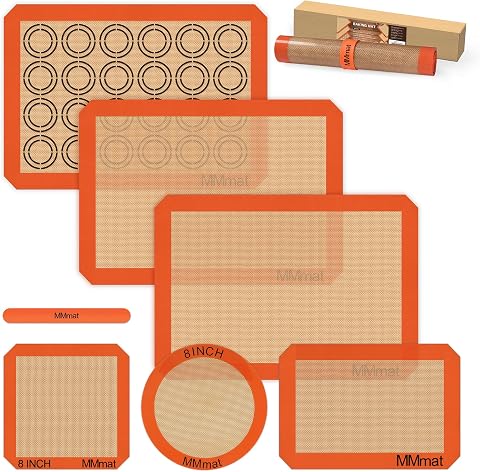
MMmat Reusable Silicone Baking Mats, Set of 6
- ✔ Quantity: 6 mats
- ✔ Set contents: 2 half-sheet, 1 cookie half-sheet, 1 quarter-sheet, 1 round 8-inch, and 1 square 8-inch mat
- ✔ Material: Food-grade WACKER silicone

GTJ Silicone Baking Mat Roll, Reusable Baking Sheet Liners, 12 in x 6 ft
- ✔ Format: Roll
- ✔ Dimensions: 12 in × 6 ft
- ✔ Material: Food-grade silicone with reinforced fiberglass backing
For frequent baking on standard sheet pans, a silicone mat can be a convenient reusable tool. For occasional baking, recipes that depend on crisp browning, or pans with unusual shapes, parchment is often the more flexible choice. The main tradeoff is repeated convenience and lower ongoing material use versus easy handling, broad versatility, and a fresh liner for each batch. The right pick depends on your baking habits, cleanup preferences, and recipe results—not simply which one is labeled nonstick.
At a Glance
| Criteria | Silicone baking mats | Parchment paper | Winner |
|---|---|---|---|
| Upfront and repeat cost | Higher initial cost; can replace many sheets of parchment if used regularly and cared for. | Low cost per roll or box, but recurring purchases add up with frequent baking. | Depends |
| Cleanup and daily convenience | Reusable, but must be washed and fully dried after each use. | Discard after use; often the quickest cleanup, though greasy waste may not suit every composting system. | B |
| Browning and texture | Can insulate the pan and produce less crisp browning on some recipes. | Often gives more direct pan contact and crisp browning, depending on recipe and oven. | B |
| Fit and versatility | Works well on compatible flat pans; usually not trimmed or used as a pan liner for every shape. | Can be cut or folded for many pans and tasks; not suitable for every cooking method or temperature. | B |
| Storage and durability | Needs flat or rolled storage; can last through many uses if kept intact and used within its temperature rating. | Compact to store; single-use sheets do not wear out, but the supply runs out. | B |
| Waste and resource use | Avoids repeated paper disposal, but manufacture, cleaning, and eventual replacement still have impacts. | Creates recurring paper waste; sourcing and local recycling or composting options affect its footprint. | A |
Zulay Kitchen Silicone Baking Mats, 2-Pack, 16.5 × 11.6 in, Dark Gray
The Zulay Kitchen 2-pack is the most straightforward choice in this group for routine cookie, pastry, and bread baking. Both mats measure 16.5 × 11.6 inches, so we get a pair of ready-to-use liners rather than a roll that needs measuring and cutting. That makes it a better fit than GTJ for anyone who wants to line familiar pans without planning a custom layout. The reusable nonstick surface is intended to reduce reliance on parchment or cooking spray, and the mats are listed as dishwasher-safe for easier cleanup.Its 480°F maximum temperature covers many everyday baking tasks, though it is lower than MMmat’s 500°F rating. Zulay also lists microwave and freezer compatibility, which gives the pair more utility than an oven-only liner. The lifetime guarantee is another stated point of distinction in this lineup, but the information provided does not explain its terms, so we should check the seller’s coverage details rather than assume what it includes.The tradeoff is fit: two fixed-size mats are convenient only when they suit our pans. Unlike GTJ, Zulay cannot be cut to make a custom shape, and it does not provide MMmat’s variety of round, square, and smaller formats. The mats can roll for storage, but buyers who prefer liners that lie flat in a drawer may find that storage approach less tidy. For a household that mainly uses standard baking sheets, however, this is the best balance of ready-to-use coverage and low setup effort.
Pros:
- Two ready-to-use mats for standard baking-sheet tasks
- Reusable nonstick surface can reduce the need for parchment or cooking spray
- Dishwasher-safe and listed for oven, microwave, and freezer use
- Rolls for compact storage and includes a stated lifetime guarantee
Cons:
- Fixed dimensions may not match smaller, larger, or unusually shaped pans
- Its 480°F limit is below MMmat’s stated 500°F maximum
- Rolling for storage may be less convenient than keeping a mat flat
Best for: Bakers who regularly use standard sheet pans and want two reusable, dishwasher-safe liners without trimming.
Not ideal for: People who need round or square pan coverage, a specific custom fit, or a stated heat rating above 480°F.
Bottom line: For everyday standard-sheet baking, Zulay is the easiest balanced choice, though its fixed size and 480°F ceiling make it less versatile than MMmat or the cut-to-fit GTJ roll.
“For everyday standard-sheet baking, Zulay is the easiest balanced choice, though its fixed size and 480°F ceiling make it less versatile than MMmat or the cut-to-fit GTJ roll.”
MMmat Reusable Silicone Baking Mats, Set of 6
MMmat is the strongest choice when a single standard-size liner will not cover the way we bake. Its six-piece set includes two half-sheet mats, a cookie half-sheet mat, a quarter-sheet mat, an 8-inch round mat, and an 8-inch square mat. That range makes it more adaptable than Zulay’s two identical rectangles and more immediately useful across different pans than GTJ, which can be cut but arrives as one long strip. We can use the assortment for baking as well as general food preparation without turning every new pan into a measuring project.The listed 0.75 mm thickness gives buyers a defined material specification, and the set’s 500°F (260°C) limit is the highest stated here. That extra temperature headroom may matter if our recipes call for hotter oven settings, although all three products are still reusable silicone options with stated oven use. The mats are also freezer-safe and dishwasher-safe, keeping the basic cleanup and cold-storage functions comparable to Zulay.The range comes with a clear compromise: six pieces take more space to organize, and a buyer who uses only one half-sheet pan may not need the round, square, or extra formats. Unlike GTJ, the set does not let us create arbitrary custom dimensions, and its assortment is not a substitute for measuring our own pans before ordering. The product details describe WACKER silicone and German silicone, but also state that the mats are not made in Germany; buyers should distinguish the material description from manufacturing origin. MMmat ranks behind Zulay for the broadest everyday recommendation because it is a more specialized, larger assortment, but it is the better pick for varied pan shapes.
Pros:
- Six pieces cover several common pan sizes and shapes
- Highest stated heat limit in this comparison at 500°F
- Specified 0.75 mm thickness and food-grade WACKER silicone
- Dishwasher-safe and freezer-safe
Cons:
- The assortment may be excessive for a baker who uses one standard sheet pan
- Fixed shapes do not provide the custom sizing possible with the GTJ roll
- Despite the German silicone description, the mats are not made in Germany
Best for: Home bakers who rotate between half-sheet, quarter-sheet, round, and square pans and want a single set for those formats.
Not ideal for: Bakers who only need one standard rectangle, have limited drawer space, or want a custom-cut liner for a nonstandard pan.
Bottom line: Choose MMmat when varied pan shapes and the highest listed heat limit matter more than keeping the set compact or narrowly tailored.
“Choose MMmat when varied pan shapes and the highest listed heat limit matter more than keeping the set compact or narrowly tailored.”
GTJ Silicone Baking Mat Roll, Reusable Baking Sheet Liners, 12 in x 6 ft
The GTJ roll solves a different problem from the two fixed-format sets: it gives us 12 inches of width across six feet of material that can be cut for individual pans or other kitchen uses. If our pans are unusually sized, or we want to line a surface for dough work, that flexibility may be more valuable than receiving several ready-made rectangles. Compared with Zulay, GTJ avoids committing us to two fixed dimensions; compared with MMmat, it offers custom lengths rather than a collection of predetermined shapes.Its food-grade silicone is listed as BPA- and PFOA-free, with reinforced fiberglass backing. The stated temperature range runs from -40°F to 480°F, so the roll is presented for oven, freezer, microwave, and refrigerator use. A dishwasher-safe nonstick surface also keeps care broadly in line with the other picks. These specifications make it a versatile option on paper, but the buyer has to turn the roll into a usable liner: scissors or a knife are needed for trimming, and each cut requires planning around pan dimensions.Material thickness is the main caution. At 0.3–0.4 mm, GTJ is notably thinner than MMmat’s stated 0.75 mm, and the supplied product details warn that it may not hold up under very heavy loads. That makes it less appealing if our priority is a more substantial individual mat or frequent handling with heavy items. Its 480°F ceiling also trails MMmat’s 500°F limit. We rank it third because customizability is valuable but asks for extra work and comes with a clear thinness tradeoff; for buyers with standard pans, Zulay is simpler, while MMmat covers more shapes out of the box.
Pros:
- Six-foot roll can be cut to fit custom pan dimensions
- BPA- and PFOA-free food-grade silicone with reinforced fiberglass backing
- Listed for oven, freezer, microwave, and refrigerator use
- Nonstick surface is dishwasher-safe
Cons:
- Requires measuring and cutting before custom use
- At 0.3–0.4 mm, it is thinner than MMmat’s stated 0.75 mm
- Product details caution that it may not suit very heavy loads
Best for: Bakers with nonstandard pan dimensions or anyone who wants to trim silicone coverage for baking, dough work, or countertop protection.
Not ideal for: People who want ready-to-use mats without cutting, need a thicker-feeling liner, or regularly handle very heavy loads.
Bottom line: GTJ is the most adaptable option for custom coverage, but buyers who value convenience or a thicker specified mat should choose Zulay or MMmat instead.
“GTJ is the most adaptable option for custom coverage, but buyers who value convenience or a thicker specified mat should choose Zulay or MMmat instead.”
As an Amazon Associate we earn from qualifying purchases.
Key Differences
The practical divide is repeat use versus easy replacement. A silicone mat is a dedicated piece of bakeware: it is ready for a compatible pan, can be used again, and can reduce the need to buy parchment for routine batches. That advantage grows with frequent use. But the mat needs to be cleaned after every session, and its large, flexible surface can be awkward to dry and store. Parchment is simpler to handle in the moment. Tear off a sheet, fit it to the pan, bake, then discard it. That simplicity has a recurring cost and produces more waste over time.
Results can also differ. Silicone mats may slow browning or crisping because they separate food from direct contact with the pan; parchment often behaves more like a thin, disposable liner. This is not a universal rule: pan color, oven performance, recipe ingredients, and baking time all matter. When a recipe depends on a crisp bottom or precise browning, parchment is the safer default unless you have tested the mat with that recipe. For many cookies, frozen foods, and sticky preparations, either can work well. Match the liner to the recipe rather than assuming both are interchangeable.
Fit and value round out the choice. Parchment can be cut to a small tray, folded around a pan, or used for a one-off task, while most silicone mats are sized for flat baking sheets and should not be cut unless their maker explicitly allows it. The upfront price of a mat pays off only when it sees enough use and remains in good condition. If you bake weekly and do not mind washing it, the mat can be worthwhile. If baking is occasional, cleanup speed matters most, or you need a liner for different pan shapes, parchment is generally the more practical purchase.
Detailed Comparison
Upfront and repeat cost (moderate difference)
Winner: depends on how often you bake. Parchment costs less to start, so it is the lower-risk purchase for occasional use. Silicone mats cost more upfront, but repeated batches can make that one-time expense more economical than continually replacing paper. The gap is moderate: a mat is not automatically a money-saver if it sits in a drawer, wears out early, or is used only a few times a year. Compare the mat’s price with your usual parchment use over time, rather than judging by shelf price alone.
Cleanup and daily convenience (Parchment paper wins — moderate)
Winner: parchment paper, by a moderate margin. With parchment, remove the baked goods and discard the liner; the pan often needs little more than a quick check or wash. A silicone mat saves the step of buying and tearing paper, but it still has to be washed, dried, and put away. Grease and baked-on residue can make mat cleaning less effortless than the word reusable suggests. Choose the mat if you prefer to avoid handling disposable sheets; choose parchment if the fastest post-bake cleanup matters more.
Browning and texture (Parchment paper wins — moderate)
Winner: parchment paper for crisp or deeply browned results, by a moderate margin. A silicone mat can act as a more insulating layer between food and pan, which may reduce browning or crispness on the bottom. Parchment is thin and often allows a result closer to direct contact with the pan. Actual outcomes vary by recipe and oven, so a mat is still suitable for many everyday bakes. If the bottom texture is central to the recipe, use parchment unless you have confirmed that your mat produces the result you want.
Fit and versatility (Parchment paper wins — moderate)
Winner: parchment paper, by a moderate margin. A sheet can be trimmed or folded to suit different pan sizes and one-off jobs. A silicone mat is most useful on the flat baking sheets it was designed to fit; an ill-fitting mat may curl, overhang, or interfere with baking. Do not cut a mat unless the manufacturer says that is safe, and follow its stated oven-temperature limits. For a kitchen with many pan shapes and mixed tasks, parchment offers more adaptable coverage.
Storage and durability (Parchment paper wins — minor)
Winner: parchment paper, by a minor margin for storage; durability depends on what you mean. A roll or box sits compactly in a cupboard, while a silicone mat needs room to lie flat or roll without damage. In repeated use, however, the mat can last through many baking sessions when handled and cleaned according to its instructions. Parchment never wears out in use because each sheet is new, but the package is consumed and must be replaced. Choose based on whether cupboard space or repeat-use life matters more.
Waste and resource use (Silicone baking mats wins — moderate)
Winner: silicone baking mats for reducing repeated disposable sheets, with a moderate practical advantage for frequent bakers. Reuse can mean less paper going into the trash or compost, but a mat also has a manufacturing footprint and must be washed and eventually replaced. Parchment’s impact depends partly on its materials and whether local services accept it for composting or recycling; greasy or coated sheets may not be accepted. If reducing single-use kitchen supplies is a priority and the mat will see regular use, it is the more direct fit.
Silicone baking mats: Pros and Cons
Pros:
- Reusable, which can cut recurring parchment purchases for frequent baking.
- Convenient for repeated use on compatible flat baking sheets.
- Helps keep sticky or messy foods from adhering to the pan.
Cons:
- Higher upfront cost and requires washing and drying after use.
- May reduce bottom browning or crispness compared with parchment.
- Takes more storage space and may not fit pans of different shapes.
Parchment paper: Pros and Cons
Pros:
- Low initial cost and easy to replace when the supply runs out.
- Simple cleanup: discard the sheet after baking.
- Can be trimmed or folded for a wide range of pans and tasks.
- Often the better choice when a recipe calls for crisp or browned bottoms.
Cons:
- Recurring purchases can become costly for frequent baking.
- Creates more single-use waste than a reusable mat.
- Requires keeping a supply on hand and may not suit every high-temperature use.
Who Should Choose What
Choose Silicone baking mats if:
- You bake often on standard flat sheet pans and want to reduce repeated parchment purchases.
- You prefer a reusable liner and are willing to wash and dry it after each use.
- Most of your recipes do not depend on a very crisp or deeply browned bottom.
Choose Parchment paper if:
- You bake occasionally and want a low-cost option without a larger upfront purchase.
- Quick cleanup, compact storage, and the ability to fit different pan shapes matter most.
- You are making recipes where crispness or browning is a priority, or the recipe specifically calls for parchment.
Skip both if: Skip both when a recipe or pan maker specifies a different lining method, when direct contact with the pan is needed for the result, or when either liner would exceed its stated temperature limits. Follow the recipe and product instructions.
Value for Money
Paying more for a silicone mat makes sense when it replaces a steady stream of parchment sheets. The strongest value case is a frequent baker with compatible pans who will reuse the mat for many batches and does not mind washing it. In that setting, the upfront cost can be offset by fewer paper purchases, though the mat should still be treated as bakeware that eventually needs replacement.
Parchment is the better value for occasional baking, varied pan shapes, and cooks who put a premium on quick cleanup. Its low starting cost and versatility matter more than long-term savings when use is infrequent. Do not buy a silicone mat solely because it is reusable: if you dislike cleaning it or it changes the texture of your preferred recipes, it may not earn its place. For many households, using a mat for routine cookies and keeping parchment for crisp results or awkward pans is a sensible middle ground.
Final Verdict
Choose silicone baking mats if you bake regularly on standard sheet pans, want to reduce disposable liners, and are comfortable cleaning and storing reusable bakeware. For that user, the higher upfront cost can be justified through repeated use. Choose parchment paper if you bake less often, want the easiest cleanup, need flexible sizing, or care more about browning and crisp bottoms. It is the better default for occasional cooks and recipes where texture matters.
The biggest deciding factor is not which liner is universally better; it is whether you will reuse and wash a mat often enough to value it, and whether your recipes tolerate its effect on browning. If you are uncertain, start with parchment because it is inexpensive and adaptable. Add a silicone mat later if frequent baking makes the recurring paper use inconvenient. For regular sheet-pan baking, the mat is a useful complement, not a complete replacement for parchment.
Frequently Asked Questions
Can silicone baking mats replace parchment paper in every recipe?
No. They work for many baking tasks, but they may affect browning and crispness, and they are not as easy to fit to unusual pans. Follow recipe guidance and the mat’s instructions; use parchment when the recipe depends on a particular texture or calls for it explicitly.
Which one is better for cookies?
Either can work, but parchment is the safer pick when you want predictable browning or crisp cookie bottoms. A silicone mat is convenient for repeated batches and can help prevent sticking, though it may change baking time or texture. If the result matters, test the recipe on your own pan and oven.
Are silicone baking mats worth the higher upfront cost?
They can be worth it if you bake frequently and reuse the mat on compatible pans. Occasional bakers may spend less overall with parchment, especially if cleanup and flexible sizing are priorities. The mat’s value depends on actual use, care, and its purchase price.
Can I cut a silicone baking mat to fit my pan?
Do not cut one unless its manufacturer specifically permits it. Altering the mat can damage it or affect safe use. If you need a custom shape or a liner for several pan sizes, parchment is the more adaptable option.
Halloween Picks

11.2-Foot Halloween Inflatable Pumpkin with LED Lights

HOPOCO Halloween Pumpkin Fog Machine with 12 LED Colors & Remote Control

ELAMAS 11ft Animatronic Flying Witch Halloween Decoration
As an affiliate, we earn on qualifying purchases.