TL;DR
The baker’s percentage system expresses ingredients as percentages of flour, making scaling and understanding dough behavior simple. It’s a game-changer for consistency and creativity in baking.
Imagine baking bread that turns out perfectly every single time—no more guesswork, no more inconsistent results. The secret? It’s all about understanding the baker’s percentage system. This powerful tool transforms recipes into simple math, giving you control over your ingredients and the confidence to experiment. Whether you’re baking sourdough or trying healthier pastries, mastering this system will make you look like a pro in your kitchen.
In this guide, you’ll discover how the baker’s percentage system works, why it matters, and how it can become your secret weapon for consistent, reliable baking. Ready to turn your baking game up a notch? Let’s get started.
The baker’s percentage system expresses ingredients as percentages of flour, simplifying scaling and adjustments.
Converting recipes to percentages involves setting flour at 100% and calculating others relative to it, making experimentation straightforward.
Understanding dough hydration through percentages helps improve dough handling and bread quality.
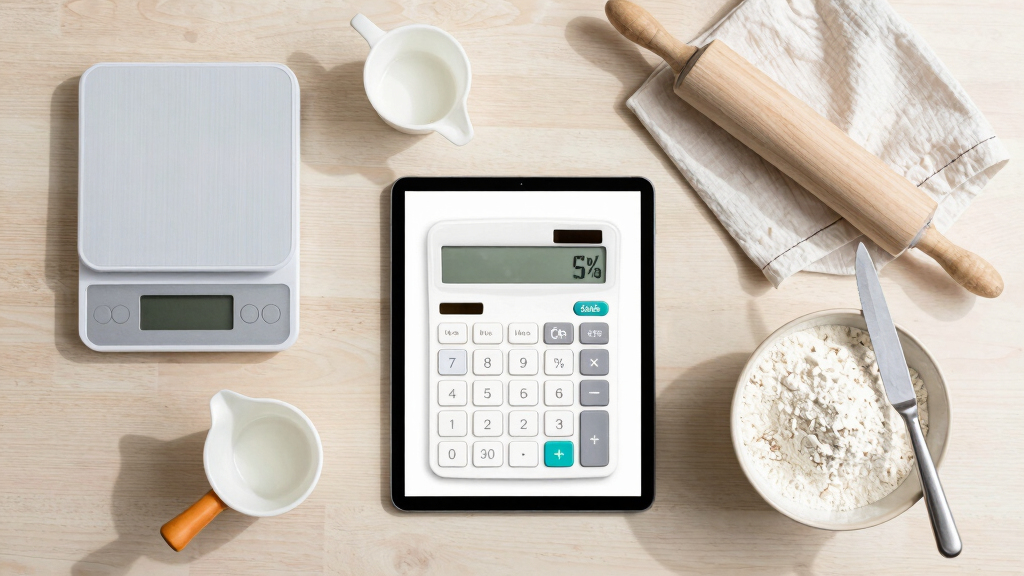
Using tools like scales and online calculators makes mastering the system easier and more accurate.
While powerful, the system requires practice—start small, experiment, and learn how ingredients relate.
The Baker’s Percentage System That Makes You Look Like a Pro
Baker’s percentage turns recipes into formulas. Flour is always 100%, and every other ingredient is measured against it, making scaling, troubleshooting, and consistent dough texture far easier.
The Core Formula
Baker’s percentage expresses each ingredient as a percentage of flour weight. Once a recipe is written this way, you can resize it without breaking its structure.
Weigh Everything
Use grams for flour, water, salt, yeast, fats, and additions. Weight removes the guesswork caused by packed cups or uneven scoops.
Set Flour to 100%
All other ingredients are divided by the flour weight, then multiplied by 100 to reveal their percentage.
Save the Formula
Record the percentages so the recipe becomes flexible, repeatable, and easier to adjust for texture or climate.
Traditional Recipe vs. Baker’s Formula
The difference is not just notation. Percentages make a recipe portable, scalable, and easier to diagnose when dough feels too stiff, too slack, or underseasoned.
| Decision Point | Traditional Recipe | Baker’s Percentage | Pro Impact |
|---|---|---|---|
| Ingredient format | 500g flour, 350g water, 10g salt | Flour 100%, water 70%, salt 2% | ✓ Relationships are instantly visible. |
| Scaling | Manual recalculation for every ingredient | Choose flour weight, then apply percentages | ✓ Batch size changes without imbalance. |
| Troubleshooting | Harder to spot why texture changed | Hydration, salt, yeast, and fat are comparable | ✓ Faster diagnosis and cleaner experiments. |
| Common risk | ~ Volume measures vary by packing | ✓ Weight-based precision | ✗ Skipping the scale weakens consistency. |
Choose Flour
Start with the batch size you want by selecting the total flour weight.
Apply Ratios
Calculate each ingredient from its percentage of the flour weight.
Adjust Texture
Move hydration up for openness or down for a tighter crumb.
Repeat Results
Document the formula so successful bakes become reproducible.
Hydration Is the Texture Dial
Water percentage shapes dough feel, fermentation behavior, crumb openness, and final chew. This is where baker’s percentage becomes a practical decision tool.
Crumb Spectrum
Lower hydration often produces a denser loaf with easier handling. Higher hydration can create a softer, more open crumb but demands better dough handling.
Calculators
Recipe apps and online calculators convert grams into percentages in seconds.
Percent Mode
Some digital scales support percentage-based input for faster formula work.
Hydration Control
Precise ratios make fermentation experiments cleaner and more repeatable.
Five Mistakes That Break the System
Percentages are simple, but they reward discipline. Most failed formulas come from weak measurement habits or missing notes.
-
1
Using volume instead of weight Cups and spoons vary by packing, humidity, and ingredient texture.
-
2
Forgetting flour is the anchor Every ingredient must be measured against flour, which remains 100%.
-
3
Skipping precise scales Small errors in salt, yeast, or water can change flavor and fermentation.
-
4
Overcomplicating the math A simple calculator or app keeps the workflow fast and consistent.
-
5
Failing to record the formula Notes turn one good bake into a repeatable professional process.
Trace the Professional Loop
What is the baker’s percentage system and why does it matter?
The baker’s percentage system is a way of expressing ingredient quantities relative to the flour weight, which acts as the foundational reference point. By setting the flour at 100%, all other ingredients—water, yeast, salt, fats—are expressed as a percentage of that flour weight. This approach allows bakers to see the relationships between ingredients at a glance, revealing how changes in one component affect the dough’s texture, flavor, and fermentation. For instance, a dough with 70% hydration (water is 70% of flour weight) will be softer and more extensible than one with 50%, influencing how easily it can be shaped and how the crumb develops. Recognizing these relationships is crucial because it helps bakers predict how dough will behave during mixing, fermentation, and baking, enabling precise adjustments for desired outcomes. It also facilitates scaling recipes up or down without losing the balance between ingredients, which is vital when adjusting batch sizes or experimenting with new formulations. Ultimately, this system transforms baking from a series of fixed recipes into a dynamic, scientific process where understanding the science behind ingredients leads to better results and more consistent quality.

Etekcity Food Kitchen Scale, Digital Grams and Ounces, 11lb
- Multiple Measurement Units: Supports oz, lb, fl oz, g, mL
- Tare Function Included: Zero out weight for accurate measurements
- Hassle-Free Operation: Includes 2 AAA batteries
As an affiliate, we earn on qualifying purchases.
As an affiliate, we earn on qualifying purchases.
How to convert your favorite recipes into baker’s percentages in 3 simple steps
- Write down the original recipe with all ingredient weights, ensuring accuracy to avoid miscalculations later. Precise measurements are essential because small errors can lead to significant deviations in dough behavior.
- Set the flour weight as 100%. For all other ingredients, divide their weight by the flour weight and multiply by 100. This step transforms your recipe into a flexible blueprint, making it easier to understand ingredient relationships and to modify proportions later. For example, if you have 600g of flour and 360g of water, the water percentage is (360/600)*100 = 60%. Recognizing these percentages helps you understand the hydration level and how it influences dough handling, elasticity, and bread texture. It also reveals how much salt, fat, or yeast is present relative to the flour, which impacts flavor development and fermentation speed.
- Adjust the percentages to create variations or scale the recipe. Increasing hydration (water percentage) results in a wetter, more open crumb, which can be desirable for artisanal loaves, but may require more skill to handle and shape. Conversely, decreasing it yields a firmer dough suitable for denser bread. By manipulating these percentages, you can tailor recipes to your preferences, ingredients, and environmental conditions, gaining greater control over the final product. This process also helps you understand tradeoffs—higher hydration can improve crumb openness but makes handling more challenging, while lower hydration yields a sturdier dough that’s easier to work with but may produce a denser crumb.
This conversion process not only simplifies experimentation but also deepens your understanding of how each ingredient impacts the final product. It enables you to troubleshoot issues—like dough that’s too sticky, not rising properly, or lacking flavor—by adjusting specific percentages rather than relying solely on trial and error. The more you practice converting and adjusting recipes, the more intuitive your baking becomes, turning science into an art.
As an affiliate, we earn on qualifying purchases.
Compare traditional recipes vs. baker’s percentage recipes — see the difference
| Aspect | Traditional Recipe | Baker’s Percentage Recipe |
|---|---|---|
| Measurement basis | By weight or volume, often inconsistent due to varying measuring methods | All ingredients expressed as % of flour, ensuring precise relationships regardless of scale |
| Scaling ease | Manual recalculation needed; scaling can introduce errors and inconsistencies | Simple—just change the flour weight and adjust other percentages accordingly, maintaining ingredient relationships |
| Understanding ingredient relationships | Less transparent; requires experience and trial to grasp how ingredients interact | Highly transparent; reveals hydration, salt, fat ratios, and their effects on dough behavior, making adjustments more predictable and precise |
| Use case | Home baking, following fixed recipes from cookbooks or family traditions | Professional baking, recipe development, and adjusting for different conditions or scales |
Using percentages transforms your approach from guesswork to a science. It provides a clear visual map of your dough’s makeup, enabling precise adjustments and consistent results. Think of it as moving from following a fixed recipe to understanding the blueprint behind it—giving you the power to innovate, troubleshoot, and refine your baking with confidence and clarity.
As an affiliate, we earn on qualifying purchases.
Frequently Asked Questions
How do I convert a traditional recipe into baker’s percentages?
Write down all ingredient weights, set the flour as 100%, then divide each ingredient by the flour weight and multiply by 100 to get their percentages. This creates a flexible blueprint for scaling and tweaking.Can I use the baker’s percentage system for all baked goods?
It’s most common in bread baking but adaptable for pastries and other products. Some recipes may need adjustments, especially when using ingredients that behave differently, like gluten-free flours.What tools or software help with baker’s percentages?
Many free online calculators, spreadsheets, and baking apps exist. A digital kitchen scale is essential for accuracy—measure everything in grams for best results.How does understanding baker’s percentages improve my baking?
It clarifies how ingredients relate, making it easier to troubleshoot, modify recipes, and produce consistent, reliable results every time.Are there challenges or limitations when using the system?
Yes. It can be tricky for beginners, especially with non-standard ingredients or volume measurements. Practice and patience are key to mastering it.As an affiliate, we earn on qualifying purchases.
Conclusion
Mastering the baker’s percentage system turns baking into a precise art. It’s like having a secret code that reveals how your dough really works. Once you get comfortable with it, you’ll bake with greater confidence, consistency, and creativity. So grab your scale and start experimenting—your perfect loaf is waiting.
Remember: baking isn’t just about following recipes. It’s about understanding the relationships between ingredients. That’s what makes you look like a pro—even when you’re just having fun in your kitchen.