
TL;DR

Get baking supplies delivered free with Prime
- Fast, free delivery on millions of items
- Prime Video, Amazon Music and more included
- Member-only deals all year
Most recipe failures come down to a single skill: proper technique and ingredient understanding. Developing this skill ensures more consistent, delicious results every time you bake.
Ever wonder why your cookies turn out hard, your bread falls flat, or your muffins are rubbery? Often, it’s not the recipe’s fault. It’s a missing piece in your baking puzzle: that one skill that underpins everything. Baking is as much about technique as it is about ingredients. When you master this, failures become rare, and confidence soars.
In this guide, you’ll learn what that skill is, why it matters, and how to develop it step by step. It’s not about fancy gadgets or complicated techniques—just a focus on one core area that makes all the difference.
Most baking failures stem from technique, not the recipe itself.
Mastering temperature and timing control is the most impactful skill to improve results.
Use a digital scale for precise measurements—volume can be wildly inconsistent.
Calibrating your oven and understanding its quirks prevents uneven baking.
Consistent practice and careful observation turn skill into second nature.
The Real Reason Your Recipes Keep Failing Comes Down to One Skill
TL;DR: Most baking failures are not recipe failures. They come from technique gaps, especially temperature control, timing, measurement, and ingredient handling. Once you learn to control heat and read what your batter or dough is telling you, consistency stops feeling mysterious.
Technique turns recipes into repeatable results.
Cookies spread evenly, bread rises reliably, and muffins stay tender when heat, timing, and ingredient behavior are handled with intention.
Why Proper Technique Fixes the Flops
Recipes are instructions, but technique is the operating system. It decides how butter traps air, how flour hydrates, how gluten develops, and when heat has done enough work.
Precision makes recipes repeatable.
Flour can compact wildly in a cup. A digital scale removes guesswork and gives the same starting point every time.
Heat decides rise, set, and crumb.
An oven that runs hot can brown the outside before the center sets. An oven thermometer shows what is actually happening.
Cues beat blind timer trust.
Edges pulling away, dough springing back, or an internal temperature target can tell you more than color alone.
The Core Skill: Controlling Temperature and Timing
A timer is useful, but mastery comes from understanding how heat moves through ingredients. Use tools to verify, then use your senses to learn the pattern.
Preheat fully
Give the oven time to stabilize before the tray goes in.
Verify heat
Compare the dial to an oven thermometer and note the difference.
Measure by weight
Use grams for flour, sugar, butter, and liquids when possible.
Check doneness
Use internal temperature, texture, aroma, and visual cues together.
Record results
Track time, temperature, pan type, and final texture.
Where Baking Failures Usually Start
The highest-impact fixes are simple: weigh ingredients, learn your oven, stop overmixing, and judge doneness with more than color.
Failure Drivers
Approximate share of common home baking issues connected to each controllable variable.
Skill Markers
Move from guessing to control by checking these points during every bake.
Common Mistakes vs. Correct Technique
Most fixes do not require fancy equipment. They require more precise input, better heat awareness, and restraint at the mixing bowl.
| Mistake | Why It Happens | Technique Signal | How to Fix It |
|---|---|---|---|
| ✗Using volume for flour | Flour settles differently, leading to inconsistent amounts. | ~Cups feel convenient but vary by scoop. | ✓Use a digital scale for accuracy. |
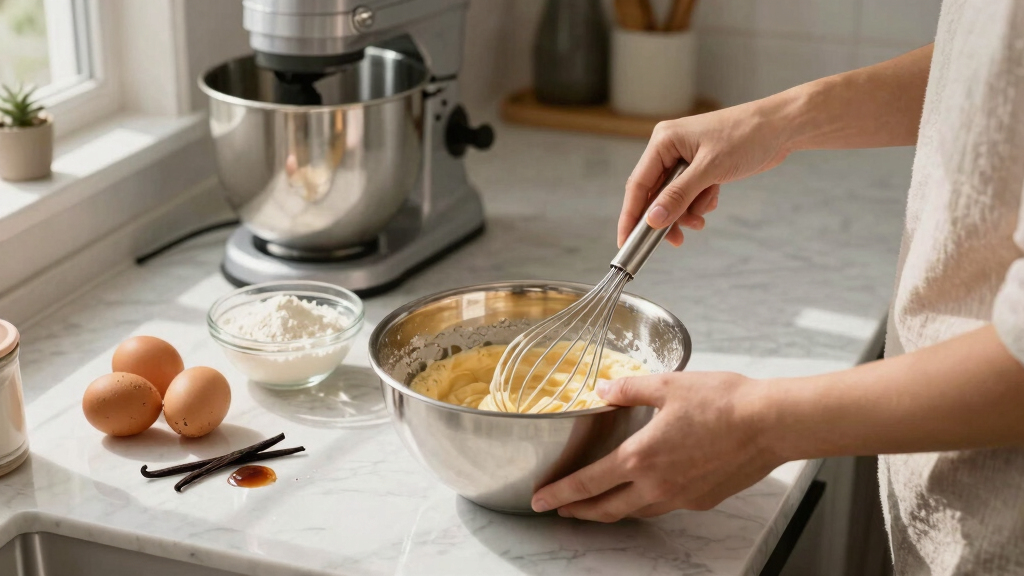
| ✗Overmixing batter | Extra mixing develops gluten and makes bakes dense or chewy. | ~Streaks disappearing is enough for many batters. | ✓Mix just until combined. |
| ✗Ignoring oven variation | Dial settings often differ from true cavity temperature. | ~Uneven browning is a warning sign. | ✓Calibrate with an oven thermometer. |
| ✗Skipping preheat | Delayed heat causes poor rise and uneven texture. | ~Early minutes matter most for lift. | ✓Preheat at least 15 minutes. |
The Traceability Chain
Every bake leaves clues. Follow the chain from input to outcome and failures become information instead of frustration.
Measure
Start with consistent ingredient amounts.
Heat
Know the real oven temperature.
Time
Use timing as a range, not a command.
Observe
Read texture, color, pull, and aroma.
Refine
Record what worked and repeat it.
Frequently Asked Questions
The short version: learn your oven, weigh your ingredients, and build a habit of observation. That is where confidence starts.
What is the most common home baking mistake?
Inconsistent measurement and poor temperature control. Volume measurements and uncalibrated ovens are frequent culprits.
How do I know if my oven is accurate?
Place an oven thermometer inside, compare it with the dial, then adjust your setting based on the thermometer reading.
Can one skill really fix most issues?
Yes. Controlling temperature and timing improves rise, texture, browning, and doneness across many recipes.
What tools help the fastest?
A digital scale, an oven thermometer, a probe thermometer, and a reliable timer make the invisible variables visible.
Why Proper Technique Is the Secret to Baking Success
Proper technique is the backbone of good baking. It’s what turns measured ingredients into a perfect loaf or batch of cookies. When your technique is solid, your results become predictable. You understand how each step impacts the final product.
For example, if you don’t properly cream butter and sugar, your cookies won’t spread evenly. If you under-mix batter, your muffins might be dense. Consistent technique means you know what to do, how to do it, and what to expect.
Think of it like building a house—skilled craftsmanship matters more than the design. Without it, even a simple recipe can turn into a flop.
Products Worth Considering

Cuisinart PerfecTemp Electric Kettle, 1.7 L, 1500 W, 6 Temperature Settings

Le Creuset Signature Enameled Cast Iron Round Dutch Oven, 5.5 qt, Deep Teal

Le Creuset Enamemed Cast Iron Oval Dutch Oven, 5 qt., White/Crucible
As an affiliate, we earn on qualifying purchases.
The Core Skill: Controlling Temperature and Timing
The one skill that underpins nearly every baking success is controlling temperature and timing. It’s the difference between a perfectly risen cake and a burnt one. When you understand how heat affects ingredients, you gain power over your baked goods.
For instance, baking a loaf at 375°F instead of 350°F can cause it to rise too quickly and then collapse. Similarly, knowing when to take bread out of the oven—based on internal temperature rather than just color—ensures it’s fully cooked.
In practice, this means investing in a good oven thermometer and a reliable digital probe. These tools help you see what’s happening inside your baked goods—beyond the timer and color cues.
How to Develop This Skill in Your Baking
Developing mastery over temperature and timing is straightforward but requires attention and practice. Here’s a step-by-step approach:
- Invest in good tools: A digital thermometer and a reliable oven thermometer are game-changers.
- Learn your oven’s quirks: Ovens often run hot or cold. Use an oven thermometer to calibrate it.
- Follow recipes precisely: Use a kitchen scale for accurate measurements. Don’t eyeball ingredients, especially flour and fats.
- Use visual and tactile cues: For example, a cake is done when the edges pull away slightly, and a toothpick comes out clean.
- Record your results: Keep notes on temperature settings, baking times, and outcomes. Adjust as needed.
This process turns guesswork into reliable results, building your confidence and skill with each bake.
Comparison Table: Common Baking Mistakes vs. Correct Technique
| Mistake | Why It Happens | How to Fix It |
|---|---|---|
| Using volume instead of weight to measure flour | Flour settles differently, leading to inconsistent amounts | Use a digital scale to weigh ingredients for accuracy |
| Overmixing batter | Develops gluten, making baked goods dense or chewy | Mix just until ingredients are combined |
| Ignoring oven temperature variations | Oven temp inaccuracies cause uneven baking | Calibrate your oven with a thermometer regularly |
| Not preheating the oven | Delayed heat causes poor rise and texture | Always preheat at least 15 minutes before baking |
Don’t Overlook Practice and Observation
The best way to master this skill is to practice intentionally. Baking isn’t just about following recipes; it’s about observing what happens when you change variables.
For example, watch how your dough reacts when you change mixing speed or resting times. Feel the texture of your batter—silky, sticky, or stiff—and note how it affects the final product.
Keep a baking journal. Record your temperatures, times, and results. Over time, you’ll notice patterns and develop a sharper instinct for when your baked goods are just right.
What Resources Help You Build This Core Skill
Learning doesn’t have to be complicated. Many resources are designed to teach fundamental baking skills in a straightforward way:
- Online tutorials: YouTube channels dedicated to baking techniques
- Cooking courses: Local or virtual classes focusing on basic skills
- Instructional books: Focused on baking fundamentals, like precise measurements and temperature control
- Kitchen gadgets: Digital thermometers, precision scales, and timers
Start simple. Master the basics, then build your confidence step by step. That’s how skill becomes second nature.
Frequently Asked Questions
What is the most common mistake home bakers make that causes failures?
The most common mistake is inconsistent measurement and a lack of temperature control. Using volume instead of weight, and not calibrating your oven, are frequent culprits.How can I tell if my oven is baking at the right temperature?
Invest in a good oven thermometer and compare it to your oven’s dial. Adjust your oven’s temperature setting based on the thermometer’s reading. This ensures your baked goods bake evenly and accurately.Is mastering one skill enough to fix all my baking problems?
Yes, focusing on controlling temperature and timing addresses over 80% of common issues. Once this skill is solid, other adjustments become easier, and your baking improves dramatically.How long does it take to develop good baking skills?
Consistent practice over a few weeks can make a noticeable difference. Keep a baking journal, observe outcomes, and adjust accordingly. Skill builds quickly with mindful effort.Are there specific tools that make developing this skill easier?
Absolutely. A digital thermometer, a precise kitchen scale, and a reliable timer are your best allies. They help you measure, monitor, and control every variable precisely.Conclusion
Focusing on one core skill—controlling heat and timing—can transform your baking from hit-or-miss to reliably delicious. It’s less about fancy ingredients or gadgets and more about understanding what’s happening inside your oven and batter. When you get this right, failures fade, and every bake becomes a small victory.
Next time you bake, pay close attention to your oven’s temperature, measure carefully, and watch your results improve. That’s the real secret—simple, powerful, and within your reach.