
TL;DR
Recipes specify particular salt types because of differences in crystal size, density, and dissolution rate, not flavor. Using the right salt ensures accurate seasoning, proper texture, and consistent results, especially in baking and curing. Converting between salts by weight or brand prevents surprises in taste and texture.
Ever added what looked like the same amount of salt to two different recipes, only to end up with wildly different tastes? That’s because not all salts are created equal. It’s not just about flavor—it’s about how the salt behaves in your kitchen.
Understanding why recipes specify certain salts helps you become a more precise cook, whether you’re baking bread or curing meat. You’ll learn how crystal size, dissolution speed, and texture influence your results—and how to handle these differences confidently.
Crystal size and packing density are the main reasons recipes specify certain salts, not flavor.
Measuring salt by weight guarantees consistent results, especially with different salt types.
Dissolution rate affects how evenly salt distributes during cooking or baking.
Use additive-free salt for pickling and curing to avoid clouding brines or compromising safety.
Choose your salt based on application: coarse for dry-brining, fine for baking, flaky for finishing.
Why Some Recipes Demand Specific Salt Types
The difference is rarely flavor. Crystal size, packing density, dissolution speed, and additives determine how much salt reaches the food—and how evenly it behaves once it gets there.
A teaspoon is a shape test, not a salt standard.
Small crystals settle closely together. Large flakes trap air. The spoon looks equally full, but the mass of salt can differ dramatically.
Table salt
Compact crystals deliver the largest dose per teaspoon and dissolve rapidly.
Morton kosher
Denser than many other kosher salts, so brand-specific recipes matter.
Diamond Crystal
Light, pinchable crystals occupy more space for the same salt mass.
Finishing salt
Designed for surface crunch and visual impact—not volume conversion.
Salt delivered by one level teaspoon
Relative mass / table salt = 100%precision kitchen scale for salt measurement
As an affiliate, we earn on qualifying purchases.
As an affiliate, we earn on qualifying purchases.
Choose salt for the job it must perform.
Crystal geometry influences handling, adhesion, dissolution, distribution, and the final eating texture.
Use fine salt
Small crystals dissolve quickly and distribute evenly. In bread, precise salt levels also regulate fermentation and strengthen gluten.
Use kosher salt
Coarse crystals are easy to pinch, spread, and see. They cling well to meat and offer tactile control during seasoning.
Use flaky salt
Large flakes provide a concentrated surface crunch and visual sparkle. Stirring them into food wastes their defining quality.
Read the recipe
Identify salt type, brand, volume, or gram amount.
Check the job
Mixing, brining, curing, preserving, or finishing?
Match the crystal
Fine for speed, coarse for control, flaky for texture.
Convert by mass
Match the intended grams—not the apparent spoonful.
Apply evenly
Distribute according to the recipe’s timing and method.
coarse sea salt for curing
As an affiliate, we earn on qualifying purchases.
As an affiliate, we earn on qualifying purchases.
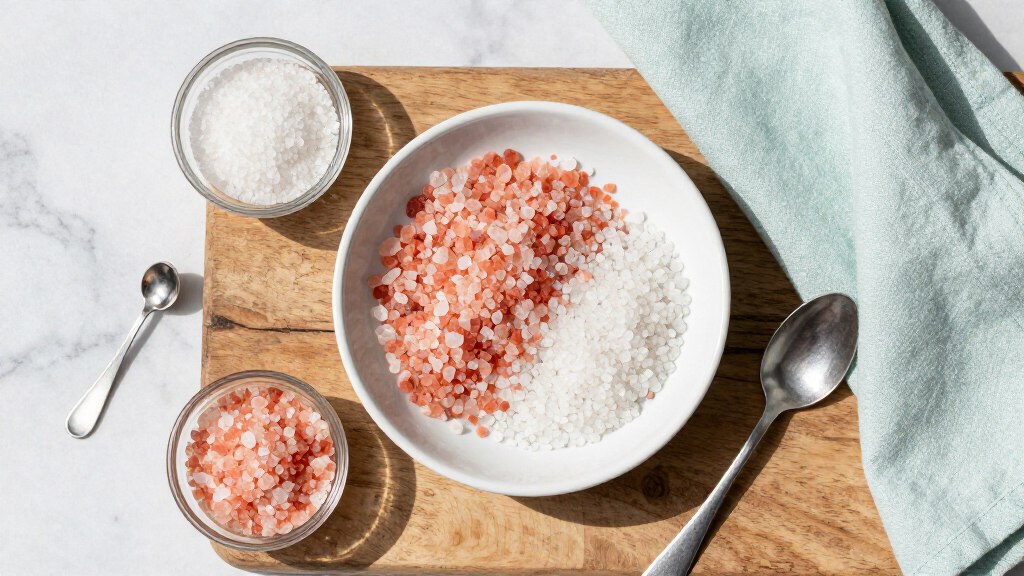
One mineral. Very different kitchen behavior.
Kosher salt takes its name from koshering meat—not from being inherently more kosher than other salt.
| Salt type | Crystal behavior | Best use | Baking | Dry-brining | Finishing |
|---|---|---|---|---|---|
| Fine table / fine sea | Dense, rapid dissolution | Doughs, batters, sauces | ✓ Excellent | ~ Usable | ✗ No crunch |
| Kosher salt | Coarse, easy to pinch | Hand seasoning, meat | ~ Weigh first | ✓ Excellent | ~ Moderate |
| Flaky finishing salt | Large, delicate flakes | Table-side texture | ✗ Uneven | ✗ Inefficient | ✓ Excellent |
| Pickling salt | Fine, additive-free | Clear preserving brines | ✓ By weight | ~ Possible | ✗ No texture |
| Curing salt | Measured nitrite/nitrate blend | Approved meat-curing recipes | ✗ Never | ✗ Not ordinary salt | ✗ Never |
finely ground baking salt
As an affiliate, we earn on qualifying purchases.
As an affiliate, we earn on qualifying purchases.
Sometimes the specified salt protects more than flavor.
Preserving and curing are the important exceptions where salt composition—not merely crystal geometry—can affect quality or safety.
Keep brines clear
Iodine and anti-caking agents may cloud brines or alter the color and texture of preserved foods. Use additive-free pickling salt when directed.
Follow exact formulas
Prague Powder #1 and #2 contain controlled nitrite or nitrate. They are specialty curing ingredients with precise, recipe-specific doses.
Iodized has a purpose
Iodization began in the United States in 1924 to combat iodine-deficiency goiter and remains an important public-health measure.
Curing salt is not interchangeable with table, kosher, sea, or pickling salt. Use only the exact curing product and quantity required by a tested recipe.
flaky finishing salt
As an affiliate, we earn on qualifying purchases.
As an affiliate, we earn on qualifying purchases.
Keep the grams constant when the crystals change.
Brand-to-brand variation makes universal teaspoon conversions approximate. A scale removes the guesswork.
Precision begins before the first pinch.
Texture and appearance differ, but pure culinary salts deliver essentially the same saltiness when compared by equal weight.
Crystal size and packing density are the main reasons recipes name a salt.
Measure by weight for reliable baking, brining, and brand substitutions.
Dissolution speed determines how evenly salt spreads through food.
Use additive-free salt where tested pickling guidance calls for it.
Match texture to purpose: fine inside, coarse for handling, flaky outside.
Common salt-switching questions
The safest culinary habit is simple: preserve the recipe’s salt mass, then choose the crystal shape that suits the technique.
Can table salt replace kosher salt?
Yes for ordinary cooking, but not teaspoon for teaspoon. Fine salt is denser, so match the original grams.
Why was my dish too salty or bland?
You likely changed salt types or kosher-salt brands without adjusting for their different packing densities.
Are gourmet salts healthier?
Sea, pink, and other gourmet salts remain mostly sodium chloride. Their trace minerals are generally nutritionally negligible.
Which salt is best for baking?
Fine table or fine sea salt distributes most evenly. For repeatable results, weigh it and follow the recipe’s gram amount.
Why Crystal Size and Density Are The Real Reasons Recipes Specify Salt Types
In the kitchen, the biggest difference isn’t flavor—it’s how the salt is shaped and packed. Fine table salt is dense and tiny, fitting tightly into a spoon. Flaky salts like Maldon are large and light, filling a spoon with air. This impacts how much salt you actually add.
For example, a teaspoon of fine salt weighs about 6 grams, while a teaspoon of flaky Maldon weighs less than 1 gram. That means if a recipe calls for 1 teaspoon of salt, using flaky salt instead of fine salt can leave your dish under-salted or overly salty if you don’t adjust.
According to Aromas Healthy Bake, understanding crystal size and density helps you measure more accurately—by weight rather than volume—avoiding salty surprises.
How Volume vs. Weight Measurements Make a Difference in Salt Use
Most home cooks rely on volume—spoons and cups—to measure salt. But salt’s weight varies with crystal size and packing. That’s why professional chefs prefer weighing salt in grams or ounces. It’s the only way to guarantee consistency.
For instance, one teaspoon of Morton kosher salt weighs around 4.8 grams, whereas the same teaspoon of Diamond Crystal kosher salt weighs about 2.8 grams. If a recipe calls for 10 grams of salt, using teaspoons can lead to big differences unless you know the brand and salt type.
By switching to a kitchen scale, you can precisely match the recipe’s intended salt content—making your baked bread, pickles, or roasted vegetables turn out just right every time.
Dissolution Rate: Why Fine Salt Dissolves Faster Than Flaky or Coarse Salt
Ever noticed how fine salt dissolves quickly into water or dough? That’s because smaller crystals have more surface area, which speeds up dissolution. Coarse or flaky salts dissolve more slowly, sometimes leaving uneven salt pockets in baked goods or sauces.
Imagine sprinkling flaky sea salt on roasted vegetables. The crystals sit on the surface, crunching and catching the light. But if you use coarse salt in a batter, it might not fully dissolve—creating pockets of saltiness or uneven flavor.
According to Aromas Healthy Bake, choosing the right salt for the application prevents these issues. Fine salt blends seamlessly into batters, while flaky salts shine as finishing touches.
Why Additives in Salt Matter for Pickling, Curing, and Baking
Not all salts are pure sodium chloride. Table salt often contains anti-caking agents and iodine. These additives can cloud pickling brines or affect the color and texture of your canned goods. For example, iodine can turn pickles slightly darker or duller.
Special salts like pickling salt are free of additives, making them ideal for preserving. Curing salts—like Prague Powder—contain sodium nitrite and are essential for safe meat preservation. These are *not* interchangeable with regular salts and should be used precisely as directed.
At Aromas Healthy Bake, we emphasize using the right salt for the job—clean, additive-free salt for pickling, and specific curing salts for meats—to ensure safety and quality.
Texture and Application: When to Use Kosher, Flaky, or Fine Salt
Salt’s texture isn’t just about aesthetics—it influences how you season. Kosher salt’s coarse crystals are perfect for pinching, rubbing, and dry-brining because they stick well and give you tactile control.
Finishing salts like fleur de sel or Maldon add a delicate crunch and visual appeal. These are best sprinkled at the end of cooking or right before serving. Using flaky salt during baking or in dough can be a waste—it doesn’t dissolve quickly enough and won’t distribute evenly.
Imagine seasoning a roasted chicken. Pinching kosher salt over the skin gives you control, while sprinkling flaky sea salt on a finished dish adds a subtle crunch and sparkle.
Converting Salt Types: How to Adjust for Different Salt Densities and Crystals
Switching between salt types isn’t as simple as swapping teaspoons. To keep your dishes consistently seasoned, convert salt amounts by weight. For example, 1 teaspoon of Morton kosher salt (about 4.8 grams) equals roughly 2 teaspoons of Diamond Crystal (about 2.8 grams).
Here’s a quick guide:
| Salt Type | Weight per teaspoon | Conversion tip |
|---|---|---|
| Table salt | 6 grams | Use half the volume of kosher or flaky salt for same saltiness |
| Morton kosher salt | 4.8 grams | Adjust volume based on grams for recipes |
| Diamond Crystal kosher salt | 2.8 grams | Use approximately double the volume to match saltiness of finer salts |
By weighing your salt, you avoid the pitfalls of volume discrepancies, especially when following precise baking recipes or curing protocols.
Frequently Asked Questions
Can I substitute table salt for kosher salt?
Yes, but you need to adjust for density. Typically, use about half as much table salt as a recipe calls for in volume of kosher salt. For best accuracy, weigh the salt to match the grams specified in the recipe.
Why did my dish turn out too salty or bland?
Most likely, you swapped salt types without adjusting the volume. Different salts pack differently, so a teaspoon of flaky salt isn’t the same as a teaspoon of fine salt in terms of saltiness.
Is sea salt or Himalayan pink salt healthier than table salt?
No. Their sodium content is similar, and trace minerals in gourmet salts are negligible in nutritional value. The main difference is texture and appearance, not health benefits.
Which salt should I use for baking?
Use fine salt—either table salt or fine sea salt—for baking. Measure by weight for consistency. Coarser salts can cause uneven seasoning or texture issues in baked goods.
How do I convert salt amounts between types?
Use the grams-per-teaspoon weights: about 6 grams for table salt, 4.8 grams for Morton kosher, and 2.8 grams for Diamond Crystal. Weighing your salt ensures perfect conversion regardless of crystal size.
Conclusion
Remember, your choice of salt isn’t just about taste—it’s about precision and control. Using the right type at the right moment transforms a good dish into a perfect one.
Next time you reach for the salt shaker, think about crystal size, texture, and purpose. Your palate—and your recipes—will thank you for it.