
TL;DR

Get baking supplies delivered free with Prime
- Fast, free delivery on millions of items
- Prime Video, Amazon Music and more included
- Member-only deals all year
Choosing piping tips depends on shape, scale, icing consistency, and technique. Small tips suit fine details, larger tips cover big areas quickly, and matching them with the right icing consistency makes decorating smoother and more precise.
When you pick the right piping tip, your decorating game instantly improves. It’s like choosing the right brush for a painting—small change, big impact. But with dozens of shapes and sizes out there, how do you know which to reach for?
This guide will walk you through how to choose piping tips based on what you want to create, the size of your project, and the icing you’re working with. Whether you’re adding delicate flowers or bold borders, understanding the nuts and bolts of tips makes decorating easier and more fun.
Match your piping tip shape and size to your design’s scale and detail level.
Use icing with the right consistency—stiff for flowers, medium for borders, thin for flooding or writing.
A small core set of tips can handle most decorating projects, saving time and money.
Practice on parchment to perfect your technique before decorating the actual cake.
Adjust pressure, angle, and icing temperature to get clean, sharp details.
How to Pick Piping Tips for Different Decorations
Choosing a piping tip depends on shape, scale, icing consistency, and technique. Small tips suit fine details, larger tips cover big areas quickly — and matching them with the right icing makes decorating smoother and more precise. Like choosing the right brush for a painting: small change, big impact.
Nine Tip Families, Nine Personalities
Tip numbers aren’t standardized across brands — compare the opening’s shape and dimensions rather than the number alone. Each family below is tailored to specific decorating needs.
Round
Writing, dots, outlines, beads, lace, and filling pastries. Clean, simple lines — the foundation of most piping techniques. Hold close to the surface for lines, vertically for dots.
Open Star
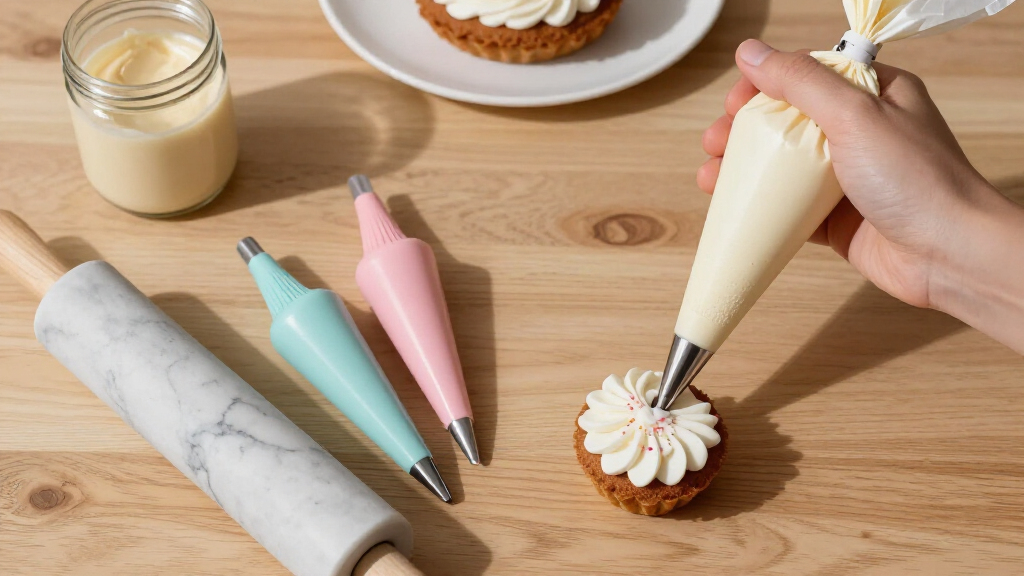
Swirls, rosettes, shells, borders, and cupcake frosting. Wide ridged openings create classic star patterns. Maintain steady pressure while moving.
Closed Star
Deeper ridges for dramatic shells, drop flowers, and bold swirls. Sharper, more compact ridges than open star — keep pressure even so ridges stay defined.
Petal
An elongated opening for realistic roses, ruffles, ribbons, and bows. Keep the narrow edge facing outward; the wide edge stays against the cake for ruffles.
Leaf
V-shaped opening forms pointed edges for leaves, vines, and accents. Squeeze, pull, and release to form a sharp point. Pinch a parchment bag into a V for ultra-fine leaves.
Drop-Flower
Quick one-squeeze flowers, perfect for cookies or mass production. Hold vertically; twist only if the design calls for it. Fast, though less refined than hand-piped blooms.
Basketweave
Flat, ridged-on-one-side tips for woven patterns, ribbons, and textured borders. Alternate horizontal strips over vertical lines — a steady hand gives a professional woven look.
Multi-Opening
Multiple tiny openings mimic grass, fur, hair, and nests. Short pulls create grass; longer strands create hair. Pull away while releasing pressure.
Specialty / Russian
Tulips, flower clusters, ruffles, and novelty shapes in a single squeeze. Pipe straight onto the surface, then stop pressure before lifting for clean release.
Match Tips to Projects in 4 Steps
Picking the right tip isn’t about guessing. Follow these four steps for confident choices every time.
Identify Shape & Scale
Tiny flowers or large borders? Small tips for detail, big tips for coverage — prevents uneven, unprofessional results.
Check Icing Consistency
Thin for writing, medium for borders, stiff for flowers. Too soft and it spreads; too stiff and lines break.
Match Tip to Design
Round for writing, star for textured borders, petal for roses — and consider how shape interacts with pressure and stiffness.
Test on Parchment
Squeeze a sample first. Learn the pressure needed and whether icing needs adjusting — before touching the cake.
How Tip Size Changes Style and Speed
Size is a tradeoff between precision and coverage. A #1 round creates delicate lace; a #16 star whips up a bold cupcake swirl in seconds. Larger tips dramatically cut decorating time; small tips demand patience but deliver control.
| Tip Size | Use Case | Effect |
|---|---|---|
| #1–#3 | Fine details, writing, tiny flowers, lacework, flower centers | Precise, delicate, slow |
| #4–#8 | Borders, rosettes, leaves, petals, smaller flowers | Versatile, moderate speed |
| #10–#16 | Cupcake swirls, large flowers, full coverage | Bold, quick, less detailed |
Icing Consistency Matters as Much as the Tip
You can have the perfect tip, but if your icing isn’t right, your decorating will suffer. Tip and icing must work together like dance partners — consistency determines flow, shape retention, and stability.
Writing & Fine Details
Small round tip + slightly thinner icing. Too thin, and lines spread uncontrollably.
Cupcake Swirls
Large open-, closed-, or French-star tip. Larger tips give full coverage with fewer rotations.
Roses & Realistic Flowers
Petal tips in several sizes, often on a flower nail — small for centers, large for outer petals.
Shell Borders
Star tip + medium-stiff icing. Pressure forms the head; release while pulling forms the tail.
Grass, Fur & Hair
Multi-opening tip: short pulls for grass and fur, longer strands for hair.
One-Step Flowers
Russian-style tips create full flowers in one squeeze — but require stiff icing and close cake contact.
The Decorator’s Cheat Sheet
Match tip shape and size to your design’s scale and detail level — small for precision, large for coverage.
Use the right icing consistency: stiff for flowers, medium for borders, thin for flooding or writing.
A small core set of tips — round, open star, petal, leaf, basketweave — can handle most decorating projects.
Practice on parchment to perfect pressure and angle before decorating the actual cake.
Adjust pressure, angle, and icing temperature to get clean, sharp details every time.
What are the main types of piping tips, and what makes each one special?
Knowing the different styles of piping tips is your first step. Each shape has a unique look and purpose, and choosing the right one can transform a simple cake into a work of art.
Here’s a quick rundown of the most common types:
- Round tips: Perfect for writing, dots, beads, and lace. They produce clean, simple lines or tiny circles. These tips are fundamental because they form the basis for many piping techniques, and mastering their use allows for precise detailing.
- Open star tips: Ideal for swirls, rosettes, shells, and borders. Their wide, ridged openings create textured, star-shaped patterns. They are versatile for both decorative borders and focal flowers, but the choice between open and closed star tips determines the texture and depth of your design.
- Closed star tips: Similar to open-star but with deeper ridges, perfect for dramatic shells and flowers. The more pronounced ridges allow for bolder, more textured effects, which can be crucial in creating dimensional floral designs or striking borders.
- Petal tips: Shaped like a small, elongated opening. Use these for realistic roses, ruffles, and flower petals. Their shape influences the natural appearance of flowers; choosing the right petal tip can make the difference between a convincing flower and an artificial-looking one.
- Leaf tips: Designed to mimic leaves, with a V-shaped opening that forms pointed edges. Proper use of leaf tips can add a natural flourish to your decorations, but understanding the pressure and angle needed will help produce realistic foliage.
- Drop-flower tips: Quick, one-squeeze flowers ideal for cookies or quick decoration. These are excellent for mass production or when time is limited, but they can sometimes lack the finesse of hand-piped flowers, so knowing when to use them is key.
- Basketweave tips: Flat with ridges, great for textured ribbons and woven patterns. Mastering these tips can lend a professional, woven look to your cakes, but they require a steady hand and consistent pressure to achieve uniformity.
- Multi-opening tips: Mimic fur, grass, or hair, with multiple tiny openings for textured effects. Their versatility hinges on how you manipulate pressure and movement, and understanding their potential can elevate your textural effects significantly.
Each of these tips is tailored for specific decorating needs. Choosing the right one depends on what you want to achieve—more on that in the next sections.
Products Worth Considering

Cuisinart SM-50R 5.5-Quart Stand Mixer, Ruby Red

Weber Genesis E-415 4-Burner Propane Gas Grill, Black

KitchenAid Go Cordless Citrus Juicer with Battery, KCJR161BM
As an affiliate, we earn on qualifying purchases.
How to match piping tips to your decorating project in 4 simple steps
Picking the right tip isn’t about guessing. Follow these four steps for confident choices every time:
- Identify your decoration’s shape and size. Are you making tiny flowers or large borders? Small tips for detail, big tips for coverage. Recognizing the scale of your design helps prevent over- or under-utilizing your tools, which can lead to uneven or unprofessional results.
- Consider your icing’s consistency. Thin for writing, medium for borders, stiff for flowers. The wrong icing makes even the best tip struggle. The consistency affects how the icing flows and holds shape—too soft and it spreads, too stiff and it won’t squeeze smoothly, which can cause uneven lines or breakage.
- Match the tip shape to your design. Use round tips for writing, star tips for textured borders, petal tips for roses. The shape directly influences the visual outcome, but also consider how the shape interacts with pressure and icing stiffness for optimal results.
- Test on a scrap or paper first. Practice makes perfect. Squeeze a bit of icing and see how the tip performs before working on your cake. This step helps you understand how much pressure to apply and whether the icing needs adjusting, saving you from costly mistakes on your final project.
Deeply understanding these steps allows you to anticipate how your chosen tools will perform, minimizing surprises and maximizing the quality of your decorations. For example, selecting the correct tip and icing stiffness together can mean the difference between a smooth, professional finish and a messy, uneven one. Consistent practice with these principles develops your intuition, making decorating more intuitive and less stressful.
How tip size affects your decorating style and speed
The size of your piping tip dramatically influences your decorating style and how quickly you finish. A small tip (like a #1 or #2) delivers precision but takes longer. Larger tips (like #12 or #16) cover more area fast but with less detail. This tradeoff impacts both the aesthetic and efficiency of your work.
Imagine piping a border: a tiny round tip creates a delicate, narrow line—perfect for refined finishes. A large star tip, however, can whip up a bold, fluffy border in seconds, ideal for cupcakes or bold statements. Understanding this tradeoff helps you plan your decorating process, balancing speed and style to match your skill level and project timeline.
Here’s a comparison table to help you decide:
| Tip Size | Use Case | Effect |
|---|---|---|
| #1–#3 | Fine details, writing, tiny flowers | Precise, delicate, slow |
| #4–#8 | Borders, rosettes, leaves | Versatile, moderate speed |
| #10–#16 | Cupcake swirls, large flowers, coverage | Bold, quick, less detailed |
Choosing the right size is about understanding the implications for your workflow. Larger tips can dramatically reduce decorating time, which is advantageous for mass production or when working under time constraints. Conversely, small tips demand patience but offer the control needed for intricate, refined designs. Recognizing these tradeoffs helps you develop a more strategic approach to decorating, ensuring efficiency without sacrificing quality.
Why icing consistency is just as important as your piping tip
You can have the perfect tip, but if your icing isn’t right, your decorating will suffer. The two must work together—like a dance partner and their partner’s moves. The interplay between tip shape and icing consistency determines the final look, texture, and stability of your decorations.
Thin icing flows easily but can spread and lose ridges, making it suitable for flooding or smooth writing but less ideal for textured flowers. Stiff icing holds shape well and creates defined edges, but if too stiff, it can be difficult to squeeze and may cause cracks or uneven lines. The choice of consistency affects how well your icing responds to pressure and how it reacts with the shape of your tip, ultimately impacting the precision and appearance of your designs.
Understanding the implications of icing consistency helps you troubleshoot common issues—like bleeding, sagging, or cracking—and adapt your technique accordingly. For instance, a softer royal icing might be perfect for delicate piping but needs careful handling to prevent collapsing. Conversely, buttercream that’s too warm becomes too soft, losing definition, so chilling or adjusting ingredients becomes necessary. Mastering this balance ensures your decorations are both visually appealing and structurally sound, elevating your overall cake artistry.
How to pick the right piping tip and icing combo for your decorating style
Matching your tip and icing isn’t just about shape—it’s about how they work together to produce your desired look. For delicate flowers, use stiff icing with petal tips. For smooth, sleek borders, medium icing with star tips is best. The right combination ensures your design is both beautiful and structurally sound.
Here are some real-world examples:
- Creating a rosette border on a cupcake? Use an open-star tip with medium-stiff icing for a lush, textured swirl. The stiffness helps maintain shape, while the open star shape creates volume.
- Designing realistic roses? Pick a petal tip with stiff icing, and pipe with a steady, gentle motion. The stiffness prevents the petals from collapsing, and the shape mimics natural petals more convincingly.
- Decorating cookies with fine outlines? Use a small round tip and thin icing for precision without blobs. Thinner icing flows smoothly through small openings, enabling detailed work.
Understanding how to pair your tools effectively makes a significant difference in your results. Proper pairing reduces mistakes, speeds up your workflow, and helps achieve consistent, professional-looking decorations. Experimentation with different combinations will deepen your understanding of how each element interacts, allowing you to develop your unique style with confidence.
Common pitfalls and how to avoid ruining your piping projects
Piping can be tricky, especially when things go wrong. Here’s what to watch out for:
- Choosing the wrong tip shape or size: Always match your tip to your design—don’t force a large tip for tiny details. Using an ill-suited tip can lead to uneven lines, blobs, or unrefined results, which can be frustrating and time-consuming to fix. Recognizing the importance of selecting the proper shape and size prevents these issues from the start, saving you time and frustration later.
- Using icing at the wrong consistency: Too soft, and your details bleed or flatten; too stiff, and you risk tearing or cracking the icing, or struggling to squeeze it out. Proper consistency ensures smooth, controlled piping and clean edges. Understanding the tradeoffs between flow and holdability allows you to troubleshoot and adapt quickly, ensuring your decorations look polished.
- Overfilling the bag: It’s tempting to fill it to the brim, but this reduces control and increases air pockets, which cause uneven piping and bursts. Properly filling and not overstuffing your bag improves control and reduces mess. Developing a technique for filling your bag efficiently minimizes air bubbles and maintains consistent pressure for cleaner lines.
- Ignoring temperature: Warm icing softens quickly, making it hard to maintain shape. Keep buttercream chilled and start with cold tools to preserve the integrity of your decorations. Awareness of temperature fluctuations helps prevent melting or sagging, especially in warm environments or during longer decorating sessions.
- Improper technique: Holding the tip at the wrong angle or pulling away too early causes peaks or gaps. Consistent, controlled pressure and correct angle are essential for polished results. Practicing proper hand positioning and steady pressure builds muscle memory, leading to more uniform and professional results over time.
To avoid these issues, test your setup on parchment first, keep your icing at the right temperature, and practice steady, controlled pressure. Patience and attention to detail are your best allies. Recognizing common mistakes and understanding how to troubleshoot them will significantly elevate your decorating skills and reduce waste and frustration.
Which piping tips should beginners start with? A simple, effective set
If you’re just starting out, don’t drown in a sea of tips. A core set of about five to eight tips covers most basic decorating needs. Here’s what to include:
- One small round tip for writing and tiny details
- One medium round tip for outlines and filling
- One medium open-star tip for swirls and borders
- One large star tip for cupcakes or bold accents
- One petal tip for flowers and ruffles
- One leaf tip for greenery and accents
- One multi-opening tip for textured effects like grass or fur
Choosing tips from the same manufacturer makes interchangeability easier, especially with a good-quality coupler. This curated set simplifies decision-making, reduces confusion, and helps you learn the nuances of each shape and size. Building a foundational collection allows you to master basic techniques, understand how different tips behave, and develop your confidence before expanding your toolkit with more specialized options.
Frequently Asked Questions
Are piping-tip numbers universal?
No, tip numbers vary among manufacturers, and similar numbers can have different shapes and sizes. Always check the manufacturer’s chart and inspect the opening before use.
Which tip is best for cupcake frosting?
A large open-star, closed-star, or French-star tip is ideal. These tips quickly produce fluffy, professional-looking swirls and borders, perfect for cupcakes and small cakes.
Which tip makes rosettes?
An open-star tip is classic for rosettes. For sharper, more compact rosettes, a closed-star tip works well. Practice the motion and pressure to get even, beautiful spirals.
What tip should I use for writing?
A small round tip, such as #1 or #2, is best. Thin your icing slightly for smooth, continuous lines, and practice on parchment to perfect your lettering.
Which tip makes roses?
Petal tips are designed for roses. Use them with stiff icing, starting from the center and working outward, keeping the narrow edge facing outward for realistic petals.
Conclusion
Choosing the right piping tip is like selecting the perfect brush for a painting. It’s about understanding your tools and your desired outcome. When you match tip shape, size, and icing consistency, your decorating becomes more confident and impressive.
Next time you bake, think of your piping tips as your creative partners—each one ready to bring your vision to life. Pick wisely, practice often, and enjoy the process of making every cake uniquely yours.