TL;DR

Get baking supplies delivered free with Prime
- Fast, free delivery on millions of items
- Prime Video, Amazon Music and more included
- Member-only deals all year
Rolling dough evenly is achievable with the right tools, proper chilling, and consistent technique. Using guides, light flour, and rotation helps prevent sticking and uneven thickness, making every bake turn out perfect.
Imagine this: you’re ready to roll out your pie crust, but it stubbornly shrinks, sticks, or turns uneven. Frustrating, right? But what if you could tame that dough, make it flat and smooth, without a fight every time?
In this guide, you’ll discover straightforward techniques and tools that turn baking frustration into confidence. Whether you’re making cookies, pies, or pizza, these tips will help you roll dough evenly and effortlessly—saving time and making your baked goods look professional.
Rest dough in the fridge for at least 30 minutes to improve elasticity and prevent shrinking.
Use adjustable guides or rings to maintain a consistent thickness across the entire dough.
Apply gentle, even pressure from the center outward and rotate the dough regularly.
Lightly flour the surface and rolling pin to prevent sticking without altering dough texture.
Patience and practice are your best tools—don’t rush the process.
Why Even Dough Thickness Matters More Than You Think
Even dough thickness ensures your baked goods cook uniformly. When parts of your dough are thicker, they take longer to bake, which can lead to uneven textures—crisp edges with undercooked centers or burnt spots. Think of it like cooking a thick steak: if parts are uneven, some areas might burn while others remain raw. Achieving consistent thickness is about control, allowing heat to penetrate evenly, resulting in perfectly cooked treats every time.
For example, a pie crust that’s uneven may cause the filling to cook unevenly, leading to a soggy bottom or underdone edges. Similarly, cookies with inconsistent thickness spread differently and bake at different rates, affecting their texture and appearance. The tradeoff is that focusing on even rolling requires patience and attention, but the payoff is a professional-looking, reliably baked product with the desired texture.
Products Worth Considering

Vitamix Propel Series 750 Professional-Grade Blender, 4 Programs, Black

De'Longhi Linea Classic Espresso Machine with Adjustable Milk Frother

Vitamix 5200 Professional-Grade Blender, 64 oz. Container, Black
As an affiliate, we earn on qualifying purchases.
Tools That Make Even Dough a Breeze
The right tools are the foundation of consistent results. A high-quality, sturdy rolling pin provides better control and less wobble, making it easier to apply even pressure. Adjustable rings or guides act like training wheels—they set a specific thickness, preventing you from rolling too thin or thick without realizing it. For instance, if you set a guide to 1/8 inch, every pass will be at that height, ensuring uniformity across the entire dough.
Using a silicone baking mat or parchment paper creates a smooth, non-stick surface that reduces the need for excess flour, which can make dough dry and tough. Imagine trying to roll dough on a sticky surface versus a slick silicone mat—your control improves, and cleanup is easier. Also, chilling your dough in the fridge for at least 30 minutes firms it up, making it less elastic and less prone to shrinking or tearing when rolled. This step is crucial because warm dough tends to be more elastic, stretching and shrinking as you work with it, much like trying to stretch warm bubble gum.
How to Roll Dough Evenly in 5 Simple Steps
- Chill the dough for at least 30 minutes. Cold dough is less elastic and more stable, making it easier to roll out evenly without shrinking or tearing. For example, if you’re making a pie crust, refrigerate it until firm—this prevents the dough from stretching or becoming too elastic, which can cause uneven thickness.
- Lightly flour your surface and rolling pin. Use just enough to prevent sticking—think of it as giving the dough a gentle barrier. Too much flour can dry out the dough, making it crumbly, while too little causes sticking and uneven rolling. The goal is a fine balance, like dusting a cake pan lightly before pouring batter.
- Set your guides or rings to your desired thickness—say, 1/8 inch for cookies or 1/4 inch for pie crust. These guides act like a tape measure for your dough, ensuring uniformity. For example, if you’re making layered cookies, consistent thickness ensures even baking and presentation.
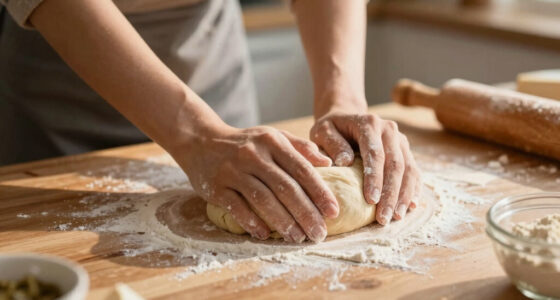
- Roll from the center outwards, applying gentle, even pressure. Rotate the dough a quarter turn regularly to maintain a round shape and even thickness. Imagine smoothing out a rippled blanket—starting from the middle and working outward ensures even distribution of pressure.
- Check thickness frequently with a ruler or guide, adjusting pressure as needed. Repeat until the dough reaches your target thickness. This continuous monitoring prevents areas from becoming too thick or too thin, much like tuning a musical instrument for harmony.
This method acts like a dance: steady, deliberate, and controlled, leading to a perfectly even, flat dough ready for baking.
Common Problems and How to Fix Them
Got dough that sticks or shrinks? Here’s what to do. If it sticks, dust it with more flour—just a light sprinkle. Think of it as giving your dough a gentle non-stick coating, like a pan before frying eggs. If it shrinks back when you try to roll, it’s probably too warm or elastic. Chill it again for 10–15 minutes—like putting a stretched rubber band back in the fridge, it regains firmness and loses some elasticity.
If your dough keeps unevenly thickening, double-check your guides and make sure you’re applying even pressure. Uneven pressure is like trying to cut a cake with a dull knife—you end up tearing or uneven slices. If it tears, it might be too dry; lightly mist it with water or knead in a tiny bit of oil to restore flexibility, similar to adding a splash of water to dry clay to make it pliable again. Patience and gentle handling turn common issues into manageable fixes, much like tuning a musical instrument to achieve harmony.
Comparison: Hand-Rolling vs. Using Guides
| Method | Pros | Cons |
|---|---|---|
| Hand-Rolling | More control, flexible, quick setup | Can lead to uneven thickness, requires skill |
| Using Guides/Rings | Consistent thickness, beginner-friendly | Limited flexibility, needs additional tools |
Choosing between them depends on your comfort and what you’re baking. Guides help ensure every part of your dough is the same thickness, much like a mold shapes a sculpture, giving you predictable results. Hand-rolling offers more control but relies heavily on your skill and feel, like trying to draw a perfect circle freehand—possible, but easier with tools. For beginners or when aiming for uniformity, guides are the reliable choice, much like training wheels on a bike that help you master balance before riding freely.
Final Tips to Make Your Dough Roll Like a Pro
- Chill your dough thoroughly—don’t skip the fridge time. Cold dough resists stretching and shrinking, allowing for more even rolling, much like cold butter in pastry making helps achieve flaky layers.
- Use a light touch—press gently, then check thickness often. Heavy pressure can cause uneven thickness or tearing, so think of it as petting a delicate animal—gentle and attentive.
- Rotate frequently—your dough needs to turn to stay even. This is similar to turning a rotating cake on a turntable to ensure even decoration; it keeps the shape balanced and uniform.
- Keep your workspace cool and clean for best results. Warm or dirty surfaces can cause sticking and uneven rolling, much like trying to write on a greasy surface.
- Practice makes perfect—don’t be discouraged by initial uneven results. Each attempt teaches you more about how your dough responds, much like learning to ride a bike, where balance and feel improve with experience.
With these habits, your dough will become your canvas for beautiful, evenly baked treats—without the fight every single time.
Frequently Asked Questions
How do I prevent my dough from sticking to the surface?
Lightly flour your work surface and rolling pin. If dough still sticks, chill it a bit longer; cold dough is less sticky and easier to handle. Using a silicone mat or parchment paper also helps keep things tidy.
What’s the best way to get an even thickness across the dough?
Use adjustable guides or rings set to your desired thickness. Roll from the center outward, applying gentle pressure, and rotate the dough 90 degrees frequently to maintain uniformity.
How long should I chill my dough before rolling?
A minimum of 30 minutes in the fridge usually does the trick. For thicker or stickier dough, up to an hour can help reduce elasticity and make rolling easier.
Can I roll dough on parchment paper or silicone mats?
Absolutely. These surfaces prevent sticking, making cleanup easier and helping you achieve a smooth, even roll without excess flour.
For cookies, handle dough gently and don’t over-flour. For pie crust, keep it cold and work quickly to prevent shrinkage. Adjust pressure based on dough elasticity for best results.
Conclusion
Perfectly even dough isn’t a matter of luck; it’s about technique, tools, and patience. Take your time, use guides, and keep your dough chilled. Soon, you’ll be rolling out cookies and pies with confidence—no more fights, just beautiful, uniform results every time.
Remember, the secret is in the details. With consistent practice, rolling dough becomes second nature—smooth, simple, satisfying.