
TL;DR
Silicone baking mats are reusable, nonstick sheets that sit on a flat baking tray and work well for many cookies, sticky treats, and roasted vegetables. They can change browning and crispness, so parchment or bare metal may suit some recipes better; check the mat’s temperature and care instructions before use.
A cookie can slide off a silicone mat with barely a nudge, while the same recipe on another surface may leave you scraping browned edges from the pan. That easy release is the appeal, but it is only part of the story. Silicone baking mats are reusable liners that can make everyday baking tidier, yet their insulation may change how food spreads, browns, or crisps.

Get baking supplies delivered free with Prime
- Fast, free delivery on millions of items
- Prime Video, Amazon Music and more included
- Member-only deals all year
This guide explains what mats are made from, which jobs they handle well, and when parchment or bare metal gives you a better result. You’ll also get practical buying, cleaning, and safety tips, so you can match the mat to your pan and recipe instead of expecting one liner to do everything.
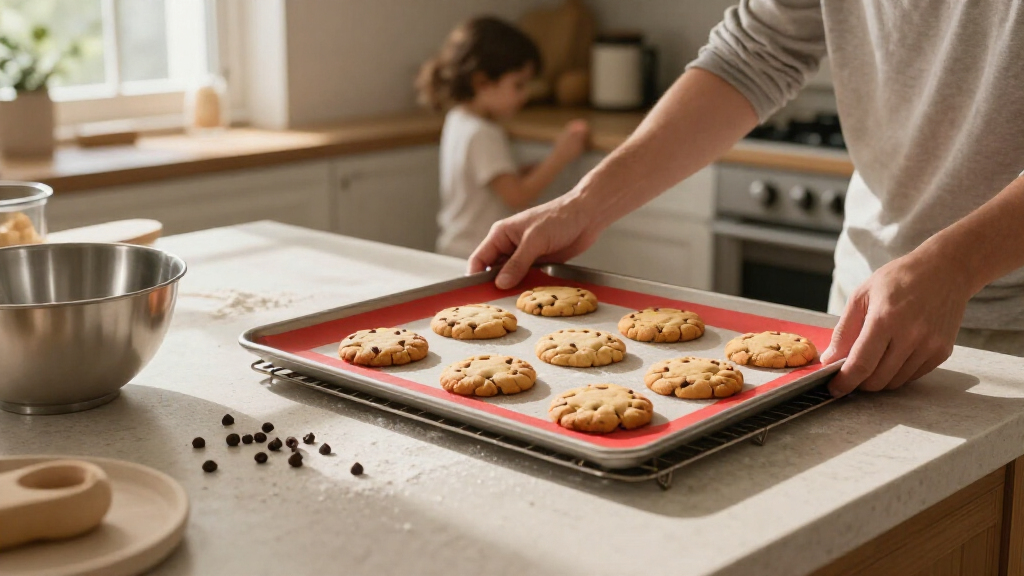
Think of a mat as a useful kitchen tool, much like a sturdy spatula: excellent for the right job, but not magic. If you bake a sheet of chocolate chip cookies every Sunday, it may earn a regular place in your routine. If you want deeply browned shortbread bottoms, the surface you choose matters.
Use silicone mats for many sticky or delicate bakes, but choose parchment or bare metal when a recipe depends on a crisper or more browned base.
Check mat dimensions and its maximum temperature before using it in a full-size oven, countertop oven, or air fryer.
Most recipes do not need extra grease on a nonstick mat; added oil can leave residue and change food spread.
Wash with warm water and dish soap, dry fully, and avoid knives, abrasive scrubbers, and sharp storage folds.
Reuse may reduce disposable liner use over time, but the impact depends on how often you bake and how long the mat lasts.
What a silicone baking mat does on your tray
A silicone baking mat is a reusable, flexible sheet that sits on a baking tray and gives food a nonstick surface. Most are made from food-grade silicone reinforced with fiberglass, though you should check a specific product’s material and care details. The mat can reduce your use of parchment, cooking spray, or oil for suitable recipes.
Picture one flexible sheet placed on a rimmed tray before you pipe macarons: the smooth surface helps keep cleanup simple, and printed circles on some models can guide consistent sizing. Many mats can also be rolled or laid flat for storage. Avoid sharp creases, since a tight fold can damage the sheet over time.
The mat spreads across the tray like a reusable skin, but that does not mean it improves every bake. It provides a consistent surface; it cannot fix a hot spot in your oven or make a dark pan behave like a pale one. For example, rotate a crowded tray of cookies if your oven browns one corner faster.
Searches for “key facts for silicone baking mats” often turn up simple claims about reuse and nonstick performance. The useful version is more specific: a mat is a practical liner for many sticky or delicate foods, and its effect depends on the recipe, pan, oven, and product instructions.
Products Worth Considering

Le Creuset Stainless Steel Roasting Pan with Nonstick Rack, 16.25 x 13.25 in

KitchenAid Artisan 5-Quart Tilt-Head Stand Mixer, KSM150PS, Almond Cream

Le Creuset Alpine Enameled Cast Iron Fondue Set, 2.5 qt., Nuit
As an affiliate, we earn on qualifying purchases.
Choose the mat, parchment, or bare pan for the bake
Use a silicone mat for easy release and repeat use, parchment when you want a disposable liner or easy lifting, and bare metal when a recipe depends on direct contact with the pan. Silicone mats often replace parchment for everyday cookies, sticky candies, and vegetables, but they are not universal substitutes. Their insulating effect can change browning and spread.
| Surface | Works well for | Tradeoff |
|---|---|---|
| Silicone mat | Sticky cookies, macarons, and many roasted vegetables | Can soften browning or crispness; needs washing |
| Parchment paper | Easy lifting, disposable cleanup, many cookies | Single use; check temperature guidance |
| Bare metal tray | Recipes that need direct pan contact or a crisp base | Food may stick; cleanup may take more work |
Say your oatmeal cookies usually have golden, crisp bottoms on parchment. On a mat, the centers may still taste good, but the bottoms can come out paler or softer. That difference is not necessarily a mistake; the mat changes the surface conditions.
Use the recipe’s specified surface when texture matters. If you are adapting a familiar recipe, bake a small test batch first. A few cookies can tell you more than a full tray of disappointing results.
Get better results with these simple baking adjustments
To use a silicone baking mat well, set it on a flat tray, follow its temperature rating, and judge the finished texture rather than assuming the timing will match parchment. The mat is part of the baking setup, much like choosing a light or dark pan. Keep the tray stable and let the recipe guide you.
- Match the size. The mat should lie flat on the tray without curling up the sides. For example, a large sheet crammed into a small countertop-oven pan may bunch near the heating area.
- Check the product rating. Read the maximum temperature and appliance instructions before baking. A product’s limit is not a target to exceed.
- Skip extra grease unless directed. Most recipes do not need spray on a nonstick mat. Grease can leave residue and may alter spread.
- Watch the first batch. Check cookies near the recipe’s stated finish time and look for color and set edges, especially when you switch from parchment.
- Cool and clean it gently. Let the tray cool enough to handle safely, then wash the mat according to the manufacturer’s care advice.
For instance, if your first mat-baked batch of sugar cookies looks pale underneath, give the next batch a little more time only if the tops and edges can take it. Some recipes simply suit parchment or bare metal better. A test batch helps you find out without sacrificing a whole afternoon’s baking.
Buy a mat that fits your oven and habits
A good silicone mat should fit your tray, state a clear temperature limit, and include care instructions. Size is easy to overlook: a mat that sticks up at the edges or buckles in a small oven is awkward to use. Most are made as flexible sheets placed on baking trays, but sizes, thicknesses, shapes, and printed guides vary.
Before ordering, measure the flat inside area of your pan. If you bake macarons, measurement circles might save time; if you roast vegetables, a plain surface may be all you need. Some newer options are designed for air fryers or countertop ovens, but compatibility depends on the exact appliance and mat.
Look for clear manufacturer information about material, maximum temperature, and cleaning. A “food grade” or “BPA-free” label alone does not tell you whether a mat fits your oven or how to care for it. If the instructions are vague, the product may not give you enough information to use it confidently.
Avoid buying a set with several sizes just because the discount looks tempting. If you mostly bake one tray of granola in a standard oven, one well-fitting mat may be more useful than a drawer full of specialty shapes. Choose around the food you actually make.
Clean away greasy film and store the mat flat
Wash a silicone mat with warm water and dish soap, then dry it fully before storing. Nonstick does not mean self-cleaning: butter, oil, and roasted vegetable juices can leave a slick film after repeated use. A mat that feels tacky may need careful cleaning, but follow its maker’s instructions rather than reaching for an abrasive scrubber.
After baking a tray of honey-glazed carrots, for example, rinse off the residue while it is fresh and wash both sides. Let the mat air-dry flat or hang it if the manufacturer permits. Damp storage can leave an unpleasant smell, while rolling the mat loosely is usually kinder than folding it into a sharp square.
Some mats are dishwasher-safe; others have different cleaning guidance. Check the label or product page before using a dishwasher. Do not cut food on the mat, scrape it with a knife, or attack stuck-on bits with an abrasive pad, since cuts and surface damage can shorten its useful life.
Inspect the mat as you clean it. Replace it if it is torn, badly warped, or remains sticky after proper cleaning. There is no single lifespan that applies to every mat: how often you use it and how you treat it both matter.
Keep heat and appliance use within the product’s limits
Use a silicone mat only within its stated temperature and appliance limits, on a flat baking sheet unless the manufacturer says otherwise. Do not put it under a broiler, over an open flame, directly against a heating element, or on an oven rack without explicit product instructions. Heat exposure beyond the rating can damage the mat.
An air fryer is a good example of why instructions matter. A mat made for one fryer may still block airflow in another basket or sit too close to a heating element. Use one only when both the mat and appliance makers allow it, and make sure the liner cannot lift or shift during cooking.
Food-grade silicone products intended for baking are generally considered safe when used according to their instructions. Choose a product with clear maker details and do not exceed its rating. As with any hot tray, use oven mitts and keep children away from the hot pan and fresh-from-the-oven mat.
Safety rule: Treat the mat’s temperature rating and appliance instructions as limits, not suggestions. If the directions do not approve broiling or direct rack use, choose another surface.
For a crisp-bottomed pizza or broiled cheese toast, parchment or a bare pan may suit the recipe better, subject to those products’ own limits. The mat’s nonstick convenience does not make it suitable for every heat source.
Decide whether reuse suits your kitchen
A reusable mat can reduce how often you reach for disposable parchment, but reuse alone does not prove a lower environmental impact. The result depends on the mat’s manufacture, how long it lasts, how often you use it, and how it is disposed of. There is no single break-even number that applies to every household and product.
If you bake several times a week and use the same mat for cookies, crackers, and vegetables, repeated use may fit naturally into your routine. If you bake once a year, a roll of parchment you already own may be the more practical choice. The mat also needs washing, which takes water and a little time.
Consider the whole routine: how many liners you use, whether you can clean the mat easily, and whether you replace damaged gear promptly. A drawer full of unused specialty mats is not a useful swap. One durable, correctly sized mat used often is a simpler choice.
When you compare products, look beyond “eco-friendly” language. Check the stated material, care advice, expected compatibility, and whether the maker explains disposal. That gives you concrete information for your own kitchen without pretending that one purchase solves a bigger waste problem.
Frequently Asked Questions
Are silicone baking mats safe to use?
Food-grade silicone mats intended for baking are generally considered safe when you follow the product instructions. Choose one with clear material and temperature information, and do not use it beyond its stated rating.
Can I use a silicone baking mat instead of parchment paper?
Often, yes, for everyday cookies and other suitable bakes. Parchment may be a better fit when your recipe calls for a crisp bottom, easy lifting, or a disposable liner; check the recipe and both products’ temperature limits.
Do I need to grease a silicone baking mat?
Usually not, because the mat provides a nonstick surface. Follow your recipe and the mat’s instructions; extra grease can build up or affect how food spreads and browns.
Can silicone baking mats go in the dishwasher?
Some mats are dishwasher-safe, while others have different care directions. Check the manufacturer’s instructions, and wash with warm water and dish soap if you are unsure.
Why do my cookies brown or spread differently on a mat?
The mat changes the baking surface and can affect heat transfer, spread, and browning. Your pan color, oven temperature, recipe, and mat thickness also play a part, so try a small test batch when switching surfaces.
Can I put a silicone mat in an air fryer?
Only if the mat is specifically suitable for your appliance and the air fryer’s instructions allow it. The mat must not block airflow or touch a heating element, so check both sets of product directions.
Conclusion
Choose a silicone mat for the jobs it handles well: easy release, repeat use, and simpler cleanup for many everyday bakes. Check its fit and heat rating, then test a small batch when you switch from parchment, since browning and crispness can change.
Keep the mat clean, store it gently, and let the recipe decide when another surface works better. A good kitchen tool earns its space one reliable tray at a time.