
TL;DR
Switching from cups to grams for measuring ingredients can improve your baking precision and consistency. Weighing ingredients with a digital scale ensures more accurate results, helping you bake perfect treats every time.
Switch to weighing ingredients in grams for more consistent baking results.
A digital kitchen scale makes measuring quick, easy, and precise, transforming your baking routine.
Understanding ingredient density helps you convert between cups and grams accurately.
Using grams reduces errors caused by packing, scooping, or sifting ingredients.
Adopting weight measurements is especially useful for scaling recipes and professional baking.
Grams or Cups? The Answer Will Change How You Bake Forever
TL;DR: Switching from cups to grams improves baking precision and consistency. A digital scale removes the uncertainty of scooping, packing, and sifting, so your cookies, cakes, and bread behave the same way every time.
Volume measures ingredients. Weight measures truth.
The same recipe can start with different amounts.
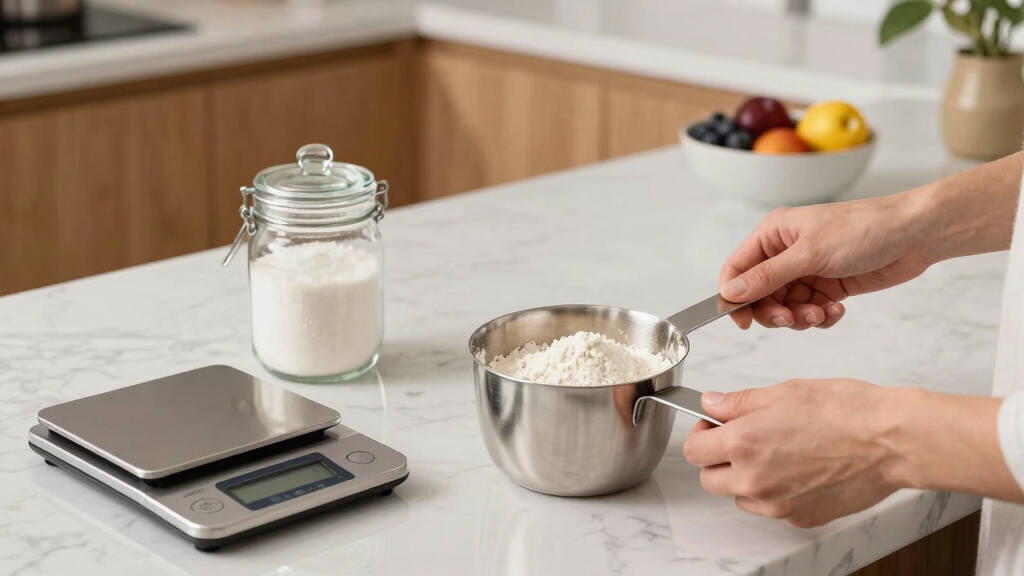
Cups measure volume, but baking ingredients have different densities. Flour can be spooned, scooped, sifted, packed, or settled, and each method changes the amount that lands in your bowl.
Flour compresses without warning.
A heavy scoop can push extra flour into the cup, turning tender cookies dry or making bread dense.
Ingredients do not convert evenly.
One cup of flour, sugar, butter, and powdered sugar all weigh different amounts.
Volume makes recipe math messy.
Grams let you halve, double, or batch recipes with clean arithmetic and fewer judgment calls.
Precision turns baking into a repeatable system.
Grams reduce variability caused by scooping and packing. That control matters most in recipes where structure, hydration, and rise depend on tight ratios.
Where measuring errors show up
Small measuring shifts can change texture, rise, spread, and flavor balance.
Cups vs. grams reliability
Volume depends on technique. Weight stays stable across bowls, bakers, and batches.
Common baking ingredients behave differently by cup.
The problem is not that cups are useless. The problem is that every ingredient brings its own density, shape, and packing behavior.
| Ingredient | Cup behavior | Typical 1 cup weight | Best measurement | Risk level |
|---|---|---|---|---|
| All-purpose flour | Depends on scooping, sifting, and settling | 120 grams average | ✓ Weigh it | ~ High variability |
| Granulated sugar | More predictable, but still volume-based | 200 grams | ✓ Weigh it | ~ Medium variability |
| Butter | Stable when measured from marked sticks or blocks | 227 grams | ✓ Weigh or use markings | ✓ Lower variability |
| Powdered sugar | Changes dramatically when sifted or compacted | 120 grams | ✓ Weigh it | ✗ Very technique-sensitive |
How to switch from cups to grams without overthinking it.
The first time you weigh ingredients, it feels more intentional. After a few bakes, it becomes faster than hunting for the right measuring cup.
Buy a digital scale
Choose one that measures in grams and has a tare button.
Use trusted conversions
Start with reliable ingredient-specific charts, not one-size-fits-all math.
Weigh into the bowl
Tare between ingredients and skip messy extra cups.
Note your results
Track texture, rise, and spread as you refine favorite recipes.
Scale with confidence
Double or halve recipes by weight for cleaner, more reliable batches.
The quick answers that save a batch.
Measuring in grams is not harder. It is usually quicker, cleaner, and easier to repeat once the scale becomes part of your setup.
Why do recipes list different gram weights?
Because packing, sifting, and measuring technique change density. Spoon-filled flour weighs differently than scooped flour.
Can I swap cups for grams?
Yes, but use ingredient-specific conversion data. Once a recipe works, stick with one method for consistency.
Do I need special equipment?
A digital kitchen scale is the key tool. It is affordable, precise, and useful far beyond baking.
Is weighing harder than using cups?
No. Tare the bowl, add the ingredient, and move on. It often saves time and reduces cleanup.
Better baking is not about fancier ingredients. It is about smarter measurement.
Choosing grams over cups turns baking from a guessing game into a controlled process. Grab a scale, measure by weight, and watch your favorite recipes become easier to repeat.
Why Your Baking Results Depend on Precise Measurements
When you measure ingredients with cups, you’re relying on volume. But ingredients like flour or sugar can vary wildly depending on how you scoop or pack them. This means two batches of the same recipe might turn out completely different.
Using grams, however, measures the exact weight. For example, 1 cup of all-purpose flour is roughly 120 grams, but can range from 110 to 130 grams depending on how it’s measured. That small difference can affect the texture, rise, and even flavor of your baked goods.
Imagine baking a loaf of bread. If your flour is slightly over or under the standard weight, it can result in a dense or flat loaf. Precise measurements eliminate these uncertainties, giving you more control over the outcome.

Etekcity Food Kitchen Scale, Digital Grams and Ounces, 11lb
- Multiple Measurement Units: Supports oz, lb, fl oz, g, mL
- Tare Function Included: Zero out weight for accurate measurements
- Hassle-Free Operation: Includes 2 AAA batteries
As an affiliate, we earn on qualifying purchases.
As an affiliate, we earn on qualifying purchases.
How Measuring in Grams Gives You Consistent, Reproducible Results
When you weigh ingredients in grams, your recipes become more reliable. You can scale them up or down without guesswork. No more guessing if you should add a little more flour or sugar to fix a batch.
This consistency is especially valuable if you bake often or want to perfect a favorite recipe. For instance, a professional pastry chef works with grams because it guarantees every tart, cake, or cookie tastes the same each time.
Try this: bake a batch of cookies weighing your flour and sugar. Next time, weigh them again. You’ll notice your results are nearly identical, unlike the variability when measuring by volume.
As an affiliate, we earn on qualifying purchases.
Comparison Table: Cups vs. Grams for Common Baking Ingredients
| Ingredient | 1 Cup | In Grams |
|---|---|---|
| All-purpose flour | Depends on how measured | 120 grams (average) |
| Granulated sugar | Depends on packing | 200 grams |
| Butter | Depends on packing | 227 grams (standard block) |
| Powdered sugar | Depends on sifting | 120 grams |
This table shows how variable volume measurements can be. Using grams removes guesswork, especially when ingredients are packed or sifted differently. It’s a game-changer for accuracy.
As an affiliate, we earn on qualifying purchases.
How to Switch from Cups to Grams in Your Baking Routine
- Invest in a good digital kitchen scale—affordable and precise.
- Find reliable conversion charts for your ingredients. For example, 1 cup of flour is about 120 grams.
- Start measuring ingredients by weight, not volume. Weigh flour, sugar, butter, and others before adding to your bowl.
- Adjust your recipes gradually, testing and noting differences.
- Keep your scales clean and calibrated for best accuracy.
It’s a small shift that can dramatically improve your baking precision. The first time you weigh ingredients, it feels different—more intentional, more confident.
As an affiliate, we earn on qualifying purchases.
The Rise of Digital Scales and Why They Matter
Digital kitchen scales have become more affordable and accurate in recent years. They measure in grams with a click of a button, making precise baking accessible to everyone.
For example, a typical scale can measure as low as 1 gram, perfect for delicate pastries or small ingredient adjustments. Plus, they tare (zero out) easily, so you can add ingredients directly on the scale without messy transfers.
Using a digital scale turns guessing into certainty. It’s like having a baking scientist in your kitchen, helping you get perfect results every time.
Common Questions About Measuring in Grams and Cups
Q: Why do recipes give different weights for the same ingredient? Because of variations in packing, sifting, and measuring technique. For example, spooning flour can give a different weight than scooping or sifting.
Q: Can I swap cups for grams? Yes, but with caution. Use a conversion chart or weigh ingredients for accuracy. It’s best to stick to one method once you find what works.
Q: Do I need special tools? A digital kitchen scale is the most helpful investment. It’s quick, precise, and makes your baking more consistent.
Q: Is measuring in grams harder? Not really—once you get used to it, weighing ingredients becomes second nature and saves time in the long run.
Conclusion
Choosing grams over cups isn’t just a detail — it’s a game changer. It turns baking from a guessing game into a science, giving you control and confidence. Your baked goods will thank you.
So, grab a scale, get precise, and watch how your results improve. Better baking isn’t about more time or fancy ingredients — it’s about smarter measurements. Ready to weigh your way to perfection?