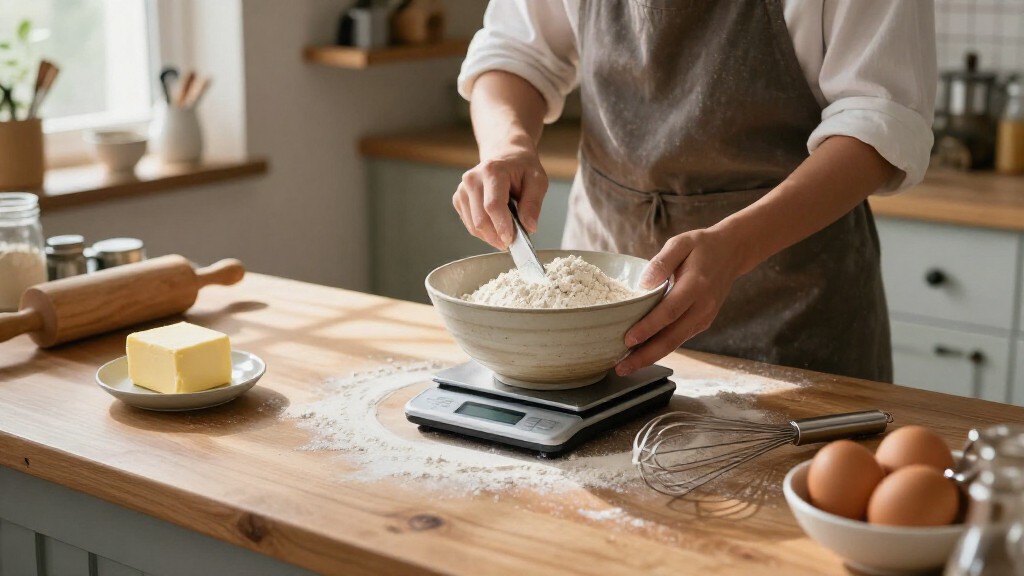
For most home bakers, I’d start with the OXO Good Grips 11-Pound Digital Kitchen Food Scale: its pull-out display is useful when a mixing bowl blocks the readout. The Ooni Dual Platform and KitchenAid KQ909 stand out for weighing small amounts alongside larger ingredients, while the Escali Primo keeps things simple for everyday recipes. The main tradeoffs are capacity versus precision for small quantities, and streamlined controls versus extra features such as rechargeable power. I compare all 15 options by how well their features suit baking tasks and where each asks you to compromise. Read on for the full breakdown and guidance on choosing the right scale for your recipes and workspace.

Get baking supplies delivered free with Prime
- Fast, free delivery on millions of items
- Prime Video, Amazon Music and more included
- Member-only deals all year
Complete the kit


Key Takeaways
- The OXO’s pull-out display addresses a practical baking problem: a wide bowl can hide a fixed readout.
- Dual-platform scales, including the Ooni and KitchenAid KQ909, let bakers weigh small additions separately from larger ingredients, though their split layouts take more counter space.
- Capacity varies widely: 11-pound models suit most home recipes, while 22- and 33-pound options leave more room for large bowls and batch baking.
- Rechargeable models such as the BakFee, GGQ, and Etekcity 22-pound option reduce reliance on disposable batteries, but charging becomes another upkeep task.
- The Escali Primo and Amazon Basics scale represent simpler approaches for buyers who value straightforward weighing over specialized platforms or charging features.
| Ultrean Digital Kitchen Food Scale, 11 lb, Stainless Steel |  | Best for Beginners | Brand and model: Ultrean UL-KS01 | Maximum capacity: 11 lb | Readout accuracy: 1 g | VIEW LATEST PRICE | See Our Full Breakdown |
| KitchenAid KQ917 Digital Kitchen Scale, 30 lb Capacity, Glass Surface, LED Display, Tare Function, Black |  | Best for Large Batches | Brand and model: KitchenAid KQ917 | Maximum capacity: 30 lb | Measurement units: Pounds, ounces, grams, fluid ounces, milliliters | VIEW LATEST PRICE | See Our Full Breakdown |
| Ooni Dual Platform Digital Kitchen Scale |  | Best for Precision Baking | Brand: Ooni | Maximum capacity: 22 lb | Precision: 0.1 g | VIEW LATEST PRICE | See Our Full Breakdown |
| KUAIVO Dual-Platform Digital Kitchen Scale, 33 lb and 1.1 lb Capacities |  | Best Dual-Platform Pick | Brand and model: KUAIVO K600H | Large platform capacity and accuracy: 33 lb; 0.1 oz | Small platform capacity and accuracy: 1.1 lb; 0.001 oz | VIEW LATEST PRICE | See Our Full Breakdown |
| Mik-Nana Digital Kitchen Scale, 10 kg/22 lb, Stainless Steel |  | Best Compact Value | Brand: Mik-Nana | Capacity: 10 kg / 22 lb | Resolution and readout accuracy: 1 g / 0.1 oz resolution; 2 g readout accuracy | VIEW LATEST PRICE | See Our Full Breakdown |
| Amazon Basics Digital Kitchen Scale with LCD Display, Tare Function, and Multiple Units |  | Best Value for Everyday Baking | Maximum capacity: 11 lb (about 5,000 g) | Minimum measurement: 2 g | Readout accuracy: 1 g | VIEW LATEST PRICE | See Our Full Breakdown |
| OXO Good Grips 11-Pound Digital Kitchen Food Scale |  | Best for Large Mixing Bowls | Maximum capacity: 11 lb | Readout accuracy: ±0.1 oz or ±1 g | Measurement units: Pounds, kilograms, ounces, grams | VIEW LATEST PRICE | See Our Full Breakdown |
| KitchenAid KQ909 Dual-Platform Digital Kitchen Scale |  | Best for Precision Baking | Large platform capacity: 11 lb (5,000 g) | Large platform increments: 0.1 oz (1 g) | Precision platform capacity: 16 oz (500 g) | VIEW LATEST PRICE | See Our Full Breakdown |
| Nicewell 22 lb Digital Kitchen Food Scale |  | Best for Large Baking Batches | Maximum capacity: 22 lb (10 kg) | Minimum weight: 3 g (0.1 oz) | Graduation: 1 g / 0.1 oz | VIEW LATEST PRICE | See Our Full Breakdown |
| Etekcity Digital Kitchen Food Scale, 11 lb Capacity |  | Best Compact Pick | Maximum capacity: 11 lb (5 kg) | Minimum measurement: 2 g | Measurement increments: 1 g | VIEW LATEST PRICE | See Our Full Breakdown |
| BakFee 33 lb Digital Kitchen Scale, USB-C Rechargeable |  | Best for Large Baking Batches | Maximum capacity: 33 lb (15 kg) | Minimum capacity: 3 g (0.1 oz) | Accuracy: Listed as 1 g; another listing states 0.1 oz | VIEW LATEST PRICE | See Our Full Breakdown |
| KitchenAid KQ908 Digital Kitchen Scale with Glass Surface, 11 lb Capacity, Black |  | Best for Straightforward Ingredient Weighing | Maximum capacity: 11 lb / 5,000 g dry; 5,000 ml liquid | Measurement units: oz, g, ml, fl oz | Readout accuracy: 2.86 g | VIEW LATEST PRICE | See Our Full Breakdown |
| GGQ Digital Kitchen Food Scale, 33 lb, Rechargeable |  | Best High-Capacity Compact Pick | Maximum capacity: 33 lb (15 kg) | Minimum capacity: 3 g (0.1 oz) | Graduation interval: 1 g | VIEW LATEST PRICE | See Our Full Breakdown |
| Escali Primo Digital Food Scale, 11 lb Capacity, Chrome |  | Best Simple Precision Pick | Maximum capacity: 11 lb (5,000 g) | Readout accuracy: 1 g (0.05 oz) | Units: oz, lb:oz, g | VIEW LATEST PRICE | See Our Full Breakdown |
| Etekcity 22 lb USB-C Rechargeable Waterproof Digital Kitchen Scale |  | Best for Spill-Prone Baking | Maximum capacity: 22 lb (10,000 g) | Minimum measurement: 2 g | Measurement increments: 1 g | VIEW LATEST PRICE | See Our Full Breakdown |
| digital kitchen scales for baking | Maximum capacity | Measurement units | Display | Power |
|---|---|---|---|---|
| Ultrean Digital Kitchen Food S | 11 lb | g, kg, lb, oz, ml, milk ml | Backlit LCD | — |
| KitchenAid KQ917 Digital Kitch | 30 lb | Pounds, ounces, grams, fluid ounces, milliliters | Backlit LED | 3 AAA batteries included |
| Ooni Dual Platform Digital Kit | 22 lb | Grams, ounces, milliliters, fluid ounces | Dual LCD | — |
| KUAIVO Dual-Platform Digital K | — | g, kg, lb, oz, lb:oz, ml, milk ml | — | — |
| Mik-Nana Digital Kitchen Scale | — | g, kg, lb, oz, ml, milk ml | — | 2 AAA batteries included |
| Amazon Basics Digital Kitchen | 11 lb (about 5,000 g) | Pounds, ounces, grams, fluid ounces, milliliters | Wide LCD | 2 AAA batteries, included |
| OXO Good Grips 11-Pound Digita | 11 lb | Pounds, kilograms, ounces, grams | Large, pull-out, backlit digital display | 4 AAA batteries, included |
| KitchenAid KQ909 Dual-Platform | — | — | Two-line backlit LCD | 3 AAA batteries, included |
| Nicewell 22 lb Digital Kitchen | 22 lb (10 kg) | g, kg, lb:oz, fl oz, ml | Backlit LCD | 2 AAA batteries, included |
| Etekcity Digital Kitchen Food | 11 lb (5 kg) | — | Backlit LCD | 2 AAA batteries, included |
| BakFee 33 lb Digital Kitchen S | 33 lb (15 kg) | g, kg, lb:oz, fl oz, ml | — | USB-C rechargeable lithium battery or 2 AAA batteries |
| KitchenAid KQ908 Digital Kitch | 11 lb / 5,000 g dry; 5,000 ml liquid | oz, g, ml, fl oz | 1.0-inch backlit readout | Three AAA batteries, included |
| GGQ Digital Kitchen Food Scale | 33 lb (15 kg) | g, kg, lb:oz, oz, ml | — | USB-C rechargeable |
| Escali Primo Digital Food Scal | 11 lb (5,000 g) | — | LCD | — |
| Etekcity 22 lb USB-C Rechargea | 22 lb (10,000 g) | g, oz, lb:oz, ml and fl oz for milk and water | Backlit LED | Rechargeable, non-removable battery via USB-C |
More Details on Our Top Picks
Ultrean Digital Kitchen Food Scale, 11 lb, Stainless Steel
The Ultrean UL-KS01 is a straightforward choice for home bakers who want to weigh flour, sugar, and liquids without learning a complicated control layout. Its 1 g readout, tare function, and six units—including milk milliliters—cover common baking tasks, while the backlit display is easier to read than a basic unlit screen. The stainless steel platform also wipes clean after sticky ingredients. Compared with the Mik-Nana Digital Kitchen Scale, it offers the same broad unit selection and a similar compact format, but its listed maximum is lower at 11 lb rather than 22 lb. That makes it better for everyday mixing bowls than large dough batches. Its main tradeoff is capacity, and the battery wrapping needs to be removed before first use.
Pros:- 1 g readout supports consistent ingredient measurements.
- Six units include milliliters and milk milliliters for liquid-focused recipes.
- Backlit LCD is designed for easier reading.
- Stainless steel surface is easy to wipe clean.
Cons:- 11 lb maximum capacity is lower than the Mik-Nana and several larger-capacity options.
- Batteries require removal of their plastic wrapping before the scale can be used.
Best for: New home bakers weighing standard recipe portions who want clear readouts and simple tare controls.
Not ideal for: Bakers who regularly weigh large dough batches or heavy mixing bowls, since its capacity tops out at 11 lb.
- Brand and model:Ultrean UL-KS01
- Maximum capacity:11 lb
- Readout accuracy:1 g
- Platform material:304 stainless steel
- Measurement units:g, kg, lb, oz, ml, milk ml
- Display:Backlit LCD
- Functions:Tare, auto shutoff
- Included components:Food scale, batteries
Our verdict“Choose the Ultrean for simple, everyday baking measurements if you do not need more than 11 lb of capacity.”
KitchenAid KQ917 Digital Kitchen Scale, 30 lb Capacity, Glass Surface, LED Display, Tare Function, Black
For bakers who weigh substantial dough batches or use heavy bowls, the KitchenAid KQ917 stands out for its 30 lb capacity. That extra headroom is the main reason to choose it over the Ultrean, whose 11 lb limit can be restrictive when ingredients and container weight add up. The KQ917 also covers grams, ounces, fluid ounces, and milliliters, so it can handle both dry ingredients and many liquid measurements. Its bright LED display and touch controls make readings and wipe-downs convenient, while the glass surface avoids seams around physical buttons. The tradeoff is that glass calls for more careful handling than stainless steel, and its unit list is narrower than the KUAIVO’s seven options. It uses three AAA batteries.
Pros:- 30 lb capacity accommodates large batches and heavier containers.
- Bright, backlit LED display is designed for easy reading.
- Touch controls and glass surface are easy to wipe clean.
- Tare function supports weighing multiple ingredients in one container.
Cons:- Glass surface may be damaged if handled roughly.
- Three AAA batteries are required.
- Offers fewer measurement units than the KUAIVO dual-platform scale.
Best for: Frequent bread and pastry bakers who weigh large batches or use heavy mixing containers.
Not ideal for: Bakers who want a rugged stainless steel platform, or who need unit options such as kilograms and milk milliliters.
- Brand and model:KitchenAid KQ917
- Maximum capacity:30 lb
- Measurement units:Pounds, ounces, grams, fluid ounces, milliliters
- Surface:Glass
- Display:Backlit LED
- Controls:Touch sensor
- Functions:Tare, auto shutoff
- Power:3 AAA batteries included
Our verdict“Pick the KQ917 if large-batch capacity matters more to your baking than a stainless steel surface or an expanded unit list.”
Ooni Dual Platform Digital Kitchen Scale
The Ooni Dual Platform Digital Kitchen Scale is the specialist pick here for bakers who need both fine measurements and larger ingredient weights. Its small platform reads to 0.1 g, making it more suited than the Ultrean or Mik-Nana to measuring tiny amounts of yeast or herbs. A second platform handles larger quantities, and the dual LCD lets you see both measurements at once—a useful setup when a recipe calls for precision alongside a main batch measurement. The included custom-fit dish gives small ingredients a contained spot to sit. The tradeoff is a shorter unit list than the KUAIVO and a 22 lb maximum, below the KitchenAid KQ917’s 30 lb capacity. Dimensions are not specified, so storage fit is harder to judge.
Pros:- 0.1 g precision supports fine measurement of small ingredients.
- Two platforms let bakers handle small and larger amounts on one scale.
- Dual LCD displays both measurements at once.
- Custom-fit dish helps contain small ingredients such as yeast and herbs.
Cons:- 22 lb maximum capacity is below the KitchenAid KQ917’s 30 lb limit.
- Four measurement units are fewer than the KUAIVO’s seven.
- Dimensions are not provided in the product data.
Best for: Bakers who regularly measure small quantities of yeast, herbs, or other ingredients alongside larger recipe amounts.
Not ideal for: Bakers who need a 30 lb capacity or want published dimensions to confirm the scale will fit their storage space.
- Brand:Ooni
- Maximum capacity:22 lb
- Precision:0.1 g
- Platforms:Two brushed stainless steel platforms
- Display:Dual LCD
- Measurement units:Grams, ounces, milliliters, fluid ounces
- Included component:Custom-fit measuring dish
- Item weight:0.8 kg
Our verdict“Choose the Ooni if fine ingredient measurements and simultaneous dual-platform readings matter more than maximum capacity.”
KUAIVO Dual-Platform Digital Kitchen Scale, 33 lb and 1.1 lb Capacities
The KUAIVO K600H earns its place for bakers who want a high-capacity platform and a separate, much more precise surface for small ingredients. The large side handles up to 33 lb, while the smaller platform reads to 0.001 oz; that split makes it more flexible than the single-platform KitchenAid KQ917 when a recipe involves both bulk flour and tiny additions. Seven units, including milk milliliters, also give it the broadest listed conversion range in this group. Tare and accumulation functions help with weighing ingredients in sequence. The small platform is limited to 1.1 lb, however, and the scale shuts off after 210 seconds without activity. Its 0.1 oz accuracy on the large platform is less fine than the Ooni’s 0.1 g precision.
Pros:- 33 lb large platform supports heavy bowls and big batches.
- Small platform offers 0.001 oz accuracy for low-weight ingredients.
- Seven units include milk milliliters and lb:oz.
- Tare and accumulation functions support sequential ingredient weighing.
Cons:- Small platform is limited to 1.1 lb.
- Large platform accuracy is 0.1 oz, coarser than the Ooni’s 0.1 g precision.
- Automatic shutoff activates after 210 seconds of inactivity.
Best for: Bakers who alternate between large dough batches and very small ingredient portions and want both tasks covered by one scale.
Not ideal for: Bakers who need fine gram-level readings across the entire weighing range or who tend to pause for long periods while measuring.
- Brand and model:KUAIVO K600H
- Large platform capacity and accuracy:33 lb; 0.1 oz
- Small platform capacity and accuracy:1.1 lb; 0.001 oz
- Measurement units:g, kg, lb, oz, lb:oz, ml, milk ml
- Functions:Tare, accumulation
- Display and auto-off:Backlit LCD; 210 seconds of inactivity
- Material and dimensions:Stainless steel; 10.8 × 7 inches
- Included components:Dual-platform scale, user manual, 2 AAA batteries
Our verdict“Choose the KUAIVO if you need one scale for both large baking batches and precise small-ingredient measurements.”
Mik-Nana Digital Kitchen Scale, 10 kg/22 lb, Stainless Steel
The Mik-Nana Digital Kitchen Scale is a compact, no-frills pick for bakers who want more capacity than the Ultrean without moving to a dual-platform design. Its 22 lb limit leaves more room for heavier bowls and dough, while six units—including milliliters and milk milliliters—cover a broad set of baking measurements. At 7.4 by 5.5 inches and 7.2 ounces, it is also easy to tuck away between baking sessions. The stainless steel platform cleans up readily, and tare simplifies weighing several ingredients into one bowl. Its stated readout accuracy is 2 g, so it is less suited to very small quantities than the Ooni’s 0.1 g precision. The 3-minute auto shutoff may also interrupt a slow, stop-and-start measuring routine.
Pros:- 22 lb capacity exceeds the Ultrean’s 11 lb limit.
- Compact 7.4 × 5.5-inch footprint and 7.2-ounce weight suit small kitchens.
- Six units include milliliters and milk milliliters.
- Food-grade 304 stainless steel platform is easy to clean.
Cons:- Stated 2 g readout accuracy is less suited to very small quantities than the Ooni.
- Automatic shutoff activates after 3 minutes of inactivity.
- Its compact platform may leave less room for large bowls than the KitchenAid KQ917.
Best for: Bakers with limited storage who want a lightweight scale with 22 lb capacity for everyday recipes.
Not ideal for: Bakers measuring tiny amounts of yeast or other ingredients who need finer precision than the stated 2 g accuracy.
- Brand:Mik-Nana
- Capacity:10 kg / 22 lb
- Resolution and readout accuracy:1 g / 0.1 oz resolution; 2 g readout accuracy
- Platform material:Food-grade 304 stainless steel
- Measurement units:g, kg, lb, oz, ml, milk ml
- Display and functions:LCD; tare; auto shut-off
- Dimensions and weight:7.4 × 5.5 × 0.6 inches; 7.2 ounces
- Power:2 AAA batteries included
Our verdict“Choose the Mik-Nana for a light, easy-to-store scale with more capacity than the Ultrean, but skip it for fine small-ingredient measurements.”
Amazon Basics Digital Kitchen Scale with LCD Display, Tare Function, and Multiple Units
For standard home baking, the Amazon Basics EK3211 covers the essentials without adding specialty features that many bakers may not need. Its 1 g readout accuracy and tare function make it straightforward to weigh flour, sugar, and other ingredients directly into a bowl. Five units, including milliliters and fluid ounces, also help when a recipe switches between weight and volume. Compared with the OXO Good Grips scale, it lacks a pull-out display to keep readings visible behind a large bowl; its wide LCD is still easy to read when the platform is unobstructed. The main baking limitation is the 2 g minimum measurement, which is less suited to tiny amounts of yeast or salt than the KitchenAid KQ909’s precision platform. It is a sensible pick for routine batches, not fine-scale work.
Pros:- Five measurement units include grams, milliliters, and fluid ounces.
- Tare function lets you weigh ingredients in a bowl and reset between additions.
- Stainless steel platform and wide LCD suit everyday kitchen use.
- Two AAA batteries are included.
Cons:- The 2 g minimum is less suitable for measuring very small baking ingredients.
- The display is not pull-out, so a large bowl can obstruct the reading.
Best for: Home bakers weighing typical recipe ingredients who want a simple scale with both metric and volume units.
Not ideal for: Bakers who frequently measure very small amounts of yeast, salt, or leavening, since its minimum measurement is 2 g.
- Maximum capacity:11 lb (about 5,000 g)
- Minimum measurement:2 g
- Readout accuracy:1 g
- Measurement units:Pounds, ounces, grams, fluid ounces, milliliters
- Platform:Stainless steel
- Display:Wide LCD
- Power:2 AAA batteries, included
- Dimensions:8.3 x 7 x 1.3 in
Our verdict“Choose this for straightforward everyday baking with flexible units, but pick the KitchenAid KQ909 if precise small-quantity measurements matter more.”
OXO Good Grips 11-Pound Digital Kitchen Food Scale
The OXO Good Grips scale is a strong fit for bakers who weigh ingredients in a deep or wide bowl and need to keep the display in view. Its pull-out backlit screen moves the reading away from the platform, addressing a common annoyance that the Amazon Basics EK3211 does not: a bowl hiding the numbers. The removable platform also makes cleanup easier, while the tare function supports adding ingredients one after another in the same bowl. It measures in grams, kilograms, ounces, and pounds, but unlike the Amazon Basics and Etekcity scales, it does not list milliliters or fluid ounces. Its 11 lb limit is enough for most baking batches, though it offers less headroom than the 22 lb Nicewell. The platform is hand-wash only, so it suits careful cleanup rather than anyone expecting dishwasher convenience.
Pros:- Pull-out, backlit display stays visible around large bowls.
- Removable stainless steel platform supports easier cleanup.
- Tare function makes sequential ingredient weighing practical.
- Measures in 1 g and 1/8-ounce increments.
Cons:- The 11 lb capacity is lower than the Nicewell’s 22 lb limit.
- The platform is designed for hand cleaning.
- Does not list milliliters or fluid ounces among its units.
Best for: Bakers who use large or tall mixing bowls and want readings to remain visible while weighing into them.
Not ideal for: Bakers who need volume units such as milliliters, or who want a platform they can clean in a dishwasher.
- Maximum capacity:11 lb
- Readout accuracy:±0.1 oz or ±1 g
- Measurement units:Pounds, kilograms, ounces, grams
- Display:Large, pull-out, backlit digital display
- Platform:Removable stainless steel
- Power:4 AAA batteries, included
- Weight:1.8 lb
- Model:11214800
Our verdict“Pick the OXO if bowl-obscured readings are your main frustration; choose the Nicewell for greater capacity or the Amazon Basics for volume units.”
KitchenAid KQ909 Dual-Platform Digital Kitchen Scale
For recipes where a small difference in salt, yeast, or a potent leavener can matter, the KitchenAid KQ909 offers something the other scales here do not: a separate platform that reads in 0.01 g increments. Its larger platform handles up to 11 lb in 1 g increments, while the smaller one measures up to 16 oz with finer resolution. The two-line backlit display shows both readings, making it easier to work across larger and smaller quantities without switching scales. Compared with the OXO Good Grips, this is the more specialized baking tool; the OXO’s pull-out display is better for keeping a reading visible behind a bulky bowl. The tradeoff is added complexity and a three-minute auto-off that may interrupt a slow, multi-step recipe. It is best for bakers who will use the precision platform regularly.
Pros:- Separate precision platform measures in 0.01 g increments.
- Large platform handles up to 11 lb in 1 g increments.
- Two-line backlit display shows both platform readings at once.
- Tare functions support weighing several ingredients in one container.
Cons:- The 16 oz precision platform has limited capacity for larger ingredients.
- Auto shut-off activates after three minutes without a weight change.
- Requires three AAA batteries.
Best for: Serious home bakers who often measure small quantities of yeast, salt, or other ingredients alongside larger amounts.
Not ideal for: Casual bakers who mostly weigh flour and sugar and would rather have a simpler, less specialized scale.
- Large platform capacity:11 lb (5,000 g)
- Large platform increments:0.1 oz (1 g)
- Precision platform capacity:16 oz (500 g)
- Precision platform increments:0.001 oz (0.01 g)
- Display:Two-line backlit LCD
- Materials:Stainless steel platforms and plastic
- Power:3 AAA batteries, included
- Auto shut-off:After 3 minutes without a change in weight
Our verdict“Choose the KQ909 if fine measurements are part of your regular baking; the OXO is a better fit when bowl visibility matters more.”
Nicewell 22 lb Digital Kitchen Food Scale
The Nicewell 22 lb scale makes the most sense when a baking session involves a large dough batch, bulk ingredients, or a heavy bowl. Its 22 lb capacity gives it twice the headroom of the 11 lb Amazon Basics and OXO models, while 1 g increments still suit ordinary recipe weighing. The backlit display, tare function, and five units—including milliliters and fluid ounces—cover familiar day-to-day tasks. Its 9 x 6.3-inch platform gives ingredients room, though it may still feel cramped beneath especially broad bowls; the OXO’s pull-out display is a better answer when the bowl itself blocks the reading. This scale starts at 3 g, so it is not the pick for tiny quantities. The stainless steel and tempered glass surface is easy to wipe, but its larger footprint is less convenient for compact storage.
Pros:- 22 lb capacity accommodates heavier bowls and larger batches.
- Five units include grams, kilograms, milliliters, and fluid ounces.
- Tare function and backlit LCD support routine ingredient weighing.
- Attached storage hook offers an alternative to keeping it on the counter.
Cons:- The 3 g minimum is not suited to very small ingredient quantities.
- The 9 x 6.3-inch platform may be restrictive for broad bowls.
- Larger platform dimensions take more storage space than compact models.
Best for: Home bakers making large bread or pastry batches who need more capacity than a standard 11 lb scale provides.
Not ideal for: Bakers with limited counter or cupboard space, or anyone who regularly measures ingredients below 3 g.
- Maximum capacity:22 lb (10 kg)
- Minimum weight:3 g (0.1 oz)
- Graduation:1 g / 0.1 oz
- Platform dimensions:9 x 6.3 in
- Measurement units:g, kg, lb:oz, fl oz, ml
- Display:Backlit LCD
- Materials:Stainless steel, tempered glass, plastic
- Power:2 AAA batteries, included
- Warranty:2 years
Our verdict“Choose the Nicewell for large batches and extra capacity, but favor the KitchenAid KQ909 if precise small measurements are a higher priority.”
Etekcity Digital Kitchen Food Scale, 11 lb Capacity
When counter and cupboard space are limited, the Etekcity scale offers a straightforward baking setup in a slim 0.6-inch profile. It weighs up to 11 lb in 1 g increments and includes tare, a backlit LCD, and five units, so it handles standard recipes much like the Amazon Basics EK3211. Its smaller 7.3 x 5.7-inch footprint is easier to tuck away, but gives less room for large bowls than the Nicewell’s 9 x 6.3-inch platform. Both this scale and the Amazon Basics have a 2 g minimum, so neither is ideal for very small measures. The two-minute auto-off helps limit battery use, yet can be inconvenient if a recipe calls for pauses between additions. For compact kitchens and ordinary batch sizes, that compromise may be worthwhile.
Pros:- Slim, lightweight design is easy to store between baking sessions.
- 1 g increments suit ordinary ingredient weighing.
- Five units include milliliters and fluid ounces.
- 304 stainless steel surface wipes clean, and two AAA batteries are included.
Cons:- The 2 g minimum limits accuracy for very small ingredient amounts.
- The smaller platform offers less room for large bowls than the Nicewell.
- Two-minute auto-off may interrupt a recipe with longer pauses.
Best for: Apartment bakers and occasional home bakers who need a compact scale for standard recipes and easy storage.
Not ideal for: Bakers who use broad mixing bowls, weigh large batches, or need the scale to stay on during longer pauses.
- Maximum capacity:11 lb (5 kg)
- Minimum measurement:2 g
- Measurement increments:1 g
- Units:g, oz, lb:oz, mL, fl oz
- Material:304 stainless steel
- Display:Backlit LCD
- Dimensions:7.3 x 5.7 x 0.6 in
- Power:2 AAA batteries, included
- Auto-off:After 2 minutes of inactivity
Our verdict“Pick the Etekcity for compact storage and everyday baking, but choose the Nicewell for large bowls or the KitchenAid KQ909 for fine measurements.”
BakFee 33 lb Digital Kitchen Scale, USB-C Rechargeable
For bakers weighing a full dough batch, multiple ingredients, or a large mixing bowl, the BakFee’s 33 lb capacity and 9 × 6.3-inch platform offer more room than the 11 lb Escali Primo. Its 1 g increments suit routine baking measurements, while five units make it useful for recipes that mix metric weights and liquid measures. The platform is described as splash-resistant, and a hanging hook gives it a practical storage option when counter space is tight.
The tradeoff is that this scale takes up more space than a compact baking scale, and its accuracy is listed inconsistently as 1 g and 0.1 oz, so I would not choose it for precision work at very small weights. It also needs a USB-C charge or two AAA batteries; the included AAA cells are not rechargeable.
Pros:- 33 lb capacity handles heavier bowls and larger baking batches.
- Large 9 × 6.3-inch platform gives bowls and containers more stable room.
- USB-C rechargeable power can be supplemented with two AAA batteries.
- Tare, splash-resistant surface, and hanging hook support everyday kitchen use.
Cons:- Accuracy is described inconsistently as 1 g and 0.1 oz.
- Its larger platform takes more storage space than the Escali Primo.
- Included AAA batteries are non-rechargeable.
Best for: Home bakers who regularly weigh large dough batches, heavy bowls, or several ingredients together.
Not ideal for: Bakers who need confidence in sub-gram or very small-quantity measurements, or who want a compact scale with one clearly stated accuracy figure.
- Maximum capacity:33 lb (15 kg)
- Minimum capacity:3 g (0.1 oz)
- Accuracy:Listed as 1 g; another listing states 0.1 oz
- Measurement units:g, kg, lb:oz, fl oz, ml
- Platform size:9 × 6.3 inches
- Materials:Stainless steel and tempered glass
- Power:USB-C rechargeable lithium battery or 2 AAA batteries
- Auto-off:2 minutes
Our verdict“Choose the BakFee if your baking often involves large batches and heavy bowls, but pick a smaller scale if counter space or measurement clarity matters more.”
KitchenAid KQ908 Digital Kitchen Scale with Glass Surface, 11 lb Capacity, Black
The KitchenAid KQ908 suits bakers who want a simple way to weigh dry ingredients and measure common liquids without a high-capacity scale. Its rotating control knob selects units and manages power, while the backlit display is easier to read than a basic unlit readout. Tare lets you add ingredients to one bowl, which keeps a baking workflow moving without repeated container swaps. Compared with the 33 lb BakFee, though, its 11 lb limit is better matched to everyday home recipes than bulk dough or heavy equipment.
The tempered glass surface is described as stain- and odor-resistant, but it needs hand cleaning with a damp cloth rather than dishwasher treatment. Its listed readout accuracy is 2.86 g, making it a less compelling fit than the Escali Primo for bakers prioritizing 1 g increments. It also relies on three AAA batteries.
Pros:- Backlit display helps make measurements easier to read.
- Rotating knob provides a direct way to select units and control power.
- Tare supports adding several ingredients to one bowl.
- Tempered glass surface is described as stain- and odor-resistant.
Cons:- 11 lb capacity is less suitable for heavy bowls and large batches than the BakFee.
- Listed readout accuracy is 2.86 g, coarser than the Escali Primo’s 1 g accuracy.
- Hand-wash cleaning and three AAA batteries add upkeep.
Best for: Home bakers who weigh standard recipe quantities, want a readable display, and prefer knob controls over touch buttons.
Not ideal for: Bakers making large batches or needing 1 g readout increments; its capacity and listed accuracy are less suited to those priorities.
- Maximum capacity:11 lb / 5,000 g dry; 5,000 ml liquid
- Measurement units:oz, g, ml, fl oz
- Readout accuracy:2.86 g
- Display:1.0-inch backlit readout
- Platform material:Tempered glass with stainless steel accent trim
- Controls:Rotating knob
- Power:Three AAA batteries, included
- Auto shut-off:After 3 minutes without a change in weight
- Cleaning:Hand wash with a damp cloth; do not immerse
Our verdict“Pick the KQ908 for readable, knob-controlled weighing of everyday baking ingredients, not for large batches or the finest listed increments.”
GGQ Digital Kitchen Food Scale, 33 lb, Rechargeable
The GGQ brings a 33 lb capacity to a smaller 7.5 × 5.5-inch platform, making it a better fit than the broader BakFee for bakers who want high capacity without as much counter footprint. Its 1 g increments and five units cover common baking conversions, and the USB-C rechargeable design removes routine battery replacement. Tare makes it practical for combining ingredients in one bowl; the nonslip feet help keep the scale steady as you add them.
The smaller surface can feel cramped beneath wide mixing bowls or sheet pans, so the BakFee remains the stronger choice when platform room matters most. The GGQ’s 2-minute auto-off may interrupt a long measuring pause, and its stated minimum is 3 g, which is not aimed at tiny yeast or spice quantities. Touch controls also may be less convenient when hands are messy than a physical knob.
Pros:- 33 lb capacity handles large baking batches and heavier bowls.
- 1 g increments and five units support varied recipe measurements.
- USB-C rechargeable power avoids routine disposable-battery changes.
- Nonslip feet, tare, and a hanging hook aid use and storage.
Cons:- The 7.5 × 5.5-inch platform is smaller than the BakFee’s and may not suit wide containers.
- Two-minute auto-off can interrupt longer measuring pauses.
- The 3 g stated minimum is not suited to very small ingredient amounts.
Best for: Bakers who need high capacity for substantial batches but have limited counter or storage space.
Not ideal for: Bakers weighing broad containers or very small ingredient quantities, or those who prefer physical controls and longer idle time.
- Maximum capacity:33 lb (15 kg)
- Minimum capacity:3 g (0.1 oz)
- Graduation interval:1 g
- Measurement units:g, kg, lb:oz, oz, ml
- Platform dimensions:7.5 × 5.5 inches
- Platform material:304 stainless steel
- Power:USB-C rechargeable
- Auto-off:2 minutes
- Special features:Tare, overload reminder, low-power alarm, hanging hook, nonslip feet
Our verdict“Choose the GGQ for high capacity in a relatively compact footprint, unless your baking calls for a wider platform or very small measurements.”
Escali Primo Digital Food Scale, 11 lb Capacity, Chrome
The Escali Primo keeps baking measurements uncomplicated: its 1 g accuracy, tare function, and two-button interface focus on the jobs most home recipes require. Sealed controls help guard against splashes while mixing, and the compact 8.5 × 6-inch footprint is easier to store than the high-capacity BakFee or GGQ. For a baker who measures flour, sugar, and butter in a bowl rather than weighing oversized batches, its 11 lb limit is often a more practical match than those larger capacities.
That simplicity comes with fewer measurement choices: it offers g, oz, and lb:oz, but no listed milliliter mode for liquid ingredients. The plastic body and separately available stainless steel platform cover are less premium than the KitchenAid KQ908’s glass surface. Its four-minute inactivity shutoff is longer than the GGQ’s, though it can still cut off during an extended pause.
Pros:- 1 g readout accuracy suits everyday baking measurements.
- Tare and two-button controls keep weighing tasks straightforward.
- Sealed control panel helps protect against spills.
- Compact dimensions and a five-year limited warranty support long-term kitchen use.
Cons:- 11 lb capacity is lower than the BakFee and GGQ.
- No listed milliliter or fluid-ounce measurement mode.
- Stainless steel platform cover is available separately.
Best for: Home bakers who want clear 1 g measurements, a compact footprint, and simple controls for standard recipes.
Not ideal for: Bakers who need liquid-volume units, rechargeable power, or a platform designed for heavy, oversized batches.
- Maximum capacity:11 lb (5,000 g)
- Readout accuracy:1 g (0.05 oz)
- Units:oz, lb:oz, g
- Dimensions:8.5 × 6 × 1.5 inches
- Material:Plastic
- Display:LCD
- Features:Tare, sealed control panel, automatic shut-off
- Automatic shut-off:After 4 minutes of inactivity
- Warranty:5-year limited warranty
Our verdict“Choose the Escali Primo for compact, straightforward 1 g baking measurements, but look elsewhere if you need liquid units or high batch capacity.”
Etekcity 22 lb USB-C Rechargeable Waterproof Digital Kitchen Scale
For bakers working with sticky doughs, wet hands, or frequent liquid measurements, the Etekcity’s IPX6 water resistance and stainless steel surface make cleanup easier than on the hand-wash-only KitchenAid KQ908. It starts at 2 g and measures in 1 g increments, giving it a lower stated minimum than the 3 g BakFee and GGQ. Its 22 lb capacity sits between the 11 lb Escali Primo and 33 lb high-capacity models, a useful compromise for many home baking batches.
The USB-C rechargeable battery and tare and hold functions add convenience, while the backlit LED display aids reading. Water resistance does not mean carefree washing: the scale should be wiped dry after spills, and the charging-port cover must be in place before washing. Unlike the BakFee, the battery is sealed and cannot be removed, so a depleted or failed battery is not replaceable by the user.
Pros:- IPX6 water resistance supports spill cleanup and wipe-downs.
- 2 g minimum and 1 g increments suit small baking measurements.
- 22 lb capacity bridges standard home batches and heavier ingredients.
- USB-C charging, tare, hold, and a backlit LED display add convenience.
Cons:- Rechargeable battery is sealed and non-removable.
- Charging-port cover must be in place before washing, and the scale should be dried after spills.
- 22 lb capacity is below the BakFee and GGQ’s 33 lb limits.
Best for: Bakers who often handle wet ingredients or sticky dough and want easy wipe-down cleaning with a lower minimum measurement.
Not ideal for: Bakers who want a replaceable battery, regularly weigh batches above 22 lb, or prefer not to manage a charging-port cover.
- Maximum capacity:22 lb (10,000 g)
- Minimum measurement:2 g
- Measurement increments:1 g
- Measurement units:g, oz, lb:oz, ml and fl oz for milk and water
- Water resistance:IPX6
- Material:Stainless steel
- Power:Rechargeable, non-removable battery via USB-C
- Display:Backlit LED
- Auto-off:3 minutes
Our verdict“Pick the Etekcity if spill resistance and a 2 g minimum matter more than replaceable batteries or maximum batch capacity.”
How We Picked
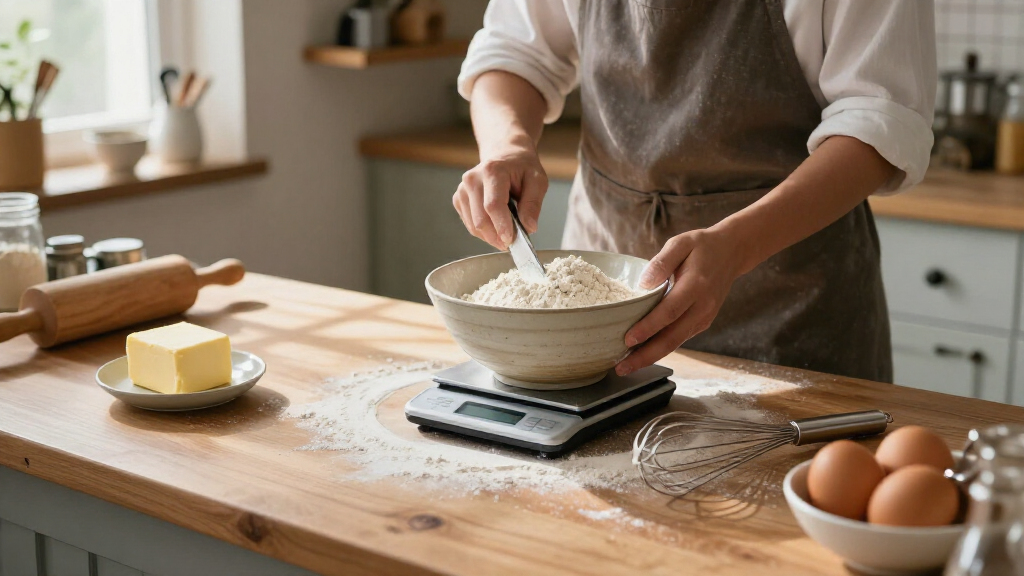
I ranked these scales around the work a baker actually does: measuring flour and sugar by weight, adding small quantities, taring between ingredients, and reading the display with a bowl on the platform. Capacity and platform layout matter because the scale must fit both the recipe and the vessel; extra capacity alone does not make small measurements easier. I also weighed usability, including display placement, unit choices, power approach, surface materials, and how much complexity each design adds to routine baking.
The ranking favors scales with a clear baking advantage and manageable tradeoffs. The OXO leads for its display placement, while dual-platform designs earn distinction for handling fine and bulk amounts on separate platforms. Straightforward 11-pound scales remain strong choices for ordinary home recipes, but sit lower when they offer fewer baking-specific conveniences. Higher-capacity and rechargeable models suit particular workflows; their broader specifications do not automatically make them better for every baker.
Factors to Consider When Choosing Digital Kitchen Scales For Baking
Choosing a scale is less about collecting features and more about matching the design to your recipes, bowls, and habits. These factors can help narrow the field before you decide which tradeoffs are worthwhile.
Match Capacity to Your Bowls and Batch Size
Think about the combined weight of the bowl and ingredients, not only the amount of flour in a recipe. A low-profile bowl may fit comfortably on an 11-pound scale, while a heavy stand-mixer bowl or a double batch can use more of its capacity than expected. A 22- or 33-pound model gives headroom for those larger loads, but capacity does not tell you how finely the scale measures. Check whether the platform can support your usual vessel without blocking the display or controls. For standard single-batch recipes, extra capacity may bring little practical benefit. Buy for the heaviest task you regularly do, rather than an occasional hypothetical one.
Decide How Often You Weigh Small Amounts
Flour and sugar are relatively forgiving to measure on a standard platform, while yeast, salt, and leaveners can be awkward when the quantity is small. A dual-platform scale gives those small additions a dedicated area, which can make sequential measuring more convenient. It also takes up more room and adds another surface to learn and clean. If you mostly measure ingredients by teaspoon or use a separate measuring spoon for tiny amounts, the extra platform may not change your routine. Check the scale’s stated increments and minimum weighing amount before assuming that high capacity means suitable detail. The useful question is whether your recipes regularly call for small quantities by weight.
Check Display Visibility With Realistic Bowls
A display that is clear on an empty counter may disappear behind a mixing bowl. Before choosing, picture the widest bowl you use and where it would sit relative to the screen. A pull-out or offset display can keep the readout visible, while a compact fixed layout may work well with smaller vessels. Touch controls and smooth glass surfaces can look tidy, but wet or floury fingers may make buttons less convenient to operate. Tare placement matters too: you may need to reach the control repeatedly as you add ingredients. Prioritize an easy-to-read screen over a feature list if you weigh directly into large bowls.
Choose a Power Setup You Will Maintain
Battery-powered scales are simple to use when replacement cells are easy to keep on hand. Rechargeable models reduce disposable battery use, but they need charging before a long baking session and may be inconvenient if the battery runs flat mid-recipe. Consider where the scale will live and whether you will remember to charge it between uses. A removable or wipeable surface can matter more than the power type if flour and sticky ingredients regularly land on the scale. Avoid assuming that a charging port or sealed-looking design means the whole unit can be washed. Follow the maker’s cleaning guidance and wipe the scale rather than immersing it unless the instructions explicitly allow that.
Pay for Features That Change Your Routine
Extra capacity, dual platforms, and rechargeable power each solve a different problem; none is automatically an upgrade for every kitchen. A baker working through large bread batches may value headroom, while someone making pastries may get more use from small-quantity weighing. A beginner following recipes in several measurement systems may prioritize unit switching and a clear tare function. If you bake occasionally, a straightforward scale can be easier to store and operate than a more specialized design. Compare the controls and layout against your actual habits before paying for features you rarely use. The best fit is the one that removes friction from the tasks you repeat.
Frequently Asked Questions
Is an 11-pound kitchen scale enough for baking?
For many home bakers, yes: an 11-pound capacity covers typical ingredient quantities for single batches. The bowl counts toward that limit, so a heavy mixing bowl or a large sourdough vessel can reduce the remaining headroom. If you often weigh ingredients directly into a stand-mixer bowl or scale up recipes, a higher-capacity model gives more flexibility. Capacity and precision are separate qualities, so compare the scale’s increments as well. Choose based on your heaviest routine setup rather than the ingredient weights alone.
Do I need a dual-platform scale to weigh yeast and salt accurately?
No. A dual platform is convenient when you frequently measure small additions by weight, but it is not a substitute for checking the scale’s stated increments and minimum load. Many bakers can weigh bulk ingredients on a standard scale and use measuring spoons for very small quantities. If you follow recipes that specify yeast or salt in grams, a small dedicated platform may make repeated additions easier. Consider counter space too: the second platform adds width and another surface to keep clean. Buy one when that workflow is a regular part of your baking.
Should I choose a rechargeable scale or one that uses replaceable batteries?
Pick the power setup that fits how you store and use the scale. Rechargeable models avoid routine battery replacement, but you need to keep them charged and plan for occasional downtime. A model with replaceable batteries is ready when you have spares, which can suit infrequent baking. Neither choice determines how well the scale weighs ingredients, so give display visibility, capacity, and controls equal attention. Check the manufacturer’s charging or battery instructions before relying on a particular setup.
Will a glass or stainless steel surface be easier to clean after baking?
Both can be wiped after loose flour or ingredient spills, but the surface material is only part of cleanup. Look for seams, edges, and control areas where sticky residue can collect, and follow the maker’s cleaning instructions. A smooth top may wipe down quickly, while flour can still gather around platform edges or buttons. Do not assume a water-resistant appearance means the scale can be submerged or put under a tap. For frequent baking, a design that is easy to wipe and store may matter more than the material name.
Can one scale handle bread dough, pastry ingredients, and small recipe additions?
Often, but the right compromise depends on which task dominates your baking. A higher-capacity scale can accommodate heavier bowls and dough batches, while a dual-platform design can make small additions more convenient. A compact 11-pound model may be simpler for pastry and everyday recipes if your bowls are light. Check both the capacity and the small-quantity specifications rather than choosing on one number alone. If your baking spans all three tasks, prioritize a readable display and controls you can use repeatedly while adding ingredients.
Conclusion
For the strongest all-around baking fit, I’d choose the OXO Good Grips 11-Pound Scale for its pull-out display and practical everyday capacity. The Amazon Basics scale is my value-minded pick for bakers who want straightforward weighing, while the KitchenAid KQ909 is the premium-style choice for those who will use two platforms. Beginners may prefer the simple workflow of the Escali Primo. For larger batches, consider the BakFee or GGQ 33-pound models; for small additions, look at the Ooni or KitchenAid dual-platform designs. Choose by your usual bowl, batch size, and smallest measured ingredient, and the right option becomes clearer.