
TL;DR
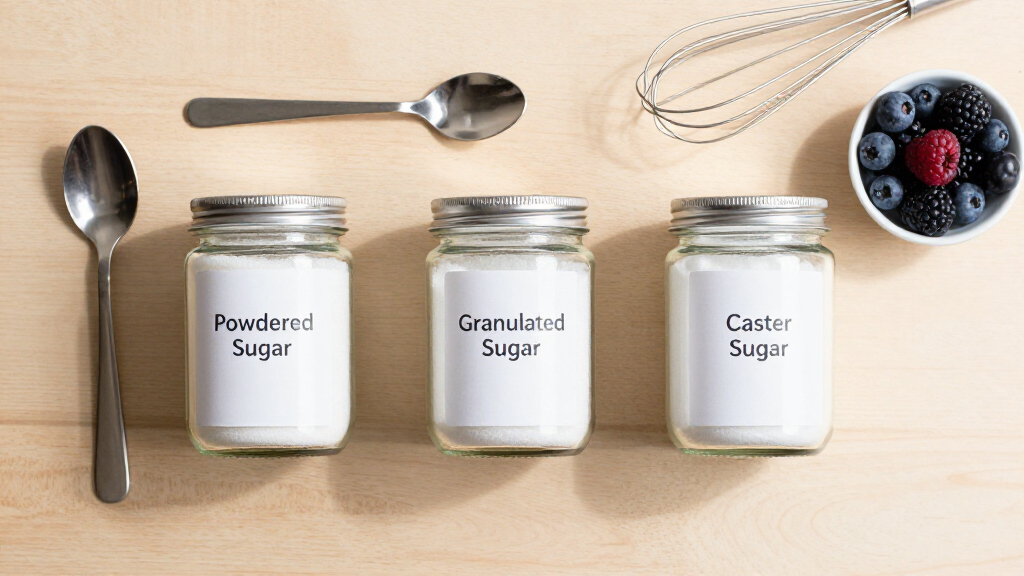
Powdered sugar is finely milled with starch for instant dissolving, caster sugar is superfine for quick dissolving in cold liquids, and granulated is the standard size for most baking. Using the right one improves texture, flavor, and appearance.
Always weigh your sugar instead of measuring by volume — differences in crystal size affect weight and outcome.
Pulse granulated sugar in a processor to make your own caster sugar at home, saving trips and money.
Powdered sugar contains cornstarch, which can alter moisture and texture in baked goods if used improperly.
Use caster sugar for meringues and cold drinks for quick dissolving; stick with granulated for baking structures.
Substitute sugars carefully, adjusting quantities and considering starch content to avoid recipe failures.
Powdered vs Granulated vs Caster Sugar
All three begin with sucrose, but crystal size—and one important starch addition—changes how they dissolve, cream, brown, and build texture. Choose by function, then weigh for consistent results.

Amazon Grocery, Powdered Sugar, 2lb
One 2 pound bag of Powdered Sugar
As an affiliate, we earn on qualifying purchases.
As an affiliate, we earn on qualifying purchases.
Same sweetness. Different mechanics.
Crystal size controls surface area and dissolution. That physical difference determines whether sugar aerates butter, disappears into egg foam, or creates a silky glaze.
Granulated
Standard table sugar with enough crystal structure to cut air pockets into butter. It supports sturdy crumbs, crisp edges, controlled browning, and caramel.
Caster
Also called superfine or baker’s sugar. Its smaller crystals blend into eggs and cold liquids quickly, reducing grit while helping delicate foams stay glossy.
Powdered
Finely milled sugar, usually with anti-caking starch. It dissolves almost immediately and slightly thickens mixtures, but performs poorly for creaming and structure.

Superfine Caster Sugar By Medley Hills Farm in Reusable Container 2.5 lbs. – superfine sugar for baking of homemade treats, icing sugar, cakes – Product of USA
Superfine Caster Sugar Includes 2.5 lbs. of superfine sugar in Reusable container for easy storage. Caster sugar, also…
As an affiliate, we earn on qualifying purchases.
As an affiliate, we earn on qualifying purchases.
Finer sugar moves faster.
Relative kitchen performance is shown below. More surface area lets liquid reach more sugar at once—especially important when heat and mixing time are limited.
Practical implication: slow-dissolving granules can leave cold drinks gritty, while fully dissolved caster sugar helps prevent grainy or weeping meringue.

DOMINO SUGAR Granulated Sugar, 64 OZ
Extra fine granulated, free-flowing and of the highest quality
As an affiliate, we earn on qualifying purchases.
As an affiliate, we earn on qualifying purchases.
What changes in the bowl?
Use this matrix as the decision shortcut. Caster is the adaptable middle ground; powdered is a specialized finishing ingredient, not a universal substitute.
| Feature | Granulated | Caster / Superfine | Powdered / Icing |
|---|---|---|---|
| Crystal size | 0.3–0.5 mm | 0.1–0.2 mm | Fine powder, often 10X |
| Dissolution | ~Slow | ✓Fast | ✓Almost instant |
| Creaming butter | ✓Excellent aeration | ✓Fast and even | ✗Poor lift |
| Meringue | ~Can stay gritty | ✓Glossy and stable | ✗Starch interferes |
| Cold drinks | ✗Sinks and settles | ✓Dissolves quickly | ~May cloud or thicken |
| Best role | Structure, caramel, crunch | Foams, light cakes, drinks | Frosting, glaze, dusting |
| Approx. cup weight | 200 g | 200–220 g | 120 g unsifted |
Superfine Caster Sugar By Medley Hills Farm in Reusable Container 2.5 lbs. – superfine sugar for baking of homemade treats, icing sugar, cakes – Product of USA
Superfine Caster Sugar Includes 2.5 lbs. of superfine sugar in Reusable container for easy storage. Caster sugar, also…
As an affiliate, we earn on qualifying purchases.
As an affiliate, we earn on qualifying purchases.
Swap with intention.
Changing the grind changes packing density, dissolution, and sometimes moisture balance. Follow the conversion path—not a casual cup-for-cup guess.
Granulated → Caster
Pulse for 30–60 seconds. Stop when superfine, before it becomes powder.
Granulated → Powdered
Blend 1 cup sugar with 1 tablespoon cornstarch, then sift thoroughly.
Caster ↔ Granulated
Usually safe by weight, but avoid coarse sugar in meringues and cold liquids.
Powdered → Either
Not recommended. Starch and lighter cup weight can alter texture and moisture.
If powdered sugar is unavoidable as a substitute, account for its roughly 25–30% lighter cup weight and added starch. Expect a denser, softer, or pastier result in structure-dependent baking.
Better texture starts here.
The right sugar improves flavor release, aeration, browning, mouthfeel, and appearance. These habits prevent the most common failures.
Weigh sugar instead of measuring by volume.
Crystal size changes how densely sugar packs. Equal cups do not guarantee equal sugar.
Make caster sugar at home.
A short processor pulse creates the superfine grind needed for most delicate recipes.
Remember the starch in powdered sugar.
It prevents clumps and stabilizes frosting, but can absorb moisture and mute delicate flavor.
Choose caster for speed, granulated for structure.
Caster excels in foams and cold drinks; granulated supports creaming, caramel, and crunch.
Treat powdered sugar as a specialist.
Use it for smooth finishes and fillings. Avoid direct substitution in cookies, bread, or cakes that depend on crystal structure and balanced hydration.
The result chain
A small ingredient choice travels through the entire recipe, from the first stir to the final bite.
What is Granulated Sugar, and When Should You Use It?
Granulated sugar is the classic white table sugar we all know. Its crystal size hovers around 0.3–0.5 mm, giving it a slightly gritty texture. It dissolves slowly, making it ideal for baking where controlled caramelization or browning is desired. Think of it as the workhorse for cookies, cakes, and sweetening hot drinks.
For example, when making a simple sugar cookie dough or caramelizing sugar for a tart, granulated sugar’s slow dissolving helps build flavor gradually. Its structure also helps create a sturdy crumb or crisp crust in baked goods, thanks to its crystalline nature that cuts into fats and flour. This characteristic can influence the final texture, making baked goods more structured or crunchy. The tradeoff is that it may require more mixing time or higher temperatures to fully dissolve, which can affect delicate batters or quick-bake items.
In recipes, if you see just ‘sugar,’ it’s almost certainly granulated. Use it for batter mixing, caramel, or when you want a bit of crunch. Understanding its behavior helps you control browning and texture, essential for achieving professional-looking results.
Why Caster Sugar Wins in Meringues, Cakes, and Cold Drinks
Caster sugar, also called superfine or baker’s sugar, is just granulated sugar ground finer — about 0.1–0.2 mm crystals. This tiny size means it dissolves faster, especially in cold liquids or delicate batters. The finer granulation minimizes the need for extended mixing or heating, which can be critical in delicate recipes.
Picture whipping up a fluffy pavlova. Using caster sugar ensures the sugar dissolves completely, creating a glossy, stable meringue without graininess. This smoothness is essential because undissolved sugar can cause the meringue to collapse or have a gritty texture. Similarly, in sponge cakes, superfine sugar dissolves quickly into eggs, leading to a uniform batter that traps air more effectively, resulting in a softer, more even crumb.
In cocktails or iced drinks, caster sugar dissolves almost instantly, avoiding the gritty mouthfeel that granulated can leave behind. This instant dissolving ability ensures that your drinks are smooth and well-integrated, which elevates their quality and presentation. The tradeoff is that superfine sugar can sometimes lead to quicker browning or caramelization, so timing in recipes should be adjusted accordingly.
Powdered Sugar: The Fineness That Melts in Your Mouth
Powdered sugar, also called icing or confectioners’ sugar, is granulated sugar milled into a fine powder — usually with about 2–3% cornstarch added. This fine dust dissolves instantly, making it perfect for frostings, glazes, and dustings. Its powdery nature creates a silky, melt-in-your-mouth texture that’s unmatched for finishing touches.
Imagine spreading a soft layer of powdered sugar over a flaky Danish pastry, or whipping up a silky royal icing. The starch prevents clumping, maintaining a smooth consistency even over time. However, this added starch can interfere with gluten development in doughs or batter rise if used improperly, as it can absorb moisture and inhibit the formation of a strong gluten network. Therefore, powdered sugar is best used in applications where quick dissolving and a delicate finish are desired, rather than as a primary sweetener in baked goods that rely on gluten structure.
In baking, powdered sugar creates smooth, melt-in-your-mouth textures, ideal for frosting, fillings, and dustings. Its fine consistency allows it to blend seamlessly into liquids, producing a uniform, glossy finish. The tradeoff is that in recipes requiring structure, like cookies or bread, it may alter the moisture balance if used excessively. Understanding these implications helps you leverage powdered sugar’s unique properties effectively.
How to Swap Between These Sugars Without Ruining Your Recipe
Switching sugars isn’t always straightforward. Here’s a quick guide:
- Granulated to caster: Pulse in a food processor for 30–60 seconds until fine but not powder. This creates a superfine texture suitable for most recipes requiring caster sugar, but be mindful that over-processing can turn it into powdered sugar, which might introduce unwanted starch.
- Granulated to powdered: Blend 1 cup granulated sugar with 1 tablespoon cornstarch, then sift thoroughly. This mimics commercial powdered sugar and is useful for frosting or dustings. Be aware that the added starch can affect moisture content, so use sparingly in recipes sensitive to moisture balance.
- Caster to granulated: use as-is; no conversion needed for most baking, but note that the superfine texture may change the rate of dissolution in some recipes. Powdered to granulated or caster: not recommended; if necessary, reduce volume by 25–30% due to starch weight and potential moisture absorption. Using powdered sugar as a substitute in baking can lead to a denser, less structured product because of the added starch and fine particles.
- In drinks: caster or simple syrup outperforms granulated, which sinks and settles, leading to inconsistent sweetness. The quick dissolving property of caster sugar ensures uniform sweetness and a better drinking experience.
For example, if you only have granulated sugar but need superfine for a meringue, blitz it in a processor. This quick hack saves a special trip to the store and ensures the sugar dissolves properly, preventing graininess and ensuring stability in your meringue.
The Real Differences in the Kitchen: What You’ll See, Feel, and Taste
| Feature | Granulated Sugar | Caster Sugar | Powdered Sugar |
|---|---|---|---|
| Crystal size | 0.3–0.5 mm | 0.1–0.2 mm | Fine powder |
| Dissolution speed | Slow | Fast | Instant |
| Best for | Baking, caramel, crunch | Meringues, cakes, cocktails | Frostings, glazes, dustings |
| Weight per cup (approx.) | 200 g | 200–220 g | 120 g (unsifted) |
Knowing these differences helps you avoid common pitfalls. For example, using powdered sugar in a cookie dough can lead to a greasy crumb, while a meringue made with granulated sugar turns gritty. Recognizing these physical and functional differences ensures you select the right sugar for the desired outcome, preventing texture issues and flavor imbalances that can compromise your final product.
When and Why You Should Pick One Over the Others
Choosing the right sugar depends on what you’re making. For sturdy cookies or caramel, stick with granulated. For delicate meringues or whipped creams, caster sugar is your best friend. And if you’re glazing a cake or dusting a pastry, powdered sugar is the way to go. Understanding these distinctions allows you to optimize each recipe’s texture, appearance, and flavor profile.
For example, during a holiday baking session, I used caster sugar for my sponge cake to get a fluffy, even rise. Meanwhile, I dusted powdered sugar over the finished tart for that perfect, snowy finish. Recognizing the specific role each sugar plays in different applications helps you make smarter choices, leading to better results and more professional-looking desserts.