TL;DR
Many home ovens are off by 25°F or more, causing baking failures. An accurate oven thermometer reveals the real temperature, helping you adjust and bake reliably every time.
Ever wonder why your cookies come out flat or that loaf is dense and gummy? The culprit might be your oven’s temperature. It’s easy to assume the oven is set right when the dial reads 350°F, but many ovens are off by quite a bit—sometimes as much as 25 or 30 degrees.
In this guide, you’ll learn how a simple tool—the oven thermometer—can reveal the truth about your oven’s actual temperature. Armed with this knowledge, you’ll be able to troubleshoot and fix common baking failures, turning your kitchen into a reliable bakery.
Most home ovens are off by at least ±25°F, which affects baking quality.
An accurate oven thermometer allows you to adjust your oven temp precisely, preventing common failures.
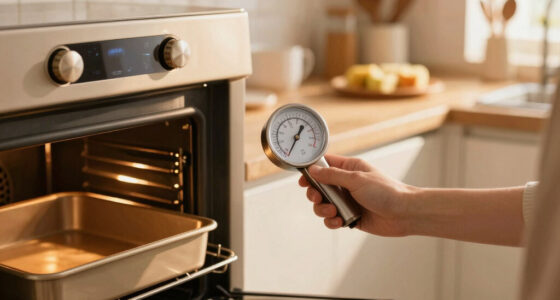
Place the thermometer in the center of the oven for the most reliable reading.
Regular calibration ensures your thermometer remains accurate over time.
Smart thermometers with app connectivity can provide real-time monitoring and troubleshooting insights.
The Oven Thermometer That Reveals Why Nothing Bakes Right
Your oven display reports a setting—not necessarily the truth. A simple independent thermometer exposes hidden heat drift, helping you correct flat cookies, gummy bread, burnt edges and raw centers.
One dial setting. Three very different ovens.
Thermostat cycling, sensor age, door seals and hot spots all influence real cavity temperature. Baking chemistry reacts to the heat that exists—not the number on the control panel.
The 50-degree uncertainty zone
A nominal 350°F oven may sit 25°F below or above target. That range separates slow structure-setting from rapid browning and scorching.
Flat cookies
Likely clue: a cool oven lets fat spread before the structure sets.
Burnt edges
Likely clue: excess heat browns the exterior before the center finishes.
Dense, gummy bread
Likely clue: insufficient heat weakens oven spring and delays crumb setting.
Uneven browning
Likely clue: multiple readings may reveal side-to-side hot zones.
Four features that turn a gadget into reliable evidence.
The best thermometer is accurate, durable and easy to read without disrupting the oven. Smart functionality adds convenience, but dependable measurement comes first.
Accuracy
Look for a stated tolerance of ±1–2°F. Higher precision makes small corrections meaningful.
Durability
Choose oven-safe materials that tolerate high heat, moisture and repeated thermal cycling.
Readability
A large dial, bright screen or external display reduces squinting and unnecessary door opening.
Smart data
Bluetooth or Wi-Fi models can log drift, send alerts and expose heating patterns over time.
Measure. Compare. Correct. Repeat.
Create a feedback loop instead of guessing. Test the oven under normal conditions, record the difference and apply the same correction consistently.
Find the center
Place the thermometer on the middle rack, away from walls, elements and door seals.
Let heat settle
Set the oven and wait at least 10–15 minutes before taking the first reading.
Calculate drift
Subtract the set temperature from the thermometer’s actual reading.
Offset the dial
Use calibration controls or adjust the recipe setting by the measured difference.
Monitor the cycle
Check more than once to distinguish ordinary cycling from persistent error.
The external thermometer sees what the oven misses.
Built-in systems are designed to control heating cycles, not necessarily report precise rack-level conditions. An external digital sensor provides an independent reference where the food actually bakes.
| Feature | Built-in thermometer | External digital thermometer |
|---|---|---|
| Accuracy | ✗ Often off by 10–25°F | ✓ Frequently within about ±1°F |
| Reading access | ~ Display may not show rack-level reality | ✓ External display avoids door opening |
| Cost | ✓ Already included | ~ Additional purchase |
| Smart monitoring | ✗ Rare on conventional ovens | ✓ Alerts, logging and app connectivity |
| Hot-spot diagnosis | ✗ One fixed sensor location | ✓ Movable or multi-point probes |
Verdict / External digital wins for precision, visibility and diagnostic value.
Turn baking symptoms into temperature evidence.
Observe the failure, verify actual heat and then choose the smallest useful adjustment. Repeated readings reveal whether the issue is a stable offset, normal cycling or uneven heating.
Runs cool
Symptoms: pale crusts, weak rise, gummy centers and long bake times.
Response: increase the set temperature by the measured offset or recalibrate the oven.
Runs hot
Symptoms: burnt edges, fast browning, cracked tops and raw interiors.
Response: reduce the set temperature and allow enough time for the center to cook.
Heats unevenly
Symptoms: one side browns faster or trays finish at different rates.
Response: test multiple zones, rotate pans and map persistent hot spots.
Five habits that remove the guesswork.
Assume the display may be wrong.
A variance of ±25°F is large enough to change texture, rise and browning.
Use an accurate independent thermometer.
A digital model near ±1–2°F gives the clearest basis for correction.
Measure in the oven’s center.
The middle rack, away from walls and seals, provides the most useful baseline.
Recheck calibration every few months.
Test sooner whenever baking results become inconsistent.
Record patterns, not just one reading.
Logging several heat cycles separates a stable offset from temporary fluctuation.
Why Your Oven’s Temperature Is Usually Wrong (And Why It Matters)
You might think your oven is accurate because it has a dial or digital display. The truth? Most home ovens are off by at least ±25°F. That means if you set it to 350°F, it could be anywhere from 325°F to 375°F inside. This discrepancy can cause baked goods to undercook, burn, or not rise properly.
Imagine baking a batch of muffins. The recipe calls for 375°F, but your oven runs cooler or hotter. The batter may not develop that golden crust or fluffy interior you’re aiming for. Over time, these small inaccuracies add up, making you wonder if you’re just a bad baker.
Understanding why your oven’s temperature is often inaccurate is crucial because it directly influences your baking results. An oven that runs cooler than the dial indicates may cause underbaking or dense textures, while one that runs hotter could lead to burnt exteriors and raw centers. Recognizing this discrepancy allows you to make informed adjustments, balancing tradeoffs between baking time and temperature to achieve the perfect bake. For instance, baking at a slightly lower temperature for a longer period can prevent burning while ensuring thorough cooking. Conversely, a hotter oven might speed up baking but risks uneven browning. Knowing your oven’s true behavior helps you choose the right approach, turning what seems like a flaw into a controllable factor.

Hotloop Digital Oven Thermometer Heat Resistant up to 572°F/300°C, LCD
- Easy-to-Read LCD Display: Shows actual oven temperature clearly
- High Temperature Accuracy: Measures 32~572°F with ±1.8°F precision
- Simple to Use: Probe fits through oven door or grill lid
As an affiliate, we earn on qualifying purchases.
As an affiliate, we earn on qualifying purchases.
How to Pick the Perfect Oven Thermometer — What Features Matter Most
Choosing an oven thermometer isn’t rocket science, but a few features make a big difference. Here’s what to look for:
- Accuracy: Look for a thermometer that reads within ±1-2°F. Digital thermometers often offer higher precision than analog ones.
- Durability: It should withstand high temperatures and quick temperature changes without breaking or losing calibration.
- Ease of Reading: Bright, clear display—whether digital or dial—is key, especially when your oven is hot.
- Smart Features: Bluetooth or Wi-Fi-enabled models can sync to your phone, giving real-time alerts. These are especially handy if you bake often or want to troubleshoot more deeply.
For example, a digital thermometer with a backlit screen and a ±0.5°F accuracy can give you precise readings, making it easier to tweak your oven settings. The tradeoff is that these models tend to be more expensive and may require batteries or charging. Simpler analog thermometers are more affordable and durable but may sacrifice some precision. Your choice depends on how much control and convenience you want versus budget and ease of use. Investing in a high-accuracy, durable thermometer with clear readability ensures you get reliable data, which is essential for fine-tuning your baking process and avoiding guesswork that can lead to inconsistent results.

AcuRite 00620A2 Stainless Steel Oven Thermometer (150°F to 600°F)
- Oven and grill safe: Suitable for leave-in use during cooking
- Temperature range: Measures from 150°F to 600°F
- Durable construction: Made of stainless steel with protective glass
As an affiliate, we earn on qualifying purchases.
As an affiliate, we earn on qualifying purchases.
Step-by-Step: How to Use Your Oven Thermometer for Perfect Results
- Place the thermometer properly: Position it in the center of the oven on a middle rack, away from walls or door seals.
- Preheat your oven: Turn it on and wait for 10-15 minutes, then check the thermometer reading.
- Compare and calibrate: If the thermometer shows a different temperature than your set, note the difference. Use your oven’s calibration feature or adjust your baking temperature accordingly.
- Monitor during baking: Keep an eye on the thermometer if it’s smart—some models send alerts if the temperature drifts.
- Adjust as needed: If your oven runs hot or cool, modify your recipe’s temperature or baking time.
For example, if your oven is consistently 20°F hotter than the dial, reduce your recipe temp by that amount for better outcomes. This proactive approach helps prevent over- or under-baking, saving you time and ingredients. Maintaining an awareness of your oven’s actual temperature also allows you to experiment with baking times and temperatures, giving you more control over the final product. It’s about creating a feedback loop—measure, adjust, and repeat—to refine your baking process for consistently excellent results.

ThermoMaven Smart Bluetooth Wireless Meat Thermometer with WiFi App
- Smart Display Base: Displays real-time temps and target setting
- Wireless Monitoring: Unlimited range via Wi-Fi and Bluetooth
- NIST Certified Sensors: Six sensors with ±0.5°F accuracy
As an affiliate, we earn on qualifying purchases.
As an affiliate, we earn on qualifying purchases.
Compare: Built-in Oven Thermometers vs. External Digital Thermometers
| Feature | Built-in Thermometer | External Digital Thermometer |
|---|---|---|
| Accuracy | Often off by 10-25°F | Within ±1°F, much more precise |
| Ease of Use | Requires opening the door to check | Displays outside the oven, no opening needed |
| Cost | Usually included or inexpensive | Costs more but offers better data |
| Smart Features | Rarely has smart tech | Many connect to apps, send alerts |
If you want consistent, reliable readings, an external thermometer is the smarter choice. It helps you understand your oven better and avoid guesswork. While a built-in thermometer might seem convenient, it often fails to give an accurate picture of your oven’s true temperature — especially over time, as calibration drifts or the sensor ages. External digital thermometers, on the other hand, provide precise, real-time data outside the oven environment, allowing you to make immediate adjustments without opening the door and losing heat. This means you can fine-tune your baking with confidence, leading to more consistent results and less frustration.

Efeng Large Dial Oven Thermometer for Gas & Electric Oven,Grill Cooking Safety Leave-in- NSF accurately Easy-to-Read Clearly Large Number Shows temperatures for Meat,Grilling or Cake Cooking Oven
- Temperature Range: 150℉ to 600℉
- Versatile Usage: Suitable for ovens, grills, smokers
- Display Type: Large, easy-to-read dial
As an affiliate, we earn on qualifying purchases.
As an affiliate, we earn on qualifying purchases.
Troubleshooting Common Baking Failures with Your Thermometer
Think of your oven thermometer as a detective. When baked goods turn out weird—flat cakes, burnt edges, or raw centers—the thermometer often reveals the culprit: incorrect oven temp. For instance, a dense bread might be due to an oven running 30°F cooler than set, meaning it never gets hot enough to rise properly. Conversely, if your baked goods are burning on the outside but raw inside, your oven might be running hotter than you think, or heating unevenly.
Understanding these discrepancies is vital because they directly influence the outcome of your baking. An inaccurate temperature can cause over- or underbaking, uneven browning, or poor rise. By consistently checking your thermometer and comparing it to your oven’s dial, you can identify patterns—like the oven always being hotter on one side or cooler in the center—and then decide whether to recalibrate, adjust baking times, or modify recipes. This process turns guesswork into control, reducing waste and improving your baking confidence.
Building a habit of recording your oven’s actual temperature over multiple uses helps you develop a personalized adjustment chart. This way, you can anticipate how your oven behaves and make precise modifications, ensuring each batch turns out just right. It’s about understanding your specific oven’s quirks and working with them, rather than against them, for consistently perfect baked goods.
Frequently Asked Questions
How do I choose the best oven thermometer for my kitchen?
Look for accuracy (±1-2°F), durability, and ease of reading. Consider smart features if you bake often or want real-time alerts. Digital models generally offer better precision than analog ones.How often should I calibrate my oven thermometer?
Every few months, especially if you notice inconsistent baking results. Regular calibration keeps your readings trustworthy and your baked goods predictable.Can I rely on my oven’s built-in thermometer?
Most built-in thermometers are inaccurate, often off by 10-25°F. An external oven thermometer provides a much more reliable reading, helping you troubleshoot and fine-tune your oven’s performance.Where’s the best place to position my oven thermometer?
Center it on the middle rack, away from walls and door seals. This ensures you get the most representative reading of your oven’s overall temperature.Why do my baked goods turn out differently each time?
Variations in oven temperature, ingredient quality, and measurement accuracy are common culprits. Using an oven thermometer helps you control these factors for consistent results.Conclusion
Understanding your oven’s true temperature is the secret to baking success. A simple, reliable oven thermometer makes this possible—and saves you from guessing why things go wrong.
Next time your baked goods disappoint, check the thermometer first. It’s the easiest fix for guaranteed perfect results—and a more confident baker in your own kitchen.