
TL;DR

Get baking supplies delivered free with Prime
- Fast, free delivery on millions of items
- Prime Video, Amazon Music and more included
- Member-only deals all year
Ukraine’s Delta system has become a leading example of software-defined warfare by combining drone feeds, satellite imagery, sensors and vetted reports into a shared battlefield map. The confirmed development is not a new weapon but a wartime command-and-control model built around cloud hosting, browser access and rapid software iteration.
Ukraine’s Delta battlefield-management system is being cited as one of the clearest working examples of software-defined warfare, after a July 1, 2026 ISR Briefing AI Dispatch described how the platform fuses drones, satellite imagery, sensors and vetted reports into a live map accessible from ordinary phones, tablets and laptops. The development matters because Delta shows how wartime advantage can come from data fusion and software speed, not only from weapons platforms.
Delta is a situational-awareness and battlefield-management platform associated with Ukraine’s military, the NGO Aerorozvidka, Ukraine’s Defense Ministry and the Ministry of Digital Transformation. According to the source material, the system combines inputs from reconnaissance units, drones, commercial and military sensors, satellite imagery, partner intelligence and vetted human reports into a geolocated common operating picture.
The platform’s defining feature is its design: a cloud-native backend and a browser-based client that can run on standard phones, laptops, tablets and PCs. The ISR Briefing report says the backend was deliberately hosted outside Ukraine to reduce the risk that a missile strike or domestic cyberattack could disable the system from inside the country.
That architecture marks a break from older defense IT systems that often rely on specialized hardware, closed networks and slow procurement cycles. Delta, according to the source material and cited reporting from CSIS and other outlets, has been developed at a faster tempo through a wartime coalition that includes military, civic technology and government digital actors. Claims about daily target processing, including a cited 1,500-targets-per-day figure, are attributed to Ukraine’s Defense Ministry and are not independently verified.
Software-defined warfare: how Ukraine’s Delta turned the battlefield into a shared, real-time map
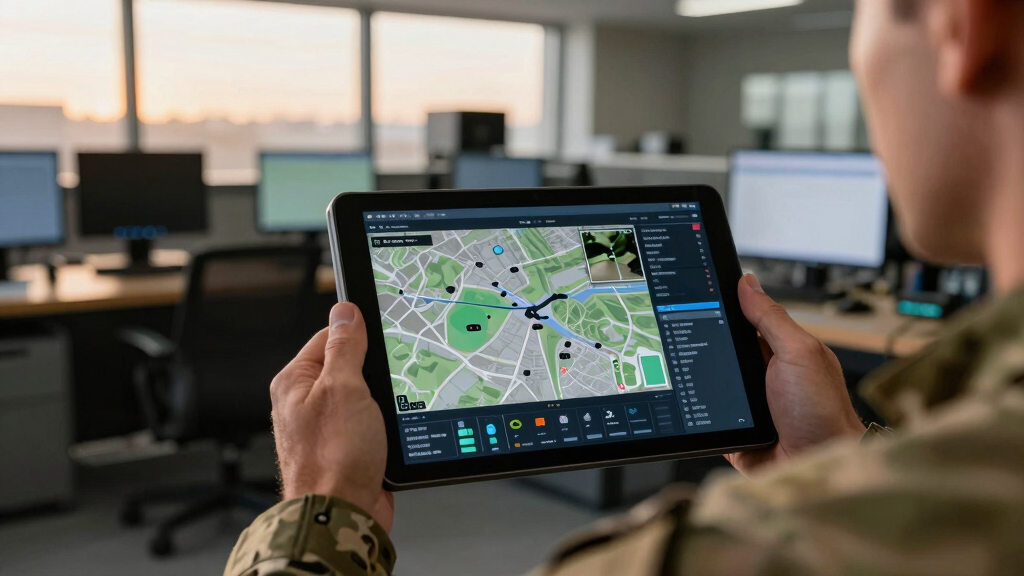
A soldier opens a browser and sees the fused war — drones, satellites, sensors and vetted reports on one live map. The backend is a cloud deliberately hosted abroad so a missile can’t take it down. The clearest case yet of treating warfare as software.
Optical sensors go blind in cloud & dark; an all-weather SAR radar layer — the kind VigilSAR produces — slots into a picture like this as one resilient, sovereign input. vigilsar.com · And note the paradox: to survive missiles & cyberattack, Ukraine hosted its crown-jewel cloud outside its own borders — trading physical sovereignty for operational survivability. Resilience through distribution.
Delta’s lasting lesson isn’t a piece of software — it’s a model of how to build: commodity clients, cloud backend, open standards, relentless iteration, fusion over hardware, and resilience through distribution. It’s why a wartime NGO out-shipped procurement bureaucracies on a fraction of the budget. The platform mattered less than the picture — and the picture is software. Own the fusion layer, own the sovereign feeds into it, and get it to the edge.
Software Becomes Battlefield Power
Delta’s importance is not limited to Ukraine. The system points to a shift in which battlefield power depends on who can collect, verify, combine and distribute information faster. In that model, the scarce resource is less the sensor itself and more the fusion layer that turns many feeds into one usable picture for commanders and frontline units.
For readers outside Ukraine, the case matters because it shows how commodity hardware can carry military-grade information when paired with secure software and disciplined data handling. It also raises hard questions for NATO and other militaries about whether large procurement systems can match the pace of wartime software development.
The system also illustrates a sovereignty tradeoff. Hosting a key wartime cloud system outside national territory can improve operational resilience against missiles and local infrastructure attacks, but it can also create dependencies on external cloud environments, connectivity and allied support. That tradeoff is now part of the wider debate over digital command systems in modern war.
Products Worth Considering

Instant Pot InstantChill Ice Cream Maker with Rolled Ice Cream Cold Plate, 2-Pint

Vitamix Propel Series 510 Professional-Grade Blender, 3 Programs, Black

Cuisinart ICE-70P1 2-Quart Ice Cream Maker with Countdown Timer
As an affiliate, we earn on qualifying purchases.
From NATO Standards To Frontline Apps
Delta’s roots are linked to earlier NATO-aligned efforts to improve information sharing in Ukraine’s armed forces and reduce the Soviet-style habit of keeping battlefield data inside vertical silos. The source material says the platform grew through cooperation among Aerorozvidka, the Ukrainian Defense Ministry’s innovation structures and the Ministry of Digital Transformation.
The 2024 CSIS analysis cited in the source material framed Delta as an example of software-defined warfare, a term used to describe the movement of military advantage toward software, data and rapid iteration. In practical terms, Delta is described as a live web application for war: users can see enemy positions, imagery and reports on a shared map, then use that picture for planning and coordination.
The system has not operated without risk. The source material cites a December 2022 cyber incident involving phishing and malware threats, and notes that any distributed battlefield network remains exposed to jamming, data poisoning and connectivity failures. Those risks are part of the same software-first model that gives Delta its reach.
“A soldier opens a browser and sees the fused war — drones, satellites, sensors and vetted reports on one live map.”
— ISR Briefing AI Dispatch, July 1, 2026
Performance Claims Still Need Proof
Several details remain unconfirmed. The source material does not independently verify the Defense Ministry’s claim that Delta processes about 1,500 targets per day, and it is not clear how often the system’s data directly leads to successful strikes, avoided casualties or faster battlefield decisions.
It is also unclear how resilient Delta remains under sustained electronic warfare, jamming, phishing campaigns and malware attempts. The platform’s reliance on connectivity means degraded networks can reduce its value, even if the cloud backend survives physical attacks inside Ukraine.
Another open issue is data trust. A system that accepts inputs from drones, sensors, partner intelligence and vetted human reports must guard against mistaken reports, spoofed locations and deliberate data poisoning. The source material identifies that risk but does not provide a public audit of Delta’s validation methods.
Militaries Watch The Delta Model
The next question is whether Delta’s model spreads. Ukraine’s experience is likely to shape how allies think about battlefield software, cloud hosting, open standards and the use of ordinary devices at the tactical edge.
Future developments to watch include whether Ukraine expands Delta’s sensor inputs, how it protects the system against cyberattacks and jamming, and whether NATO militaries adopt similar cloud-backed common operating pictures. For now, Delta’s central lesson is clear but still being tested: in modern war, the side that controls the shared battlefield picture may gain speed, coordination and resilience that hardware alone cannot provide.
Key Questions
What is Ukraine’s Delta system?
Delta is a battlefield-management and situational-awareness system that combines drones, satellite imagery, sensors, intelligence and vetted reports into a live geolocated map for military users.
Why is Delta described as software-defined warfare?
It is described that way because its value comes from software, data fusion and rapid updates, rather than from a single weapon or specialized hardware platform.
Can Delta run on ordinary devices?
According to the source material, Delta runs through a browser on ordinary phones, laptops, tablets and PCs, while its backend operates in a cloud environment.
Are all claims about Delta verified?
No. The system’s general role is documented in the supplied material, but performance claims such as 1,500 targets per day are attributed to Ukraine’s Defense Ministry and are not independently verified here.
What are the main risks for systems like Delta?
The main risks include cyberattacks, phishing, malware, jamming, connectivity loss and data poisoning. A shared battlefield map is powerful, but it also becomes a high-value target.
Source: Thorsten Meyer AI